
Revision summary
PVTGs are about 75 ST groups listed after the Dhebar line, defined by fragile demography, pre-agricultural technology, and low literacy. Problems include forest loss, disease on contact, language-mismatched schools, and collapsed crafts such as Asur smelting. Programme challenges are bad lists, scattered hamlets, one-size housing, and under-used FRA habitat rights. Andaman contact ethics and PM-JANMAN saturation sit at opposite risks: neglect versus forced assimilation. Elwin’s limit on over-administration is still a design rule.
Model answer
Copper italics in this answer — like this — are the key facts. Each one is unpacked in the Facts & figures rail.
Introduction
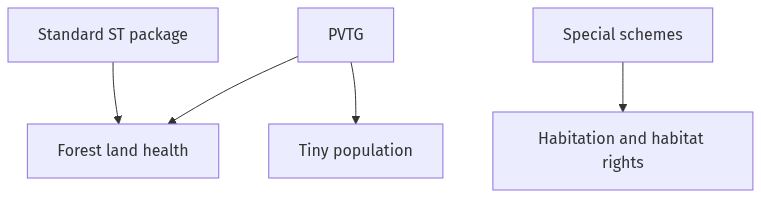
Particularly Vulnerable Tribal Groups are a subset of Scheduled Tribes identified as the most fragile in population, technology, and literacy. Special programmes exist because ordinary ST schemes miss them. Problems of life and problems of programme design are two sides of one fact.
Body
Who they are
- The category began as Primitive Tribal Groups after the Dhebar Commission (1960–61) and was renamed PVTG in 2006. About 75 groups are listed across states.
- Criteria used in administration: stagnant or declining population, pre-agricultural or hunting-foraging technology, extremely low literacy, and a subsistence economy.
- Examples: Jarawa, Onge, and Great Andamanese; Sentinelese (contact policy of restraint); Birhor, Asur, Birjia in Jharkhand; Baiga, Abujh Maria in the central belt; Chenchu in Andhra–Telangana; Cholanaikkan in Kerala; Toda and Kota in the Nilgiris; Shompen in Nicobar.
Problems they face
- Land and forest loss after the Indian Forest Act tradition, mining, and parks. Birhor rope-making and Asur iron-smelting collapsed when forest and ore access closed.
- Health: malnutrition, malaria, measles on first contact, and in some groups sickle-cell burden. Jarawa contact on the Andaman Trunk Road brought infection and exploitation.
- Language and school: primers in the state language fail when the child speaks a isolate or a small Munda tongue.
- Debt, bonded labour, and sexual exploitation at the forest–market edge, recorded in Xaxa and earlier Elwin notes on Baiga and Gond fringes.
- Demographic smallness means one epidemic or one dam can erase a local band.
Challenges in special programmes
- Identification: lists mix hunter-gatherers and small cultivators; some PVTGs are politically quieter than larger ST neighbours and lose budget inside a district ST pool.
- Scattered hamlets: a hostel or PHC on the road does not reach an Abujhmarh or Andaman forest camp. PM-JANMAN (2023) tries habitation-level saturation; delivery still depends on staff who stay.
- One-scheme-fits-all: housing prototypes ignore mobile foraging; cash without forest rights repeats dependence.
- Consent and contact: Andaman policy must not become forced assimilation. The Sentinelese case shows that “development” can be lethal.
- FRA and habitat rights (section 3(1)(e) of FRA for PVTGs) are under-used. Without habitat title, a livelihood scheme is a patch.
- Data: outdated population figures and weak baseline make targets theatrical.
What a better formulation needs
- Habitation micro-plans, local language workers, health before spectacle tourism, and habitat rights before brick housing.
- Verrier Elwin’s warning against over-administration remains practical, not romantic.
Flow diagram
Conclusion
PVTGs face collapsing subsistence, disease, and tiny numbers. Special programmes fail when they treat PVTGs as a smaller ST, ignore habitat rights, and push contact or standard housing. The challenge is to design from the hamlet and the forest, not from a district average.
Quick related
Students also ask
-
Role of the Governor in the Fifth Schedule areas
Next question on this syllabus topic (2022 · Q5(d)). View answer →
-
Are all PVTGs hunter-gatherers?
No. The list includes small cultivators and pastoral groups such as Toda. The shared fact is extreme vulnerability, not one economy.
-
Why not use ordinary ST schemes only?
District ST averages hide PVTG hamlets. Hostels and jobs are captured by larger, more literate ST neighbours unless targeting is habitation-specific.
Same topic · past papers
UPSC has asked this before
These previous-year questions sit on the same topic. Open one to practise the earlier ask.
-
2026 · Q8(b) · Anthropology GS 2 · 15 marks
What are the major challenges tribal communities are facing in contemporary India? -
2015 · Q2(c) · Anthropology GS 2 · 15 marks
Discuss the problems faced by religious minorities in India
More from this topic
Q2(a) · UPSC Mains 2024 · Anthropology GS 2 · 20 marks · Solution
Critically discuss the recent welfare measures initiated by the Government for the Particularly Vulnerable Tribal Groups (PVTGs). Comment why PVTGs were erroneously called Primitive Tribal Groups (PTGs).
History of administration of tribal areas, tribal policies, plans, programmes of tribal development and their implementation. The concept of PTGs (Primitive…
PVTGs are 75 listed communities identified by vulnerability, not by a primitive essence. CCD plans, FRA habitat rights and PM-JANMAN (2023) are the main recent measures. Delivery still misses hamlets; mining and land loss can cancel welfare. Primitive Tribal Groups was an evolutionist and colonial name that ranked cultures. Particularly vulnerable correctly points to isolation and dispossession as historical facts.
Q5(d) · UPSC Mains 2022 · Anthropology GS 2 · 10 marks · Solution
Role of the Governor in the Fifth Schedule areas
History of administration of tribal areas, tribal policies, plans, programmes of tribal development and their implementation. The concept of PTGs (Primitive…
The Governor is the Fifth Schedule’s special law-maker for Scheduled Areas. Regulations may cover land, allotment, and money-lending after TAC consultation. PESA adds Gram Sabha but does not delete the Governor’s scale. Samata showed what land rules can do; Xaxa showed weak use. Paper power exceeds political practice.
Q5(e) · UPSC Mains 2015 · Anthropology GS 2 · 10 marks · Solution
Role of Governor in Fifth Schedule Areas.
History of administration of tribal areas, tribal policies, plans, programmes of tribal development and their implementation. The concept of PTGs (Primitive…
The Fifth Schedule gives the Governor special law and land powers in Scheduled Areas. A Tribes Advisory Council and a report to the President are mandatory tools. The aim is to stop tribal land alienation. In practice the powers are under-used. PESA and FRA still need that gubernatorial watch.