
Revision summary
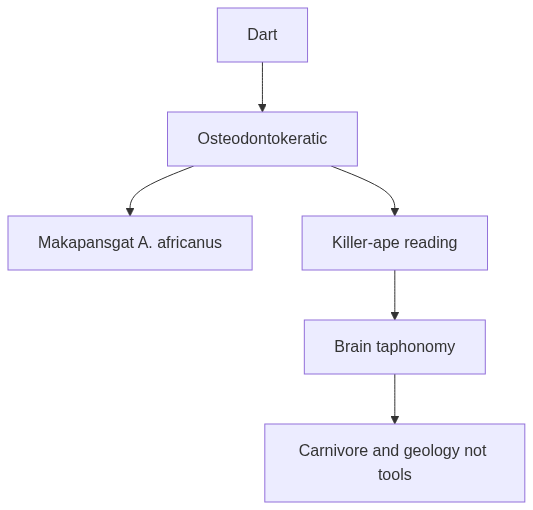
Osteodontokeratic means a supposed bone–tooth–horn culture named by Raymond Dart at Makapansgat. The claimed makers were Australopithecus prometheus, now placed in Australopithecus africanus. Dart read clubs, saws and daggers from antelope parts, and inferred hunting and violence. C. K. Brain showed that leopards, hyenas and cave processes explain much of the assemblage. The idea survives as a taphonomy lesson, not as a real industry. Osteodontokeratic is defined by site, claimed maker, and the later critique.
Model answer
Copper italics in this answer — like this — are the key facts. Each one is unpacked in the Facts & figures rail.
Introduction
Raymond Dart gave the name osteodontokeratic culture to a supposed bone, tooth and horn tool kit from Makapansgat in South Africa. He said australopithecines made those tools and used them to hunt. The idea is now taught as a warning: do not call every broken bone a culture before taphonomy has been done.
Body
Dart’s claim
At Makapansgat Limeworks Dart described a non-stone industry. He read long bones as clubs, mandibles as saws and scrapers, canine teeth as projectiles, and horns as daggers. He called this osteodontokeratic (bone–tooth–horn) and gave it to Australopithecus prometheus, a name later folded into Australopithecus africanus.
- Site: Makapansgat, South Africa, in australopithecine-bearing cave breccias.
- Background: Dart’s Taung child (1924) had already placed australopithecines on the human side of the family. In the 1950s the osteodontokeratic papers tried to give those hominins culture without stone tools.
- Story attached: Hunting, and even interpersonal violence. Robert Ardrey’s later “killer ape” popular writing drew on this mood, even though Ardrey was not the field scientist.
Why the idea was tempting
If early hominins made tools from carcass parts, culture would be older than the Acheulean handaxe, and hunting could be pushed deep into the Pliocene. That fitted a mid-century taste for “man the hunter” and for African origins after Taung.
The critique that stuck
C. K. Brain, especially in The Hunters or the Hunted? (1981), showed that many supposed tools are the signature of leopards, hyenas and cave collapse, not of artisans. Tooth marks, spiral fractures and the over-representation of certain bones match carnivore dens and geological concentration. A famous related image is the leopard puncture in some australopithecine skulls: the hominin was prey, not always hunter.
The fossils at the site remain australopithecine. The culture does not survive as a real tool tradition.
- Lesson: Hominins present in a cave are not automatically tool-makers. Osteodontokeratic is a taphonomy parable, not Africa’s first industry.
- What remains useful: The debate professionalised faunal analysis. Hunting versus scavenging, and how cave assemblages form, still rest on Brain’s ground, not on Dart’s clubs. Later accepted bone tools, such as some from Swartkrans, are a different and much more cautious file.
Flow diagram
Conclusion
Dart named a bone–tooth–horn culture and gave it to Makapansgat australopithecines. Taphonomy took the culture away and left the fossils. The significance is methodological: culture must be demonstrated, not read off every broken bone.
Quick related
Students also ask
-
Discuss the Acheulian and Oldowan traditions of Indian Paleolithic cultures with suitable illustrations.
Next question on this syllabus topic (2024 · Q4(b)). View answer →
-
Were australopithecines tool makers?
Stone tools later linked with early Homo and the Oldowan are a different file. Osteodontokeratic bone tools at Makapansgat are not accepted as a designed industry.
-
Why is this topic still taught?
It tests whether a famous name can be separated from a falsified interpretation, and whether taphonomy is understood.
Same topic · past papers
UPSC has asked this before
These previous-year questions sit on the same topic. Open one to practise the earlier ask.
-
2025 · Q4(b) · Anthropology GS 1 · 15 marks
Write a note on Mousterian tool tradition, Mousterian culture and its makers
More from this topic
Q4(b) · UPSC Mains 2026 · Anthropology GS 1 · 15 marks · Solution
Give the distribution of Palaeolithic sites around the Himalayan and Sub-Himalayan areas, highlighting the typo-technologies of the tools
Paleolithic
• Concentrated primarily in the Siwalik Hills, Kashmir valley, and Potwar Plateau along river terraces and intermontane valleys. • Key geographical locations include Chaontra, Toka, and the Soan, Beas, and Banganga river valleys. • Lower Palaeolithic features the Soanian pebble tool tradition with quartzite choppers, chopping tools, and crude flakes. • Middle Palaeolithic exhibits a shift to flake industries using prepared-core techniques like Levalloisian methods for scrapers and points. • Upper Palaeolithic is marked by advanced blade and burin industries reflecting specialized stone-working techniques. • Sites reflect hominin adaptations to altitudinal gradients and fluctuating Pleistocene climatic conditions in mountain-fringe zones.
Q4(b) · UPSC Mains 2024 · Anthropology GS 1 · 15 marks · Solution
Discuss the Acheulian and Oldowan traditions of Indian Paleolithic cultures with suitable illustrations.
Paleolithic
Oldowan/Mode 1 uses simple cores and sharp flakes; Acheulian/Mode 2 adds shaped large cutting tools. Indian Acheulian is rich in handaxes, cleavers and picks, often made on large quartzite flakes. Foote discovered a handaxe at Pallavaram in 1863. Attirampakkam has Acheulian occupation around 1.5 million years ago; Isampur preserves quarry-workshop behaviour. Riwat, Bori and Masol figure in early Mode 1 debates, but context and dating are contested. Soanian is not automatically Oldowan, and tools alone cannot identify the hominin maker.
Q2(b) · UPSC Mains 2023 · Anthropology GS 1 · 15 marks · Solution
Discuss the Paleolithic environment in light of available evidences with special reference to India.
Paleolithic
India’s Paleolithic climate is monsoon and drought inside global Pleistocene cycles. Attirampakkam shows early Acheulian in the south. Hunsgi–Isampur show factory sites on limestone. Didwana records Thar palaeolakes and dunes. Hathnora places a hominin in Narmada river fauna. Toba ash at Jwalapuram is a marker whose demographic effect is debated. Bhimbetka and Son–Belan track later shelter and valley use.