
Revision summary
Postmodern anthropology doubts grand narratives and treats ethnography as a positioned text, as in Clifford and Marcus. Foucault links knowledge to power. Said and Spivak ask who may represent the marginalised. These tools support voice, anti-essentialism, participatory methods and queer or Dalit or Adivasi self-description. Current examples include Forest Rights claims, testimony movements and counter-mapping. The limit is that style without land and law does not empower. Join voice to political economy.
Model answer
Copper italics in this answer — like this — are the key facts. Each one is unpacked in the Facts & figures rail.
Introduction
Postmodernism questions the existence of a single, universal truth and examines how power, knowledge, language, and institutions shape social reality. Its emphasis on multiple voices, lived experiences, reflexivity, and counter-discourses makes it relevant for social justice and the empowerment of marginalised communities.
Body
1. Challenging Power-Knowledge Structures
- Michel Foucault – Power/Knowledge: Institutions produce dominant ideas of what is normal, legitimate, or deviant, which can reproduce inequality.
- Social Justice: Exposing these power structures helps identify institutional discrimination and unequal access to rights and resources.
- Empowerment: Marginalised groups can challenge dominant discourses and create counter-narratives based on their own experiences.
- Example: Reframing caste, gender, disability, or sexuality as issues of rights and structural inequality rather than individual deficiency challenges established forms of exclusion.
2. Deconstructing Oppressive Categories
- Jacques Derrida – Deconstruction: Dominant texts and institutions often depend on hierarchical binaries such as civilised/primitive, male/female, and normal/deviant.
- Social Justice: Deconstruction exposes the assumptions behind such categories and challenges colonial, ethnocentric, and discriminatory classifications.
- Empowerment: It creates space for alternative and more inclusive identities and narratives.
- Example: Treating “the tribe” as a historically constructed colonial category allows greater focus on land rights, Forest Rights Act claims, and bilingual education rather than treating tribal communities as museum cultures.
3. Giving Voice to Marginalised Communities
- Polyphony and Multiple Truths: Postmodernism recognises that knowledge can emerge from multiple lived and situated experiences.
- Social Justice: Including these voices helps correct the historical misrepresentation and exclusion of marginalised communities.
- Empowerment: Life histories, oral narratives, and participatory research allow people to become producers of knowledge rather than passive subjects.
- Example: Dalit, Adivasi, Muslim, disabled, and queer life histories can become legitimate sources of knowledge rather than merely illustrations of a dominant social system.
4. Recognising Social Suffering
- Veena Das – Critical Phenomenology: Social suffering is experienced through the body, memory, silence, and everyday life, rather than only through macro-level structures.
- Social Justice: Recognising lived suffering makes otherwise invisible forms of violence, discrimination, and state neglect visible.
- Empowerment: Victims gain legitimacy to articulate their experiences and demand recognition, accountability, and redress.
- Example: Survivors of Partition, communal riots, and industrial disasters may express trauma through silence, bodily symptoms, and everyday practices, which can be treated as legitimate forms of testimony.
5. Biological Citizenship and Rights
- Adriana Petryna – Biological Citizenship: Marginalised people can use their bodily suffering and medical recognition to negotiate rights and state support.
- Social Justice: It exposes unequal distribution of health risks, compensation, and state protection.
- Empowerment: Biological injury becomes a basis for demanding healthcare, compensation, recognition, and accountability.
- Example: Chernobyl survivors used recognition of radiation-related suffering to negotiate compensation and state benefits.
6. Reflexivity and Participatory Justice
- Reflexivity: Researchers examine their own positionality, power, assumptions, and biases instead of presenting ethnography as completely neutral.
- Social Justice: It reduces the risk of researchers reproducing colonial, caste, gender, or institutional biases in knowledge production.
- Empowerment: Participatory approaches allow communities to define problems, produce knowledge, and influence policy.
- Example: In Indian Lawyers Association v. State of Kerala (2018) (the Sabarimala case), the bench emphasized that judges must set aside personal faith and social prejudices to uphold the supreme text of the Constitution.
7. Challenging Gender and Kinship Norms
- Postmodern critique: Questions the assumption that the heterosexual nuclear family is the only natural or legitimate form of kinship.
- Social Justice: It challenges discrimination based on gender identity, sexuality, and non-conventional family structures.
- Empowerment: It creates conceptual space for diverse gender identities, sexualities, and chosen families.
- Example: Hijra, transgender, and chosen-family networks can be recognised as legitimate forms of social relatedness rather than deviations from a fixed family model.
8. Producing Knowledge from Below
- Counter-narratives: Postmodernism treats knowledge produced by marginalised groups as valuable rather than dismissing it as merely subjective.
- Social Justice: Such narratives can expose state, corporate, caste, and institutional injustices that dominant accounts may overlook.
- Empowerment: Communities can use their own narratives to demand rights, representation, recognition, and institutional accountability.
- Example: MeToo testimonies, anti-CAA street archives, and Adivasi opposition to mining produce knowledge from below and convert lived experience into political claims.
9. Critical Limitations
- Relativism: Excessive emphasis on multiple truths may make it difficult to establish shared ethical standards for confronting injustice.
- Material inequality: Excessive focus on discourse may underplay poverty, landlessness, class exploitation, and economic deprivation, which require material and institutional solutions.
- Accessibility: Dense postmodern terminology can make its ideas difficult to access for the very communities it seeks to empower.
- Way forward: Postmodern insights are most useful when combined with rights-based approaches, material redistribution, constitutional justice, and institutional reform.
Flow diagram
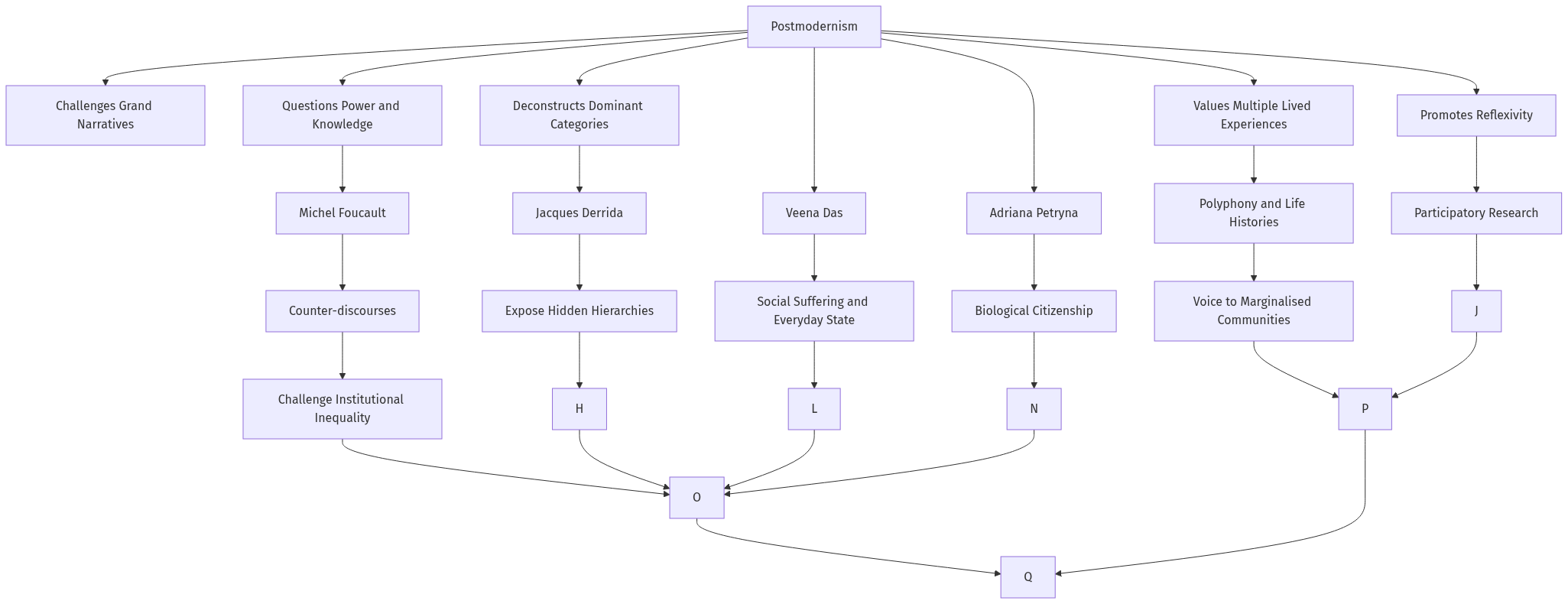
Conclusion
Postmodernism promotes social justice by questioning dominant knowledge, exposing power, validating marginalised voices, and recognising multiple lived realities. Its major contribution is shifting anthropology from speaking about marginalised communities to recognising their capacity to speak from their own experiences. However, its critical insights are most effective when combined with attention to material inequality, rights, and institutional change.
Quick related
Students also ask
-
Critically explain the notion of 'deconstruction' in the light of the postmodern works of Jacques Derrida.
Next question on this syllabus topic (2024 · Q7(a)). View answer →
-
Is postmodernism anti-science?
Here it is a critique of the god’s-eye monograph, not a denial of bones or genes.
-
How does empowerment appear in practice?
Life history, counter-mapping, Forest Rights documentation, or community archives, justified by the duty to listen to positioned voices.
Same topic · past papers
UPSC has asked this before
These previous-year questions sit on the same topic. Open one to practise the earlier ask.
-
2015 · Q3(c) · Anthropology GS 1 · 20 marks
Explain the basic features of 'Postmodernism' in Anthropology
More from this topic
Q7(a) · UPSC Mains 2024 · Anthropology GS 1 · 20 marks · Solution
Critically explain the notion of 'deconstruction' in the light of the postmodern works of Jacques Derrida.
Post-modernism in anthropology.
Derridean deconstruction is a close reading of unstable hierarchical oppositions. Différance means that signs differ and final meaning is deferred. Trace marks the excluded term within the privileged one; aporia is an internal impasse. Derrida exposed contradictions in Lévi-Strauss's nature/culture and speech/writing contrasts. Clifford, Marcus and Abu-Lughod brought reflexive textual critique into anthropology. Its limit is textualism unless linked to history, institutions and material inequality.
Q3(c) · UPSC Mains 2015 · Anthropology GS 1 · 20 marks · Solution
Explain the basic features of 'Postmodernism' in Anthropology
Post-modernism in anthropology.
Postmodernism treats ethnography as a written, situated account. Writing Culture named the crisis of representation. Reflexivity, polyphony, and partial truths are the kit. Foucault and Said tied knowledge to power and empire. The limit is paralysis; the gain is honest voice and better ethics.