
Revision summary
Adaptability is plasticity, acclimatisation and subsistence flexibility. Ecology is energy, season, pathogen and land, and it is not a neutral stage. Political economy is class, market, state and colonial history, as in Wolf and Mintz. The join is political ecology and the embodiment of inequality, as in Goodman and Leatherman. The household is the hinge of diet, labour and exposure. Poverty is not an adaptation.
Model answer
Copper italics in this answer — like this — are the key facts. Each one is unpacked in the Facts & figures rail.
Introduction
Bio-cultural anthropology studies how bodies and environments make each other through culture. Political economy asks who owns the land, water and labour. The question wants the join: adaptation is never only a clever fit to climate. It is a fit to a climate already shaped by prices, stigma and the state.
Body
Integration of political economy, ecology and adaptability
- Biocultural framework: Modern biocultural anthropology integrates political economy, ecological perspectives, and human adaptability to explain how human biology is shaped by the interaction of culture, environment, economic systems, and power. Human biology is therefore not a fixed given but a dynamic outcome of biological and socio-cultural processes.
Political economy and ecological perspective
- From natural to socially produced environments: Traditional cultural ecology often examined how people adapt to their physical surroundings. The political economy perspective adds that environments are also socially and politically produced, because states, markets, colonial histories, and unequal power determine access to resources.
- Restructuring local ecologies: Global capitalism, state policies, and colonial economic systems can transform local environments by determining who controls land, forests, water, minerals, and markets.
- Unequal access to resources: The same ecological resource may be available to one group but inaccessible to another because of class, gender, ethnicity, ownership, or political power.
- Political mediation of stress: Environmental stresses such as food scarcity, displacement, pollution, and ecological degradation are not always purely natural phenomena. They may be intensified or unequally distributed through political and economic processes.
- Banaba Island: The destruction of Banaba Island through phosphate mining driven by colonial economic interests demonstrates how political-economic forces can physically transform and even destroy an entire ecological niche.
- Key insight: Political economy therefore changes the question from “How do people adapt to the environment?” to “Who controls the environment, who bears its costs, and how does power shape adaptation?”
Political economy and adaptability perspective
- Human adaptability: Adaptability refers to the physiological, developmental, and behavioural responses through which humans cope with environmental and social stresses.
- Differential adaptation: Socio-economic inequality influences the biological capacity to respond to stress. Differences in nutrition, healthcare, housing, occupation, and sanitation can therefore produce measurable differences in growth and health.
- Undernutrition and stunting: Chronic undernutrition can lead to growth retardation or stunting, demonstrating how long-term socio-economic deprivation can become biologically embodied.
- Structural violence: Structural violence refers to social and economic arrangements that systematically expose certain groups to disease, malnutrition, poverty, and premature mortality. Biological outcomes are therefore partly shaped by social structures.
- Paul Farmer: Paul Farmer’s work in Haiti and Rwanda demonstrated how diseases such as HIV and tuberculosis cannot be understood only as biological events; poverty, political inequality, colonial histories, and economic dependency influence exposure, treatment, and survival.
- Nancy Scheper-Hughes: Her work among impoverished Brazilian communities showed how extreme scarcity could shape maternal responses to infant illness and mortality. This illustrates how social suffering and economic deprivation can become embodied in everyday behaviour.
- Political economy of the body: The body becomes a site where poverty, inequality, exploitation, and social stress are physically expressed, demonstrating the close relationship between political economy and human biology.
Ecology and adaptability
- Ecology as context: Ecology provides the environmental conditions and stresses within which humans live, while adaptability explains the biological, developmental, and behavioural responses to those conditions.
- Biocultural interaction: Human adaptation is rarely purely biological or purely cultural. Cultural practices can modify environmental pressures, while biological responses can subsequently influence how populations interact with their environment.
- Biocultural feedback: Culture can create new selection pressures and ecological opportunities, which may contribute to biological adaptation over generations. This creates a feedback relationship between culture, biology, and environment.
- Lactase persistence: Lactase persistence provides a classic example of gene–culture coevolution. Pastoralist populations with long histories of milk consumption gained an advantage from maintaining the ability to digest lactose into adulthood, creating a relationship between cultural practice and biological adaptation.
- High-altitude adaptation: Populations living at high altitudes face chronic hypoxia or low oxygen availability. Adaptation involves both biological and cultural responses.
- Tibetan adaptation: Tibetan populations show physiological and genetic adaptations to high altitude, including changes involving oxygen regulation and variants near the EPAS1 pathway. Cultural strategies such as settlement patterns, diet, and livelihood practices further reduce environmental stress.
- Andean adaptation: Andean populations show different physiological responses to hypoxia, including adaptations involving haemoglobin concentration and oxygen transport. Cultural practices such as agriculture, pastoralism, and settlement strategies complement these biological responses.
- Integrated adaptation: High-altitude populations demonstrate that adaptation is not simply a biological change in the body. It involves an interaction between genetic adaptation, physiological adjustment, cultural behaviour, diet, and livelihood strategies.
Overall integration
- Ecological perspective: Ecology provides the environmental context and stresses within which human populations live, but that environment may itself be transformed by human activities and political forces.
- Adaptability perspective: Adaptability explains the biological, developmental, and behavioural responses of individuals and populations to environmental and social stress.
- Political economy perspective: Political economy explains how power, markets, class relations, state policies, and historical inequalities determine who is exposed to environmental stress and who has access to resources and healthcare.
- Integrated biocultural approach: Together, these perspectives show that human health and biological variation are produced through a continuous interaction between environment, culture, biology, and political-economic structures.
- Core argument: Modern biocultural anthropology therefore moves beyond the idea that humans simply adapt to nature. It asks how social power transforms environments, how unequal environments produce differential biological outcomes, and how cultural practices can reshape biological adaptation.
Flow diagram
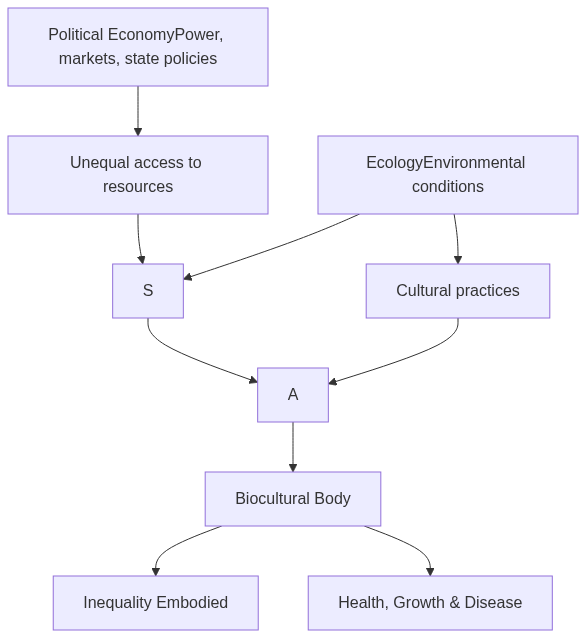
Conclusion
Integrate the three by treating environment as political and the body as historical. Adaptability is the capacity. Political economy decides which bodies must use it, and how far. That is bio-cultural anthropology after the critique of cultural ecology’s innocent ecosystem.
Quick related
Students also ask
-
What is acclimatization? Discuss adaptive responses to high altitude and cold climate
Next question on this syllabus topic (2021 · Q6(a)). View answer →
-
Is this the same as cultural materialism?
It is a related ancestor in Marvin Harris, but this question wants power and inequality, not infrastructure as destiny. Prefer Wolf, political ecology and biocultural health.
-
What example joins all three lenses?
Stunting as seasonal ecology plus landlessness plus gendered serving of food. Adivasi health near mines is another.
Same topic · past papers
UPSC has asked this before
These previous-year questions sit on the same topic. Open one to practise the earlier ask.
-
2025 · Q6(c) · Anthropology GS 1 · 15 marks
Describe briefly the theoretical perspectives in linguistic anthropology to explain the relationship of culture, language and thought
More from this topic
Q6(a) · UPSC Mains 2021 · Anthropology GS 1 · 20 marks · Solution
What is acclimatization? Discuss adaptive responses to high altitude and cold climate
Concepts and methods of Ecological Anthropology: Bio-cultural Adaptations
Acclimatization is reversible adjustment within a lifetime. It is not the same as genetic adaptation, though they combine. Altitude responses are ventilation, heart rate, and later haematology. Tibetans and Andeans solve hypoxia by different mixes of physiology and genes. Cold responses are shivering, vasoconstriction, diet, and Arctic clothing.
Q8(b) · UPSC Mains 2016 · Anthropology GS 1 · 15 marks · Solution
Discuss the genetic and non-genetic factors in the bio-cultural adaptations of human beings to different environments.
Concepts and methods of Ecological Anthropology: Bio-cultural Adaptations
Genetic adaptations include malaria alleles, altitude genes, and lactase. Non-genetic adaptations are sweating, ventilation, and developmental shape. Culture—clothes, food, houses—does most polar and desert work. Farming and malaria show culture selecting genes. No environment is solved by DNA alone.
Q7(b) · UPSC Mains 2015 · Anthropology GS 1 · 15 marks · Solution
Critically examine the physiological responses and acclimatization to cold climate in Man
Concepts and methods of Ecological Anthropology: Bio-cultural Adaptations
Immediate cold defence is skin constriction and shivering. Finger hunting reaction rewarms digits at a cost. Acclimatization can raise heat production and habituation. Bergmann and Allen rules are population trends. Technology and diet do most of the work in polar life.