
Revision summary
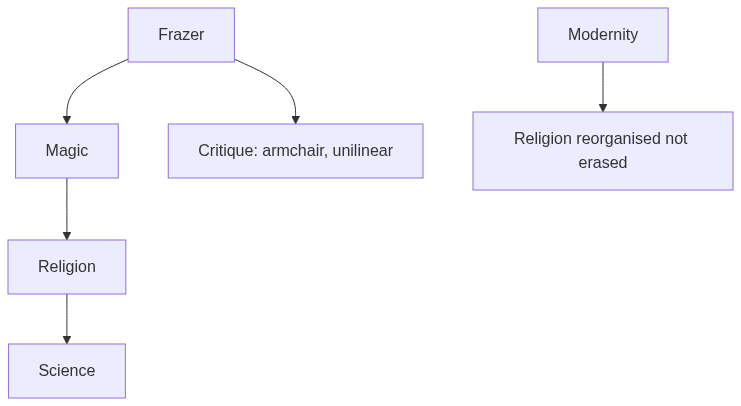
Frazer moved from magic as coercion, to religion as petition, to science as law, with sympathetic magic and survivals. Critique him for armchair method, unilinear stages, intellectualism and colonial ranking. Magic, religion and science coexist. The usable fragment is like-produces-like and contact. Modernity is incomplete disenchantment: civil religion, revival movements and political religion. A smartphone pilgrimage is not a fossil stage. Durkheim and Weber are better guides to religion as social fact and meaning.
Model answer
Copper italics in this answer — like this — are the key facts. Each one is unpacked in the Facts & figures rail.
Introduction
- Sir James Frazer’s The Golden Bough offered a grand evolution of the human mind: from magic to religion to science. It was armchair, unilinear and too clean. Later theories of religion had to step around that staircase. The second part of the question is whether religion ended when the staircase reached modernity.
Body
Frazer’s evolutionism
Frazer treated magic as mistaken natural science. By the law of similarity, like produces like. By the law of contact, things once together remain linked. The magician tries to coerce nature. When coercion fails, humans petition personal powers. That is religion. When petition is found wanting, science explains impersonal law. Folk custom survives as a fossil of earlier stages. Comparison was global and ripped from context: a rite in Rome and a rite in a colonial ethnography became one type.
This is intellectualist evolutionism. Belief systems are ranked as proto-theories of nature, by how much they err.
Critique
- Armchair method: Frazer compared library notes, not living economies. Malinowski’s Trobriand magic in fishing and gardening is practical and social. That already wounds Frazer.
- Unilinear stages: Magic, religion and science coexist in every living society, including laboratories with lucky charms. Stages are a Victorian ranking, not a field sequence.
- Too cognitive: Ritual does social work that an error-theory of belief cannot see. Émile Durkheim’s collective effervescence and Turner’s ritual process are the usual counters. E. E. Evans-Pritchard on Azande witchcraft also showed that “irrational” belief can be logically organised in daily life.
- Colonial frame: “Savages” as the childhood of Europe. Later anthropology refused that timeline.
- What survives: The catalogue of sympathetic magic still teaches. The staircase does not.
Religion in modernity
Modernity did not empty the world. Max Weber’s disenchantment was a tendency, not a completed eviction. Secularisation in parts of Europe coexisted with public religion elsewhere, with nationalism as civil religion, with Pentecostal and other revival growth, and with science and piety in the same persons.
- Place: Religion remains a source of identity, ethics, protest and consolation. It also remains a field of power, including gender and majoritarianism.
- Not survivals: A smartphone pilgrimage, online darshan during COVID-19 lockdowns, or a televised Kumbh is not a Frazerian fossil of magic. It is a contemporary institution and a media form.
- Indian household: Clinical medicine and a vow at a shrine often sit in the same family. That coexistence undercuts Frazer’s staircase more cleanly than a sermon about secularism.
- Elucidation: Modernity pluralises the religious field — privatised belief, marketised devotion, political religion — rather than replacing it with Frazer’s science.
- Durkheim and Weber help the modernity argument more than Frazer himself: religion as social fact and as meaning under rationalisation.
Flow diagram
Conclusion
Frazer gave a memorable unilinear career of the mind and a weak ethnography of ritual. Religion in modernity is not the middle step before science. It is a reorganised public and private power. Sympathetic magic remains his usable fragment; the staircase does not.
Quick related
Students also ask
-
Discuss historical particularism as a critical development to the classical evolutionism.
Next question on this syllabus topic (2024 · Q2(a)). View answer →
-
What must be remembered from The Golden Bough?
The three-stage scheme, sympathetic magic, survivals, and the main lines of critique. The dying-god plot is not required in detail.
-
What is a modern religion example?
Civil religion around the nation-state, or clinical medicine coexisting with vow-and-temple practice in the same household. Both undercut Frazer’s staircase.
Same topic · past papers
UPSC has asked this before
These previous-year questions sit on the same topic. Open one to practise the earlier ask.
-
2024 · Q2(a) · Anthropology GS 1 · 20 marks
Discuss historical particularism as a critical development to the classical evolutionism. -
2015 · Q2(c) · Anthropology GS 1 · 15 marks
How do diffusionism and evolutionism differ as explanations of Culture Change?
More from this topic
Q2(a) · UPSC Mains 2024 · Anthropology GS 1 · 20 marks · Solution
Discuss historical particularism as a critical development to the classical evolutionism.
Classical evolutionism (Tylor, Morgan and Frazer)
Classical evolutionism arranged societies on universal stages using decontextualised comparison. Boas argued that similar traits may have different causes and histories. His 1896 critique required fieldwork, language, distribution and chronology before comparison. The Boasian school separated race, language and culture and advanced cultural relativism. Baffin Island and Northwest Coast research replaced armchair sequence with documented context. Its limits were anti-generalisation, salvage assumptions and insufficient attention to colonial power.
Q6(c) · UPSC Mains 2021 · Anthropology GS 1 · 15 marks · Solution
Critically evaluate Lewis Morgan's classification of family
Classical evolutionism (Tylor, Morgan and Frazer)
Morgan ranked families from group marriage to Victorian monogamy. He linked terms, property, and a three-age history of culture. No ethnography confirms consanguine or punaluan stages. Boas, Lévi-Strauss, and feminist work dismantled the ladder. Keep his comparative kinship method, not his timetable.
Q2(b) · UPSC Mains 2015 · Anthropology GS 1 · 20 marks · Solution
How did Morgan explain the evolution of marriage, family and Socio-Political organization, and how did other evolutionists disagree with his explanation?
Classical evolutionism (Tylor, Morgan and Frazer)
Morgan sequenced family from promiscuity to monogamy with property. Socio-political order ran gens to tribe to territorial state. Savagery–barbarism–civilisation was invention-marked. McLennan, Maine, Bachofen, and Tylor kept evolution but not his rungs. Boas and Lowie rejected unilinear necessity.