
Revision summary
Lévi-Strauss treats the Asdiwal myth as transformations among relations, not failed history. Mountain/sea, hunting/fishing and residence rules form linked oppositions. Mythemes gain meaning through position, following Saussurean linguistics. Different versions transform one structural problem rather than copy one original. The method reveals patterned classification and contradiction. Critics argue that analyst-chosen binaries neglect performance, history, agency and power.
Model answer
Copper italics in this answer — like this — are the key facts. Each one is unpacked in the Facts & figures rail.
Introduction
For Claude Lévi-Strauss, myth is not an inferior historical chronicle but a machine for thinking contradictions. His analysis of the Tsimshian story of Asdiwal reads successive versions as transformations of relations—high/low, land/sea, nature/culture and matrilocal/patrilocal.
Body
Asdiwal as structural analysis
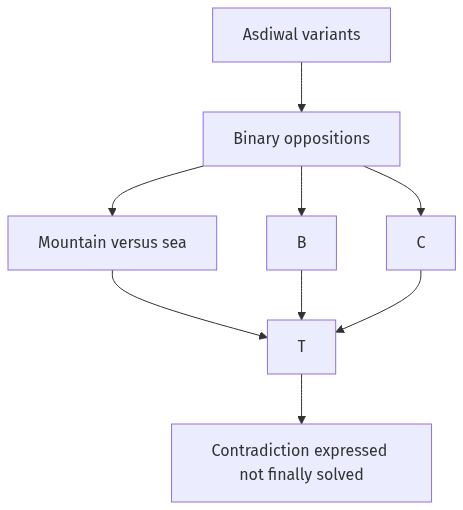
Asdiwal, born through the intervention of a supernatural helper, travels vertically and horizontally, hunts, marries women from different domains, and ultimately fails to reconcile the worlds he crosses. Lévi-Strauss maps geography, subsistence and marriage together. Mountain versus sea, hunting versus fishing, east versus west and matrilocal versus patrilocal residence form homologous oppositions. Mediating figures and journeys temporarily bridge them.
The myth does not simply mirror Tsimshian society. Its ending exposes contradictions between ideal and lived social arrangements that cannot be permanently solved. Different versions are therefore not corrupt copies; each transforms a common relational matrix.
Structuralist theory illustrated
Borrowing from Saussurean linguistics, Lévi-Strauss argues that meaning lies in relations, not isolated motifs. Minimal relational units or “mythemes” combine like language. Binary oppositions reflect unconscious classificatory structures; transformation explains variation across myths. In The Structural Study of Myth and the Mythologiques, he sought a comparative science of thought.
Critical assessment
The method rescued myth from evolutionist fantasy and showed patterned variation across ecology, kinship and symbolism. It is replicable in asking what relations transform.
Yet Edmund Leach warned that neat binaries can be selected by the analyst. Historical colonial change, performance, emotion and the narrator's purpose recede. Pierre Bourdieu objected more generally to rule-like structures detached from practice, while post-structuralists question a universal stable code. Some critics also dispute whether Asdiwal's variants support all the geographic alignments assigned to them.
A stronger use joins structure to who tells a version, on what occasion, and under which historical conditions.
Flow diagram
Conclusion
- Asdiwal demonstrates structuralism at its best: myth transforms stubborn social and ecological contradictions rather than reporting events. Its weakness is the same abstraction—relations become elegant while speakers, history and unequal power can disappear.
Quick related
Students also ask
-
Explain the structural analysis of kinship as proposed by Levi-Strauss
Next question on this syllabus topic (2021 · Q8(c)). View answer →
-
What contradiction does Asdiwal solve?
It symbolically mediates ecological and marital oppositions but does not permanently solve them; the failure is analytically important.
-
Is structuralism the same as structural-functionalism?
No. Structuralism seeks unconscious relational codes; structural-functionalism asks how institutions maintain a social system.
Same topic · past papers
UPSC has asked this before
These previous-year questions sit on the same topic. Open one to practise the earlier ask.
-
2026 · Q2(c) · Anthropology GS 1 · 15 marks
How is the theory of structuralism helpful in understanding the concepts of caste and gender? -
2026 · Q8(a) · Anthropology GS 1 · 15 marks
Compare Edmund Leach's structuralism with interpretive anthropology of Clifford Geertz
More from this topic
Q8(a) · UPSC Mains 2026 · Anthropology GS 1 · 15 marks · Solution
Compare Edmund Leach's structuralism with interpretive anthropology of Clifford Geertz
Structuralism (Lévi-Strauss and E. Leach)
Edmund Leach gave structuralism a political, empirical edge through Kachin fieldwork: structures contain contradiction, and ritual can be used to shift power. Clifford Geertz moved anthropology toward meaning — culture as symbols, read through thick description (e.g. the Balinese cockfight). Both rejected static functionalism, but Leach kept structure and process while Geertz dissolved structure into interpretation. Together they pushed anthropology from mechanical models toward meaning and contested social life.
Q2(c) · UPSC Mains 2026 · Anthropology GS 1 · 15 marks · Solution
How is the theory of structuralism helpful in understanding the concepts of caste and gender?
Structuralism (Lévi-Strauss and E. Leach)
Claude Lévi-Strauss's structuralism posits that human culture is shaped by universal, unconscious mental structures based on binary oppositions. In anthropology, this methodology provides powerful tools to decode complex social institutions like caste and gender. For caste, structuralism reveals how hierarchy is maintained through underlying binary classifications of purity and pollution. For gender, it unpacks kinship systems and alliance theories where women act as structural signs exchanged between groups. Far from static, this framework exposes the deep mental grammars that underpin social stratification and inequality across diverse cultural contexts.
Q8(c) · UPSC Mains 2021 · Anthropology GS 1 · 15 marks · Solution
Explain the structural analysis of kinship as proposed by Levi-Strauss
Structuralism (Lévi-Strauss and E. Leach)
Kinship is treated as a system of exchange, not a biological family stage. The incest rule creates alliance between groups. Restricted exchange is two-sided; generalised exchange is a circle. Kachin and Dravidian systems are teaching models; Dumont extended the method. Feminist critique, after Weiner, refuses women as mere signs.