
Revision summary
Stratification is institutional ranking that produces unequal resources, honour and power. Marx stresses property; Weber separates class, status and party. Bourdieu explains reproduction through several forms of capital and habitus. Dumont highlighted purity hierarchy; Ambedkar highlighted endogamy, graded inequality and coercion. Srinivas showed Sanskritisation and dominant caste, mobility that need not end hierarchy. Intersectionality, law and movements show both compounded inequality and resistance.
Model answer
Copper italics in this answer — like this — are the key facts. Each one is unpacked in the Facts & figures rail.
Introduction
Social stratification is the durable, institutional ranking of categories of people into unequal life chances, honour, resources and power. Difference becomes inequality when it is inherited, justified and reproduced through institutions.
Body
How hierarchy reproduces itself
Karl Marx located class inequality in ownership of productive property: dominant classes control labour and ideology. Max Weber separated class, status and party, explaining why ritual honour or political power need not follow income exactly. Davis and Moore claimed unequal rewards motivate socially necessary roles; Melvin Tumin replied that inherited privilege restricts talent and lets elites define which work is valuable.
Pierre Bourdieu shows reproduction through economic, cultural, social and symbolic capital. Schools can convert a dominant group's language and habitus into apparently neutral merit. Louis Dumont's Homo Hierarchicus interpreted caste through purity and pollution, while B. R. Ambedkar centred graded inequality, endogamy and coercion. M. N. Srinivas's Sanskritisation demonstrates mobility, but often mobility within rather than abolition of hierarchy. Dominant caste links number, land and political office.
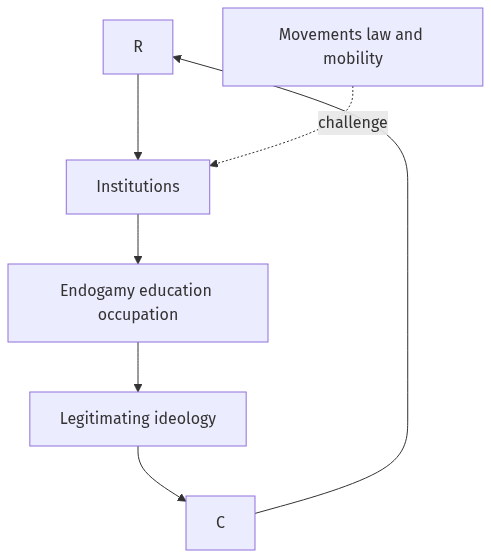
Endogamy transmits status and property; occupational closure restricts opportunity; ideology naturalises privilege; law and everyday discrimination enforce boundaries. Gendered unpaid care and control of marriage reproduce caste and class together. Dalit women's location shows Kimberlé Crenshaw's intersectional insight: axes of inequality combine rather than simply add.
Stratification is not perfectly closed. Reservation, urbanisation, social movements, education and democratic politics create mobility and counter-power. Yet wealth, networks, English-medium credentials, residential segregation and digital access can remake old advantage in new forms. Functional integration cannot excuse unequal dignity, and a purely ritual account misses land and violence.
Flow diagram
Conclusion
Stratification sustains inequality by turning resources into inherited status and then naming the result merit, purity or tradition. Marx, Weber, Bourdieu and Ambedkar together reveal material, cultural and political reproduction; agency and constitutional justice reveal that it is never uncontested.
Quick related
Students also ask
-
Critically evaluate different types of social stratifications with suitable examples
Next question on this syllabus topic (2021 · Q7(a)). View answer →
-
Does social differentiation always mean stratification?
No. Differentiation becomes stratification when categories are durably ranked with unequal rewards and power.
-
Does Sanskritisation eliminate caste?
It may alter a group's claimed rank or practices, but usually leaves the hierarchical field and endogamous boundaries intact.
Same topic · past papers
UPSC has asked this before
These previous-year questions sit on the same topic. Open one to practise the earlier ask.
-
2021 · Q7(a) · Anthropology GS 1 · 20 marks
Critically evaluate different types of social stratifications with suitable examples -
2025 · Q3(a) · Anthropology GS 1 · 20 marks
How anthropologists assess the nutritional status of a community? Discuss the significance of intersectionality of ecology, culture, and social inequality in the study of nutritional anthropology
More from this topic
Q3(b) · UPSC Mains 2025 · Anthropology GS 1 · 15 marks · Solution
Critically examine the drawbacks in assuming culture as an 'integrated-closed system in understanding of contemporary society
The Nature of Society
Closed integrated culture is the picture in Benedict, functionalist equilibrium and the bounded field. Its virtue was holism against trait lists. Its drawbacks are conflict, history as in Wolf, power, internal plurality as in Barth, multi-sited scale and rapid change. Holism remains useful as connection-thinking without a sealed, harmonious whole. Contemporary society is an open system with unequal articulation.
Q7(a) · UPSC Mains 2021 · Anthropology GS 1 · 20 marks · Solution
Critically evaluate different types of social stratifications with suitable examples
The Nature of Society
Stratification is durable structured inequality. Egalitarian bands limit surplus; ranked chiefdoms give hereditary honour. Class is relation to production (Marx) plus status and party (Weber). Caste ranks endogamous groups by purity and occupation; estates are legal orders. Slavery, social race, and gender are further axes; types mix in living societies.
Q1(a) · UPSC Mains 2016 · Anthropology GS 1 · 10 marks · Solution
Differences between Social Anthropology and Sociology.
The Nature of Society
Social anthropology grew from intensive fieldwork in small-scale societies. Sociology grew from industrial class, state, and survey. Malinowski versus Durkheim is the textbook origin split. Srinivas and Béteille show the Indian overlap. The wall is departmental, not a law of nature.