
Revision summary
Derridean deconstruction is a close reading of unstable hierarchical oppositions. Différance means that signs differ and final meaning is deferred. Trace marks the excluded term within the privileged one; aporia is an internal impasse. Derrida exposed contradictions in Lévi-Strauss's nature/culture and speech/writing contrasts. Clifford, Marcus and Abu-Lughod brought reflexive textual critique into anthropology. Its limit is textualism unless linked to history, institutions and material inequality.
Model answer
Copper italics in this answer — like this — are the key facts. Each one is unpacked in the Facts & figures rail.
Introduction
Jacques Derrida's deconstruction is not destruction or the claim that any reading is equally true. It is a close reading that shows how a text depends on unstable oppositions and on meanings it excludes, so its claim to a single self-present centre cannot hold.
Body
Core moves
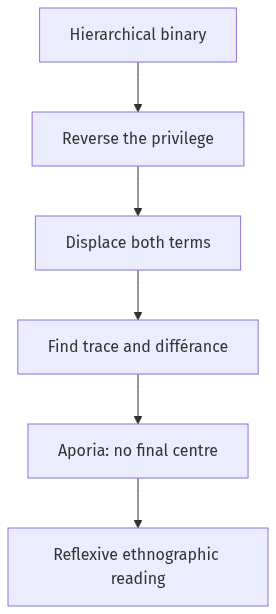
Western thought often organises hierarchical binaries—speech/writing, reason/emotion, civilised/primitive, male/female—privileging the first term. Deconstruction first identifies the hierarchy, then reverses or displaces it to show mutual dependence.
Différance names both difference and deferral: a sign means through differences from other signs, while final meaning is continually postponed. A supposedly absent term leaves a trace in the present one. An aporia is an impasse where a text's own premises prevent a stable resolution. Derrida's reading of Lévi-Strauss in “Structure, Sign and Play” showed that even a critique of ethnocentrism could reproduce the nature/culture and speech/writing oppositions it questioned.
Anthropological relevance
Postmodern anthropologists such as James Clifford and George Marcus treated ethnographies as authored, partial texts rather than transparent windows. Lila Abu-Lughod's “writing against culture” unsettles the bounded culture/individual binary; Edward Said's Orientalism exposes how West/East representation constituted imperial authority. In India, deconstructing tribe/caste, traditional/modern or literate/illiterate can reveal administrative power and hybrid lives.
Critique
Deconstruction enables reflexivity, attention to silences and recovery of marginal voices. But textual indeterminacy can underplay land, labour and violence. Eric Wolf's political economy and feminist or subaltern ethnography remind us that unequal meanings are backed by institutions. The method also risks becoming an analyst's wordplay unless grounded in language, history and field evidence.
Flow diagram
Conclusion
Deconstruction makes anthropology ask how its categories manufacture the other they claim merely to describe. Its best use is disciplined and empirical: destabilise false binaries, identify exclusions, then reconnect representation to material power.
Quick related
Students also ask
-
Explain the basic features of 'Postmodernism' in Anthropology
Next question on this syllabus topic (2015 · Q3(c)). View answer →
-
Does deconstruction mean there are no facts?
No. It analyses how claims and categories are organised; field evidence can still falsify an assertion.
-
What is the simplest deconstructive move?
Identify a privileged binary, show that each term depends on the other, and examine what the hierarchy excludes.
More from this topic
Q8(a) · UPSC Mains 2025 · Anthropology GS 1 · 20 marks · Solution
How the theories of postmodernism are relevant in promoting social justice and empowerment of marginalised communities?
Post-modernism in anthropology.
Postmodern anthropology doubts grand narratives and treats ethnography as a positioned text, as in Clifford and Marcus. Foucault links knowledge to power. Said and Spivak ask who may represent the marginalised. These tools support voice, anti-essentialism, participatory methods and queer or Dalit or Adivasi self-description. Current examples include Forest Rights claims, testimony movements and counter-mapping. The limit is that style without land and law does not empower. Join voice to political economy.
Q3(c) · UPSC Mains 2015 · Anthropology GS 1 · 20 marks · Solution
Explain the basic features of 'Postmodernism' in Anthropology
Post-modernism in anthropology.
Postmodernism treats ethnography as a written, situated account. Writing Culture named the crisis of representation. Reflexivity, polyphony, and partial truths are the kit. Foucault and Said tied knowledge to power and empire. The limit is paralysis; the gain is honest voice and better ethics.