
Revision summary
Benedict’s configurationalism treats culture as a selective, integrated ethos. Her American South-West example is Zuni/Pueblo Apollonian restraint, cooperation and ceremonial order. Dionysian cultures value intensity, ordeal and self-assertion. Plains and Kwakiutl cases are comparative contrasts; Kwakiutl is Northwest Coast, not South-West. The model challenged racial determinism and universal normality. Critics identify selective evidence, group-personality reification, Western labels and neglect of gender, colonialism and internal variation.
Model answer
Copper italics in this answer — like this — are the key facts. Each one is unpacked in the Facts & figures rail.
Introduction
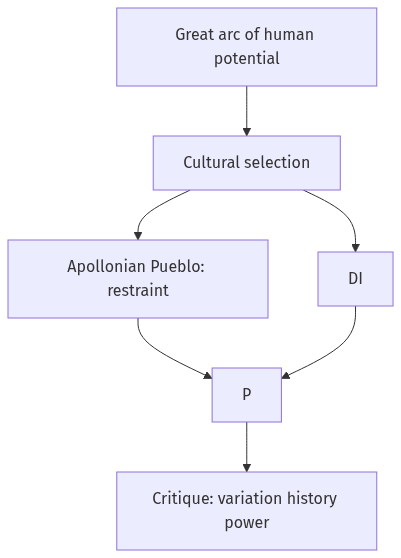
In Patterns of Culture (1934), Ruth Benedict argued that a culture selects from the “great arc” of human potential and integrates selected traits into a characteristic configuration or ethos. Her American South-West exemplar was the Zuni/Pueblo Apollonian pattern, understood through contrast with Dionysian cultures.
Body
The psychological types
Borrowing Nietzsche’s terms, Benedict described Pueblo life, especially Zuni, as Apollonian: moderation, restraint, cooperation, ceremonial order and suspicion of individual excess. Ritual office was distributed and disciplined; achievement was absorbed into collective form. Altered states, violent competition and self-glorification were muted in her portrait. Child training and social sanctions produced a personality congruent with this ethos.
The Dionysian contrast sought intensity, excess, ordeal, vision and conspicuous self-assertion. Benedict drew comparative material especially from Plains vision quests and the Northwest Coast Kwakiutl/Kwakwaka’wakw potlatch. The latter are not South-West Pueblo; they are comparative cases used to sharpen the type. Her Dobu “paranoid” configuration likewise came from Melanesia, not the American South-West.
The approach was configurational, not a claim that every Zuni person had one clinical personality. Institutions selected and reinforced compatible motives, producing a cultural “style”. This rejected evolutionist ranking and expressed the Boasian separation of cultural difference from race.
Critical examination
- The type is elegant but selective: counterexamples and ordinary variation can be filtered out to preserve coherence.
- It treats named peoples as bounded personalities and risks the ecological fallacy—moving from a cultural pattern to each individual psyche.
- Gender, faction, colonial violence, missionisation and economic history receive too little attention.
- Edward Sapir warned that culture is differently experienced by persons; later practice theory emphasises strategic and contradictory action.
- “Apollonian” and “Dionysian” are Western aesthetic categories imposed on Indigenous worlds. They are interpretive metaphors, not measured psychological diagnoses.
- Yet Benedict’s moral contribution remains important: normality is culturally organised, and no cultural configuration is biologically destined or inherently superior.
Flow diagram
Conclusion
Benedict’s South-West type is the restrained, ceremonially ordered Pueblo/Zuni Apollonian configuration. Its comparative power lies in showing cultural selection of temperament; its danger lies in turning a selective pattern into a homogeneous group mind. Use it as a heuristic, not a diagnosis of a people.
Quick related
Students also ask
-
Did Benedict call all South-West cultures Dionysian?
No. Her best-known South-West Pueblo/Zuni characterisation is Apollonian; Dionysian material largely supplies the contrast.
-
Is a configuration a clinical personality?
No. It is a cultural pattern or ethos, though Benedict’s language sometimes encouraged an unsafe slide from shared institutions to group psychology.
Same topic · past papers
UPSC has asked this before
These previous-year questions sit on the same topic. Open one to practise the earlier ask.
-
2023 · Q3(b) · Anthropology GS 1 · 15 marks
How did Clifford Geertz look at religion. Differentiate between anthropological and psychological approaches to the study of religion.