
Revision summary
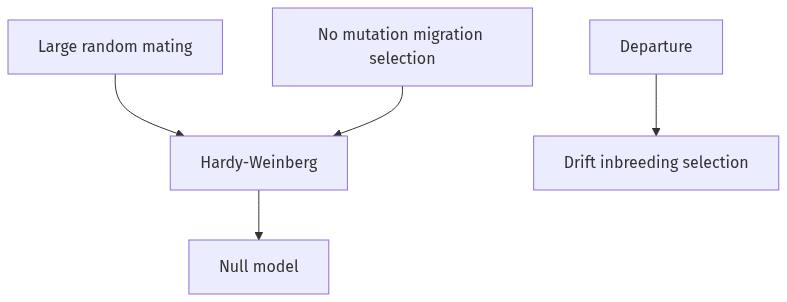
Hardy and Weinberg showed that p², 2pq, and q² persist under stated assumptions. Assumptions are large size, random mating, and no mutation, migration, or selection. Equilibrium is the null against which evolution is inferred. Forensics and counselling use it to get genotype frequencies. Sickle-cell selection and isolate inbreeding are standard anthropological departures. Real populations only approximate the model.
Model answer
Copper italics in this answer — like this — are the key facts. Each one is unpacked in the Facts & figures rail.
Introduction
Genetic equilibrium is the Hardy–Weinberg state in which allele and genotype frequencies stay stable across generations. It is a null model, and it holds only when a short list of assumptions is met.
Body
The Hardy–Weinberg statement
- For two alleles, p and q, random mating produces genotypes p², 2pq, and q², a relation named for G. H. Hardy and Wilhelm Weinberg in 1908.
- If the assumptions hold, those frequencies recur, and allele frequencies do not drift by the mating system itself.
Assumptions
- The population is indefinitely large, so chance genetic drift is negligible.
- Mating is random with respect to the locus, with no inbreeding or assortative mating that would raise homozygotes.
- There is no mutation at rates that would shift p and q in the study window.
- There is no migration that imports a different allele frequency.
- There is no selection for or against genotypes at that locus.
- Generations are discrete in the simple teaching model, and the locus is autosomal in the basic two-allele form; sex-linked and multiple-allele extensions need extra algebra.
Importance
- Equilibrium is the null hypothesis of population genetics: departure diagnoses drift, inbreeding, migration, or selection, which is why R. C. Lewontin and anthropological genetics use it on blood groups and now on SNPs.
- Forensic match probabilities and genetic counselling use Hardy–Weinberg expectations to translate allele frequencies into genotype frequencies.
- Sickle-cell heterozygote advantage in malaria belts is taught as a selection break of equilibrium, not as a failure of Mendelism.
- Inbreeding in small tribal isolates raises homozygosity above 2pq expectations, which is an anthropological use of the same test.
- Conservation genetics of small populations uses the opposite of the infinite-population assumption to explain loss of diversity.
What it is not
- No real human population meets every assumption forever.
- The model is still necessary as a measuring stick.
Flow diagram
Conclusion
Hardy–Weinberg equilibrium needs a large, randomly mating population without mutation, migration, or selection at the locus. Its importance is as a null model for detecting evolutionary forces and for translating allele frequencies into expected genotypes.
Quick related
Students also ask
-
Balanced and transient genetic polymorphism
Next question on this syllabus topic (2022 · Q5(a)). View answer →
-
Does equilibrium mean no evolution ever?
It means no change from those forces at that locus in that window. Other loci can be under selection at the same time.
-
Why teach a model that is never fully true?
Because departure from it is how drift, inbreeding, and selection become visible in data.
Same topic · past papers
UPSC has asked this before
These previous-year questions sit on the same topic. Open one to practise the earlier ask.
-
2025 · Q6(a) · Anthropology GS 1 · 20 marks
What are genetic markers? Discuss their applications in understanding population variation, disease association and forensics -
2022 · Q8(a) · Anthropology GS 1 · 20 marks
Discuss the contemporary population problems in the light of various socio-cultural demographic theories
More from this topic
Q1(d) · UPSC Mains 2026 · Anthropology GS 1 · 10 marks · Solution
Genetic polymorphism and natural selection.
Concept of genetic polymorphism and selection, Mendelian population, Hardy-Weinberg law
Genetic polymorphism is the presence of multiple alleles in a population at frequencies too high for mutation alone.
Q5(a) · UPSC Mains 2022 · Anthropology GS 1 · 10 marks · Solution
Balanced and transient genetic polymorphism
Concept of genetic polymorphism and selection, Mendelian population, Hardy-Weinberg law
Polymorphism is lasting allelic diversity at one locus. Balanced polymorphism keeps alleles, classically by heterozygote advantage. Sickle-cell and malaria is the human type case. Transient polymorphism is a passing stage while one allele replaces another. Lactase persistence is a human illustration of a sweep still in motion.
Q8(b) · UPSC Mains 2015 · Anthropology GS 1 · 15 marks · Solution
Define genetic polymorphism. Give details of its types with suitable examples
Concept of genetic polymorphism and selection, Mendelian population, Hardy-Weinberg law
Polymorphism is two or more common alleles at a locus. Balanced types include sickle cell and malaria. ABO, Rh, and HLA are serological polymorphisms. SNPs and STRs are DNA types used in medicine and forensics. Most human genetic variation is polymorphic within populations.