
Revision summary
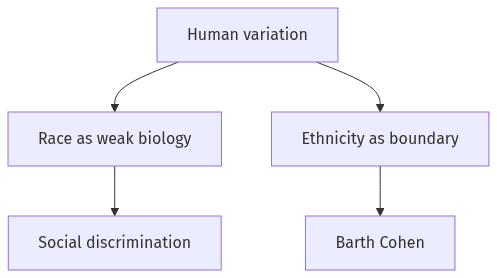
Race as a few fixed stocks fails Boas’s plasticity evidence and Lewontin’s genetic apportionment. Race still organises inequality as a social category. Ethnicity is a maintained boundary of language, history, and politics, as Barth argued. Cohen showed ethnicity at work in urban competition. In India the same people may be sorted by caste, tribe, or language depending on the boundary in play.
Model answer
Copper italics in this answer — like this — are the key facts. Each one is unpacked in the Facts & figures rail.
Introduction
Race and ethnicity both sort people into groups, but they do not sort the same way. Race claims biology; ethnicity claims history, language, and belonging.
Body
Race
- Classical racial types treated skin, hair, and skull as fixed stocks, a scheme that Franz Boas undermined by showing that head form changes with environment.
- Richard Lewontin showed that most genetic variation lies within so-called races, not between them, so race is a poor biological taxonomy.
- UNESCO statements after 1950 and later human-genome work keep the same lesson: clines and local populations exist; continental race as destiny does not.
- Race remains a social fact of discrimination, census, and violence even when it fails as a gene map.
Ethnicity
- Fredrik Barth in Ethnic Groups and Boundaries treated ethnicity as a boundary that people maintain, not a list of inner traits.
- Language, origin story, ritual, and political claim make an ethnic we, as Abner Cohen showed for urban ethnic politics.
- In India, tribe, caste, language, and religion can all be ethnicised; the anthropologist must say which boundary is at work, not paste one label on all difference.
Flow diagram
Conclusion
Race is a weak biological class and a strong social injury. Ethnicity is a made boundary of belonging, and the two must not be used as synonyms.
Quick related
Students also ask
-
Explain the role of heredity and environment in the formation of races.
Next question on this syllabus topic (2016 · Q6(b)). View answer →
-
Are race and ethnicity the same?
No. Race claims a biological stock. Ethnicity claims a historical and political we. Both can be used to exclude, but they are not the same concept.
-
Does anthropology deny human biological variation?
No. It denies that a few races explain that variation better than local populations, clines, and culture.
More from this topic
Q6(b) · UPSC Mains 2016 · Anthropology GS 1 · 15 marks · Solution
Explain the role of heredity and environment in the formation of races.
Race and racism, biological basis of morphological variation of non-metric and metric characters. Racial criteria, racial traits in relation to heredity and…
Some traits are heritable and locally selected. Most genetic variation is within groups, not between classical races. Environment and plasticity change the growing phenotype. Boas showed that ‘racial’ head form shifts with place. Populations form by clines and admixture, not pure types.