
Revision summary
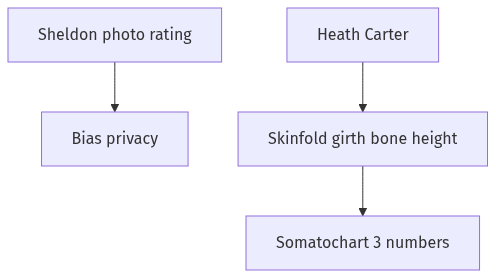
Sheldon’s photoscopic somatotype depended on nude pictures and rater eye. Heath and Carter used skinfolds, girths, bone breadths, height, and weight. Three components are calculated, not guessed from a print. The method fits sports and growth surveys. It describes present shape, not race or temperament.
Model answer
Copper italics in this answer — like this — are the key facts. Each one is unpacked in the Facts & figures rail.
Introduction
William Sheldon photographed bodies and scored endomorphy, mesomorphy, and ectomorphy by eye. Heath and Carter replaced the photograph with callipers and a formula so that somatotype could be repeated in the field.
Body
Why not photographs
- Sheldon’s atlas needed posed nudes and a trained rater. Bias, privacy, and poor repeatability followed, which Hooton and later sports scientists criticised.
- A photo cannot give true girths or skinfolds. Camera distance and posture change the apparent type.
- Anthropology in schools, armies, and villages cannot run a nude photo studio. Heath and Carter (1967 onward) needed a method that works with tape, stadiometer, and skinfold calliper.
The Heath–Carter method
- Ten measurements are standard: height, weight, four skinfolds, two bone breadths, and two limb girths.
- Three components are calculated: endomorphy from skinfolds, mesomorphy from bone and girth corrected for height, ectomorphy from height-weight ratio.
- The result is a three-number somatotype plotted on a somatochart. A wrestler and a distance runner separate without a photograph.
- Carter applied it to Olympic athletes. Indian physical anthropologists used it in growth and sports selection studies.
Limit
- Somatotype is a shape index, not a race or a character type. Sheldon’s temperament claims are dropped.
- Fat and muscle change with training and diet, so the score is a present body, not a destiny.
Flow diagram
Conclusion
Heath and Carter left the photograph because it was unethical, unrepeatable, and metrically weak. Their anthropometry turns somatotype into a field measurement of shape, not a moral portrait.
Quick related
Students also ask
-
Discuss the physiological and evolutionary theories of aging
Next question on this syllabus topic (2021 · Q8(b)). View answer →
-
Can somatotype from photos still be used?
Only as history. Research ethics and error make Heath–Carter anthropometry the living method.
-
Is mesomorphy the same as strength?
It is a musculo-skeletal robustness index. Strength still needs testing.
Same topic · past papers
UPSC has asked this before
These previous-year questions sit on the same topic. Open one to practise the earlier ask.
-
2015 · Q7(a) · Anthropology GS 1 · 20 marks
What is an anthropometric somatotype? Describe Heath and Carter's method of somatotyping
More from this topic
Q2(a) · UPSC Mains 2026 · Anthropology GS 1 · 20 marks · Solution
What is meant by a somatotype? Discuss the Heath-Carter anthropometric method, giving its advantages over that of Sheldon's method. How can somatotyping be applied in sports sciences?
Ageing and senescence. Theories and observations
Somatotyping quantifies human body shape and composition into endomorphy, mesomorphy, and ectomorphy components. While Sheldon used visual ratings and photography with rigid whole-number scales, the Heath-Carter method uses anthropometric measurements like skinfolds, girths, and breadths, allowing continuous ratings and statistical analysis. In sports sciences, somatotyping aids talent identification, position allocation, and training optimisation by matching specific body builds with biomechanical demands of different disciplines.
Q8(b) · UPSC Mains 2021 · Anthropology GS 1 · 15 marks · Solution
Discuss the physiological and evolutionary theories of aging
Ageing and senescence. Theories and observations
Physiological theories include oxidative damage, telomeres, and endocrine decline. Hayflick limits and repair failure describe cells, not purpose. Medawar: late harmful mutations accumulate. Williams: genes good early can be bad late. Kirkwood: the soma is disposable once reproduction is served.
Q7(a) · UPSC Mains 2015 · Anthropology GS 1 · 20 marks · Solution
What is an anthropometric somatotype? Describe Heath and Carter's method of somatotyping
Ageing and senescence. Theories and observations
Somatotype rates roundness, muscularity, and linearity. Sheldon began with photos; Heath and Carter used anthropometry. Skinfolds feed endomorphy; bone and girth feed mesomorphy; ponderal index feeds ectomorphy. Scores are written as three numbers on a somatochart. Use it for sport and growth, not for temperament.