
Revision summary
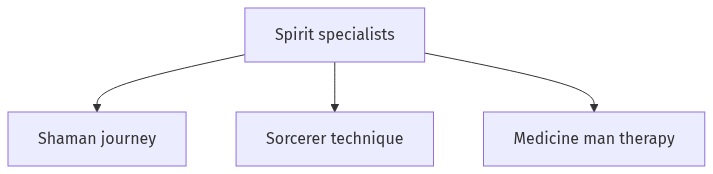
A shaman uses trance and soul travel, as in Siberian cases Eliade used. A sorcerer harms by learned rite, as Azande sorcery shows. Witchcraft in Evans-Pritchard is a different, often inherited, accusation. A medicine man treats with herbs and ritual skill. Roles can overlap; the terms should not.
Model answer
Copper italics in this answer — like this — are the key facts. Each one is unpacked in the Facts & figures rail.
Introduction
These three figures heal, harm, and mediate spirits, but they are not one office. Ethnography keeps the words apart.
Body
Shaman
- Mircea Eliade stressed ecstasy and a soul journey. Siberian Tungus cases named the type. Evans-Pritchard would have called this a specialist who travels, not only a priest who prays.
- Amazonian and Himalayan specialists, including some Bhotia and Naga ritualists, fit when trance and retrieval of soul are central.
Sorcerer
- A sorcerer uses techniques, medicines, and spells to injure. Evans-Pritchard’s Azande distinguished witchcraft as inherited substance from sorcery as learned rite.
- The sorcerer is often accused in feud, as in many Melanesian and African village studies.
Medicine man
- The medicine man or woman, in North American and African usage, diagnoses and treats with herbs, sucking, and song. Rivers already treated such healing as a social institution.
- One person may hold two roles. The analytic task is to name trance, malice, and therapy separately.
Flow diagram
Conclusion
The shaman journeys, the sorcerer attacks by art, and the medicine person treats. Azande and Siberian cases keep the triangle clear.
Quick related
Students also ask
-
Animism and Deep Ecology
Next question on this syllabus topic (2021 · Q1(a)). View answer →
-
Is every tribal healer a shaman?
No. Many priests sacrifice without trance. Reserve shaman for ecstatic mediation.
-
Is sorcerer only a colonial insult?
The word is loaded, but the analytic contrast with inherited witchcraft remains useful if local terms are also given.
More from this topic
Q4(c) · UPSC Mains 2022 · Anthropology GS 1 · 15 marks · Solution
Critically examine various anthropological interpretations about the Kula Ring
Religion
Malinowski made kula a total social fact of the Massim. Mauss generalised the gift from kula and potlatch. Weiner restored women’s wealth and rank. Munn and others added fame and political economy. The ring is historical, not a frozen primitive market.
Q1(a) · UPSC Mains 2021 · Anthropology GS 1 · 10 marks · Solution
Animism and Deep Ecology
Religion
Tylor’s animism is belief in spiritual beings as the minimum of religion. Later work reads animism as relating to animals and places as persons. Naess’s Deep Ecology gives nature intrinsic worth beyond human use. The two meet as critiques of a dead, owned environment. They are not the same theory and must not revive Tylor’s ladder.
Q3(c) · UPSC Mains 2016 · Anthropology GS 1 · 15 marks · Solution
Critically examine different Anthropological approaches to Religion.
Religion
Tylor and Frazer treated religion as explanation and stage. Malinowski tied magic to practical anxiety. Durkheim and Radcliffe-Brown tied rite to the group. Geertz and Turner stress meaning and symbol. Asad warns that ‘religion’ is not a neutral universal box.