
Revision summary
White tied cultural evolution to energy capture. Steward replaced one ladder with multilinear ecology. Sahlins used Service’s types, then the affluent forager and a turn to meaning. None simply revived Morgan’s three stages. The debate is how far energy and habitat explain culture.
Model answer
Copper italics in this answer — like this — are the key facts. Each one is unpacked in the Facts & figures rail.
Introduction
After Boas blocked unilinear ladders, White, Steward, and Sahlins rebuilt evolution in different keys: energy, ecology, and then a critique of the West’s own story.
Body
Leslie White
- Culture evolves as the amount of energy harnessed per capita. Tools and thermodynamics, not ideas alone, move stages.
- The scheme is neo-evolutionist and general. It underplays local history, which Boasians had prized.
Julian Steward
- Multilinear evolution and cultural ecology: similar environments can yield similar adaptations, as in irrigation states.
- The patrilineal band and Great Basin Shoshone work showed culture as a working relation with habitat, not a single ladder.
Marshall Sahlins
- Early Sahlins with Elman Service still used bands, tribes, chiefdoms, states. Stone Age Economics then stressed the original affluent society of foragers.
- Later Sahlins turned against crude materialism and, in Culture and Practical Reason, against treating economy as nature. Evolution became a question about meaning as well as surplus.
Together
- White gives a global energy metric. Steward gives local pathways. Sahlins first classifies, then warns that evolution stories are themselves cultural.
Flow diagram
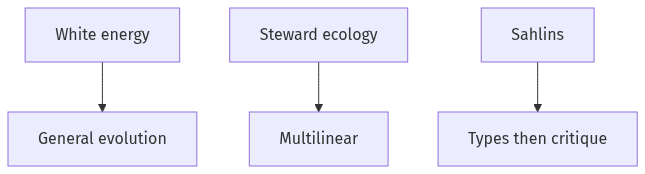
Conclusion
White measured energy, Steward mapped many paths, Sahlins first used neo-evolutionary types and then criticised the reduction of culture to calories. Cultural evolution after Boas is plural.
Quick related
Students also ask
-
Is White the same as Morgan?
Both are general evolutionists. White’s metric is energy, not kinship stages of savagery.
-
Did Sahlins abandon evolution?
He abandoned simple material ranking. He did not abandon history.
Same topic · past papers
UPSC has asked this before
These previous-year questions sit on the same topic. Open one to practise the earlier ask.
-
2026 · Q6(b) · Anthropology GS 1 · 15 marks
Critically discuss how culture determines human behaviour in the light of Leslie White's theory
More from this topic
Q6(b) · UPSC Mains 2026 · Anthropology GS 1 · 15 marks · Solution
Critically discuss how culture determines human behaviour in the light of Leslie White's theory
Neo-evolutionism (Childe, White, Steward, Sahlins and Service)
Leslie White saw culture as a superorganic system that shapes behaviour more than individual psychology. His formula E × T = C links energy harnessed and technology to cultural evolution. Technology drives social organisation, which in turn shapes ideology. Strength: a macro framework for comparing societies. Weakness: technological determinism, weak attention to ecology and human agency, and a near-unilinear ladder. Modern anthropology uses White for energy and technology themes but pairs him with multilinear and ecological approaches.