
Revision summary
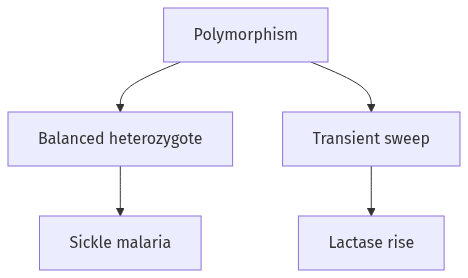
Polymorphism is lasting allelic diversity at one locus. Balanced polymorphism keeps alleles, classically by heterozygote advantage. Sickle-cell and malaria is the human type case. Transient polymorphism is a passing stage while one allele replaces another. Lactase persistence is a human illustration of a sweep still in motion.
Model answer
Copper italics in this answer — like this — are the key facts. Each one is unpacked in the Facts & figures rail.
Introduction
Polymorphism means two or more alleles at one locus stay at frequencies that mutation alone cannot explain. Balanced and transient name two different fates of that variation.
Body
Balanced polymorphism
- Heterozygote advantage holds both alleles. A. C. Allison linked sickle-cell haemoglobin to malaria. AS people resist falciparum; SS is costly; A and S both remain.
- E. B. Ford and R. A. Fisher framed the idea. PTC tasting and some HLA alleles are taught as further human cases, with weaker proof than sickle cell.
- Frequency-dependent selection, as in some immune loci, is another balancing path.
Transient polymorphism
- A new advantageous allele rises and the older one falls. The population is polymorphic only while replacement is unfinished.
- Industrial melanism in Biston betularia, used by Kettlewell, is the animal textbook. In humans, lactase persistence alleles are still spreading in some dairying populations.
Distinction
- Balanced variation is maintained. Transient variation is a stage on the way to fixation or loss.
Flow diagram
Conclusion
Sickle-cell malaria is balanced polymorphism. A sweeping advantageous allele is transient polymorphism. Both produce diversity, but only one is an equilibrium.
Quick related
Students also ask
-
Define genetic polymorphism. Give details of its types with suitable examples
Next question on this syllabus topic (2015 · Q8(b)). View answer →
-
Is all human variation balanced?
No. Most new mutants are lost or, if useful, may sweep. Balance is a special explanation.
-
Does balanced mean good for every person?
No. The SS child pays a cost so that AS resistance can persist in a malarial place.
Same topic · past papers
UPSC has asked this before
These previous-year questions sit on the same topic. Open one to practise the earlier ask.
-
2026 · Q1(d) · Anthropology GS 1 · 10 marks
Genetic polymorphism and natural selection. -
2015 · Q8(b) · Anthropology GS 1 · 15 marks
Define genetic polymorphism. Give details of its types with suitable examples
More from this topic
Q1(d) · UPSC Mains 2026 · Anthropology GS 1 · 10 marks · Solution
Genetic polymorphism and natural selection.
Concept of genetic polymorphism and selection, Mendelian population, Hardy-Weinberg law
Genetic polymorphism is the presence of multiple alleles in a population at frequencies too high for mutation alone.
Q7(b) · UPSC Mains 2023 · Anthropology GS 1 · 15 marks · Solution
What assumptions must be met for a population to be in genetic equilibrium. Explain the importance of genetic equilibrium.
Concept of genetic polymorphism and selection, Mendelian population, Hardy-Weinberg law
Hardy and Weinberg showed that p², 2pq, and q² persist under stated assumptions. Assumptions are large size, random mating, and no mutation, migration, or selection. Equilibrium is the null against which evolution is inferred. Forensics and counselling use it to get genotype frequencies. Sickle-cell selection and isolate inbreeding are standard anthropological departures. Real populations only approximate the model.
Q8(b) · UPSC Mains 2015 · Anthropology GS 1 · 15 marks · Solution
Define genetic polymorphism. Give details of its types with suitable examples
Concept of genetic polymorphism and selection, Mendelian population, Hardy-Weinberg law
Polymorphism is two or more common alleles at a locus. Balanced types include sickle cell and malaria. ABO, Rh, and HLA are serological polymorphisms. SNPs and STRs are DNA types used in medicine and forensics. Most human genetic variation is polymorphic within populations.