
Revision summary
The definition blocks anecdote, presentism, and a West-only sample. Boas and Malinowski made fieldwork and comparison the system. Holism joins bones, tools, words, and institutions. All times and places include fossils and Indian villages alike. Objectivity is method, not innocence about colonial power.
Model answer
Copper italics in this answer — like this — are the key facts. Each one is unpacked in the Facts & figures rail.
Introduction
The sentence is a teaching definition of anthropology as one science of humans. Each adjective blocks a common reduction.
Body
Systematic and objective
- Systematic means comparison, genealogy, excavation, and measurement, not traveller’s anecdote. Franz Boas made method the reply to armchair ranking.
- Objective here means controlled observation and the attempt to separate the ethnographer’s values from the report. It does not mean a view from nowhere. Malinowski’s Trobriand diary later showed the strain.
- Emile Durkheim and Radcliffe-Brown wanted social facts treated as things. Interpretive workers such as Clifford Geertz kept systematic description while reading public meaning.
Holistic, all times, all places
- Holism joins biology, language, archaeology, and social life. A palaeolithic flake, a kinship term, and a haemoglobin allele are one species’ file.
- All times runs from Australopithecus and the Indian palaeolithic to the factory and the clinic.
- All places refuses a civilised-savage split. Boas, Herskovits, and Srinivas at Rampura treated every society as a full case.
Limits of the slogan
- Objectivity is an ethic of method, not a claim that culture has no power. Feminist and postcolonial critique, after Talal Asad and others, showed how colonial offices shaped the archive.
- Holism is a research programme. No monograph covers everything. The argument still holds as a refusal to study only the West, only the present, or only the gene.
Flow diagram
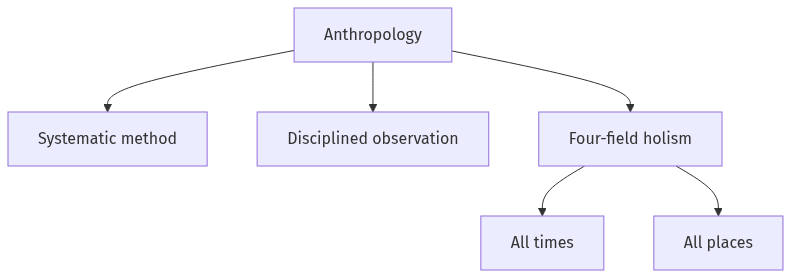
Conclusion
Anthropology is systematic comparison, an effort at disciplined observation, and a four-field holism across time and space. The slogan is a charter. Practice must still name power, history, and the observer.
Quick related
Students also ask
-
Discuss various tools of data collection in conducting anthropological research
Next question on this syllabus topic (2021 · Q8(a)). View answer →
-
Does holistic mean one person does everything?
No. Teams and reading across fields keep holism. The point is not to drop biology or history.
-
Is anthropology only the study of tribes?
No. The charter is humankind. Cities, labs, and courts are inside the same argument.
Same topic · past papers
UPSC has asked this before
These previous-year questions sit on the same topic. Open one to practise the earlier ask.
-
2022 · Q7(b) · Anthropology GS 1 · 15 marks
Write the historical development of field work tradition in anthropology till recent times
More from this topic
Q1(c) · UPSC Mains 2026 · Anthropology GS 1 · 10 marks · Solution
Myth as oral literature.
Tools of data collection
Myth as oral literature represents sacred narratives transmitted across generations through spoken word, embodying cosmological beliefs and social charters of traditional societies. Anthropologists study myths not merely as folklore, but as functional systems that validate social institutions and cultural values. Fieldwork methodologies involving participant observation, audio-visual recording, and contextual analysis are essential for capturing oral texts. Prominent structural and functional perspectives, such as those by Malinowski and Lévi-Strauss, highlight the dual nature of myth as social glue and a logical cognitive model. Preserving oral literature remains critical for safeguarding indigenous heritage and intangible cultural history.
Q1(e) · UPSC Mains 2022 · Anthropology GS 1 · 10 marks · Solution
Participatory Rural Appraisal (PRA) and Participatory Learning and Action (PLA).
Tools of data collection
PRA lets villagers draw maps, seasons, and wealth ranks. Chambers made facilitation the outsider’s job. PLA adds action-reflection loops in health and natural-resource work. The method descends from participant observation. Watch caste and gender capture of the exercise.
Q8(a) · UPSC Mains 2021 · Anthropology GS 1 · 20 marks · Solution
Discuss various tools of data collection in conducting anthropological research
Tools of data collection
Participant observation is the socio-cultural core, after Malinowski. Genealogies, maps, and interviews structure the field diary. Linguistic texts and speech events are data, not extras. Biological anthropology adds measures and genetics; archaeology adds dig and date. Triangulation and ethics decide whether the toolkit is science or extract.