
Key points
Who counts as a minority here
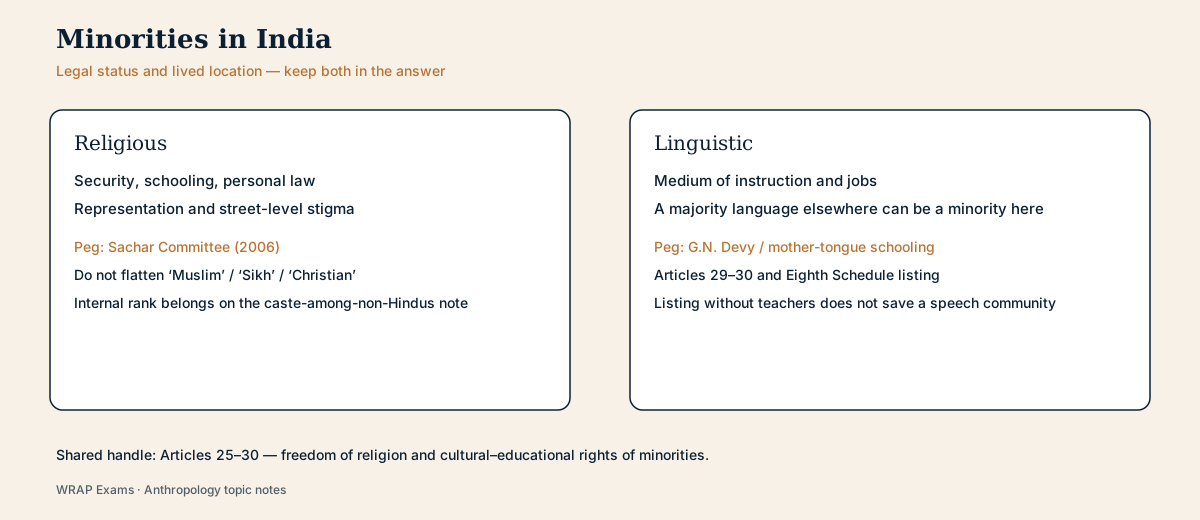
Minority is a legal-political status and a lived social location. Keep the two together in answers.
- Religious minorities in the Constitution are recognised through freedom of religion, educational rights (Articles 25–30) and related statutory bodies — not through a single anthropological essence.
- Linguistic minorities are territorial as well as cultural: a language majority in one state can be a minority in another.
- Anthropology’s job is to show how minority status is lived — in schooling, land, marriage, census categories and street-level stigma — not only listed.
| Axis | Typical concern | Handle in answers |
|---|---|---|
| Religious | Security, representation, personal law, education | Sachar (2006) as evidence of Muslim socio-economic lag, not as a slogan |
| Linguistic | Medium of instruction, jobs, cultural survival | G.N. Devy and language-endangerment work; Eighth Schedule politics |
| Overlap | ST/SC and religious conversion | Do not collapse tribe, caste and minority into one box |
Key points
Religious minorities — teaching points
- Ashutosh Varshney and Christophe Jaffrelot are useful for how riots, polarisation and party systems shape Hindu–Muslim relations — cite as political sociology that anthropologists also use.
- Partha Chatterjee’s line on minorities negotiating national and cultural identity is a short theory hook: community is not outside the nation, it bargains inside it.
- Empirical caution: Sachar Committee (2006) documented high poverty and low literacy among Muslims relative to several other groups — use it as a data peg, then add a local case.
- Caste among Muslims, Sikhs and Christians (ashraf–ajlaf patterns; Dalit Sikhs; church seating) belongs on the caste-among-non-Hindus page; here stress minority rights and security.
Examples
- Pasmanda politics shows intra-Muslim inequality; do not treat ‘Muslim’ as a flat vote or culture.
Field angle
Linguistic minorities
- G.N. Devy’s People’s Linguistic Survey of India work underlines how many mother tongues sit outside school and office Hindi/English.
- Educational marginalisation: a child taught only in an alien medium loses classroom confidence before ‘merit’ is even tested.
- Economic effect: jobs and mobility track the languages of administration; language shift can look like ‘development’ while emptying a speech community.
- Safeguards: Articles 29–30, Eighth Schedule listing, and state language policies — always add that listing does not by itself fund teachers or textbooks.
WRAP Exams coaching notes for UPSC Anthropology optional. Pair with the official syllabus when you need every heading in order.