Profile
Irawati Karve — kinship, caste formation, regional India; Indology meets fieldwork.
- Trained in Germany; worked from Deccan/Pune intellectual base.
- Shelf: kinship zones; caste formation; markets; displacement; inheritance; Yuganta.
Caste formation
- Castes form through multiple processes — tribal incorporation, occupation, sect, migration.
- Rejects single-cause origin; regional history matters.
- Links tribe→caste pathways with cultural absorption themes (compare Bose HMTA).
Weekly markets
- Periodic markets as nodes of rural exchange across caste and village.
- Social information, marriage networks and hierarchy perform in market space.
- Economy is social — not only price signals.
Koyna displaced
- Study of communities displaced by Koyna dam project.
- Development-induced displacement: loss of land, kinship disruption, rehabilitation gaps.
- Early Indian anthropological voice on big-project human cost.
Examples
- Koyna = anthropology of development / displacement case.
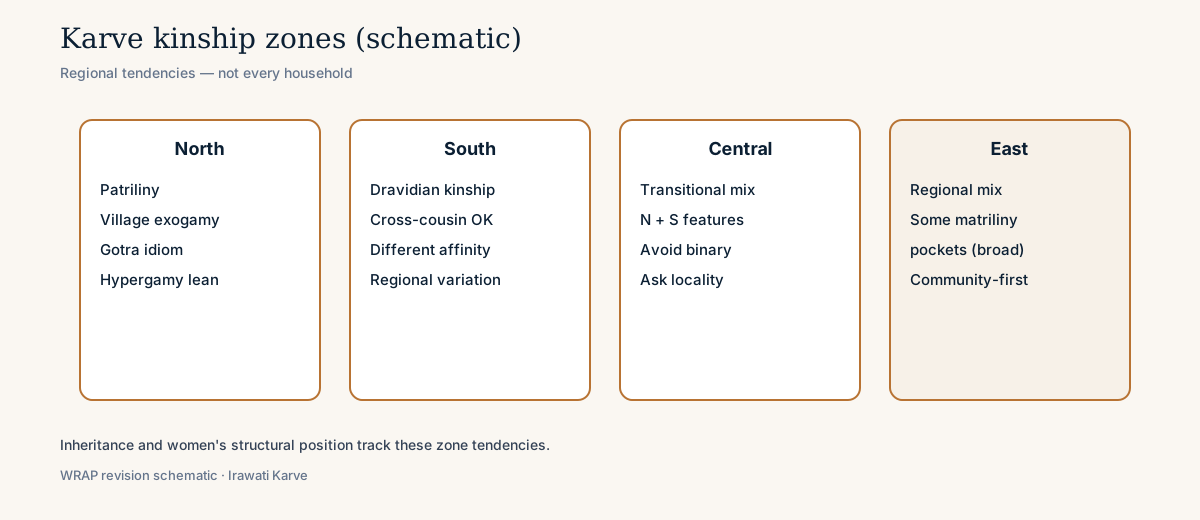
Kinship zones (N / S / C / E)
India is not one kinship template — Karve mapped regional tendencies.
- Northern zone: strong patriliny, village exogamy, gotra idiom, hypergamy tendencies.
- Southern zone: cross-cousin marriage common; different affinity logic; Dravidian kinship.
- Central zone: transitional mix of northern and southern features.
- Eastern zone: further variation; some matrilineal pockets in broader East/NE teaching map.
- Always say 'regional tendencies', never 'every household'.
| Zone | Marriage / descent tendency | Exam hook |
|---|---|---|
| North | Patriliny; village exogamy; gotra | Avoid cousin marriage ideal |
| South | Cross-cousin OK; Dravidian terms | Affinity close, descent varied |
| Central | Mixed / transitional | Do not force N/S binary |
| East | Regional mix; some matriliny pockets | Ask which community |
Inheritance and Phaltan
- Inheritance patterns follow kinship zones — patrilineal land/name vs matrilineal alternatives.
- Phaltan (and Deccan field) used for concrete kinship/caste observation in teaching notes.
- Women's structural dependence often tracks patrilineal property rules.
**Yuganta** themes
- Yuganta: reading Mahabharata characters as human, historical, end-of-an-age.
- Indological imagination — epic as social document of values and gender.
- Shows Karve bridging text and anthropology of Indian civilisation.
Examples
- Draupadi, Kunti, etc. read as social types — not only devotion.
Pair with syllabus short notes for clause-by-clause Paper coverage.