Definition
Definition (exam-ready)
Caste = hereditary, endogamous, ranked social groups with rules of commensality, occupation and ritual status.
- Birth ascribes membership; mobility is group/ideological more than open individual (classical picture).
- Local jati is the lived unit; varna is the ideological fourfold frame.
- Anthropology studies caste as system of relations, not only a list of names.
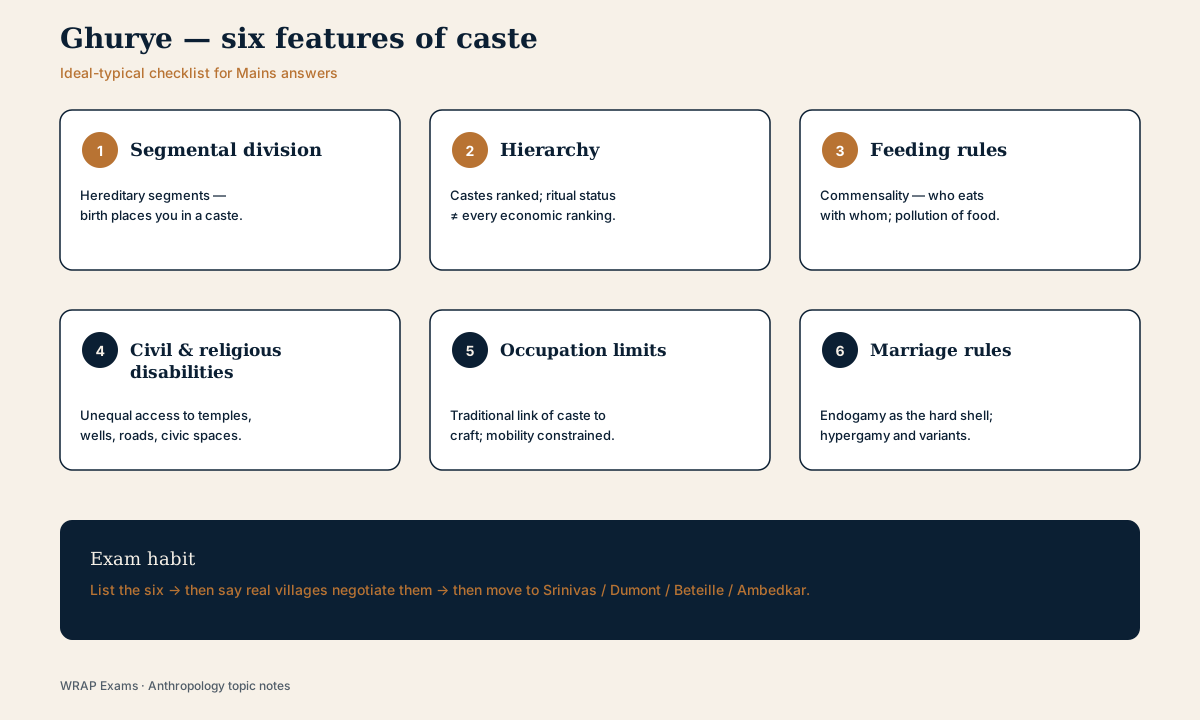
Ghurye's six features
- Segmental division of society
- Hierarchy
- Restrictions on feeding and social intercourse
- Civil and religious disabilities / privileges
- Lack of unrestricted choice of occupation
- Restrictions on marriage (endogamy)
Origin theories
| Theory | Core claim | Watch-out |
|---|---|---|
| Divine / mythical | Purusha Sukta — varna from cosmic body | Ideology, not history |
| Racial (Risley) | Caste = race; nasal index etc. | Influential and deeply criticised |
| Political | Conquest / state freezes ranked groups | Partial |
| Occupational (Nesfield) | Hereditary crafts crystallise castes | Partial |
| Tribal (Majumdar / Karve line) | Tribes drawn into Hindu order become castes | Compare Bose HMTA |
| Composite | Race, occupation, politics, culture intertwine | Safest Mains line |
Attributional vs interactionist
Attributional
- Caste via attributes: purity rules, occupation, ritual markers
- Status listed on the group
- Closer to Indological feature lists
Interactionist
- Caste via relationships: food, marriage, dominance
- Status enacted in interaction
- Closer to village fieldwork
Field examples — Bailey, Mayer, Marriott
- F.G. Bailey: caste and politics/economy in highland Odisha — change and political opportunity.
- Adrian Mayer: caste ranking and village relations in Central India — interaction observed.
- McKim Marriott: attributional vs interactional ranking; food transactions as status currency (India village studies).
- Together: caste is performed in transactions, not only described in shastras.
Examples
- Who accepts whose kachcha/pakka food = living hierarchy test.
- Land + numbers can reorder local rank even if ritual texts lag.
Pair with syllabus short notes for clause-by-clause Paper coverage.