
Revision summary
Rice–wheat and cane have mined soil carbon and micronutrients in U.P. Soil Health Cards show nitrogen bias and missing zinc and organic matter. Fertilizer, diesel, and seed costs have risen faster than many farm-gate prices. Small holdings feel the squeeze first. Sustainability needs balanced nutrients and groundwater care, not only higher grain totals.
Model answer
Introduction
Uttar Pradesh still lives off the plough, but the same plains now show tired soil and dearer seed, diesel, and fertilizer. The statement is therefore a live risk, not a slogan, and analysis must join soil science to the farm bill.
Body
Soil health
- Decades of rice–wheat in the west and cane in the belt have mined organic carbon and left micronutrient gaps that a urea bag does not fill.
- Soil Health Card data have shown nitrogen overuse and missing zinc, sulphur, and organic matter in many districts.
- Groundwater over-pull in western U.P. salts and hardens profiles, which is a soil-health wound as well as a water wound.
- Nilgai and residue burning add physical damage and carbon loss on the same plots.
Rising input cost
- Fertilizer, diesel, labour, and hybrid seed have risen faster than many farm-gate prices, so the surplus of a small holding shrinks even in a decent monsoon.
- Imbalanced NPK, driven by cheap urea relative to phosphate and potash, raises the bill and still starves the soil.
- Custom hiring and power tariffs add to the cash cost of irrigation when tube-wells deepen.
Sustainability threat
- A system that mines soil and buys more input each year is not sustainable, even if foodgrain tonnage still looks large.
- Small and marginal holdings, which dominate U.P., cannot wait out a bad price year, so input inflation becomes an exit pressure.
- Soil Health Cards, micro-nutrient drives, drip in horticulture, and less residue burning are the correct direction, but they are slower than the cost spike.
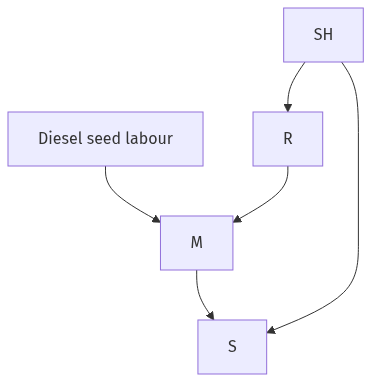
Flow diagram
Conclusion
The statement holds. Tired soil and dearer inputs together squeeze U.P. agriculture, especially on small holdings. Tonnage can still rise for a time, but sustainability needs organic carbon, balanced fertilizer, and cheaper, cleaner irrigation, not only more urea.
Quick related
Students also ask
-
Mention the guidelines of Uttar Pradesh Government for scientific processing and disposal of municipal waste.
Next question in the 2025 paper (Q7). View answer →
-
If foodgrain output is still high, is sustainability already safe?
No. Output can rise while soil carbon and water fall. That is mining, not a steady farm system.
-
Does a Soil Health Card cut the fertilizer bill by itself?
Only if the farmer follows the dose and if phosphate, potash, and organics are available and priced. The card is advice, not a subsidy.
Same topic · past papers
UPPSC has asked this before
These previous-year questions sit on the same topic. Open one to practise the earlier ask.
-
2024 · Q5 · UPGS6 · 8 marks
What are the benefits of commercialization of agriculture in Uttar Pradesh? -
2024 · Q15 · UPGS6 · 12 marks
How can "Million Farmers School Program" and "National Mission on Natural Farming Scheme" become key elements in promoting the commercialization of agriculture in Uttar Pradesh? Give your suggestions. -
2023 · Q1 · UPGS6 · 8 marks
How does the Uttar Pradesh Agriculture Export Policy – 2019 strengthen the agricultural export activities in the State? -
2025 · Q15 · UPGS6 · 12 marks
Discuss how economic progress of Uttar Pradesh is possible through integrated development of agriculture, horticulture, fisheries and allied activities.
More from this paper
Q1 · UPSC Mains 2025 · UPGS6 · 8 marks · Solution
Discuss the recent tax reforms undertaken by the Uttar Pradesh Government.
Public finance and ODOP
U.P. tax reform after GST is mainly stamp duty, electricity duty, SGST incentives, and online commercial tax. Industrial policy uses those three state tools to attract plants. Digitised registration and e-way bills cut compliance delay. Households see stamp-duty concessions more clearly than GST rates, which are Union-led. The state cannot rewrite GST slabs; it can only run administration and property-linked taxes better.
Q2 · UPSC Mains 2025 · UPGS6 · 8 marks · Solution
What is the concept of Invest U.P.? Evaluate its role in the economic development of Uttar Pradesh.
Schemes, skill and investment
Invest U.P. is the state investment promotion agency, not a factory owner. It markets sectors and walks files through Nivesh Mitra. Summits and land banks are the pitch; after-care is the development test. It helps a land-locked state compete on speed of clearance. It cannot substitute power, logistics, or skills.
Q3 · UPSC Mains 2025 · UPGS6 · 8 marks · Solution
What is "Green Star Rating System" launched in 2025?
Economy, budget and industry of UP
U.P. launched a Green Star Rating in 2025 as a state mark for greener buildings and industry. Stars rest on energy, water, and waste performance. The rating is a signal for buyers and departments, not a replacement for pollution law. It has no privately invented ISO number in this answer. Its worth depends on audit, not on the logo alone.