
Revision summary
Small U.P. holdings need horticulture, fish, and dairy beside grain. ODOP names a district product so integration can be marketed. Cold chain and food parks turn glut into GSDP. Residue–dung–biogas is the circular farm loop. Without vets, coolers, and roads, integration stays a pamphlet.
Model answer
Introduction
A grain-only plains economy plateaus. Uttar Pradesh’s next farm rupee sits in horticulture, milk, fish, goat, and processing joined to the same holding. Integration is the method; ODOP and food parks are the public tools.
Body
Why integration
- Small holdings cannot live on wheat and paddy procurement alone when input costs rise; a mango orchard, a pond, or a buffalo fills the calendar.
- Horticulture in Bundelkhand, Gorakhpur, and western mango–guava belts needs cold chain, not only a tree.
- Fisheries in ponds and reservoirs, including Bundelkhand tanks and eastern floodplain pits, add protein and cash with less land.
- Dairy and goatery already exist as allied activity; integration means feed, vet, and bulk-milk coolers, not a stray animal.
How the pieces join
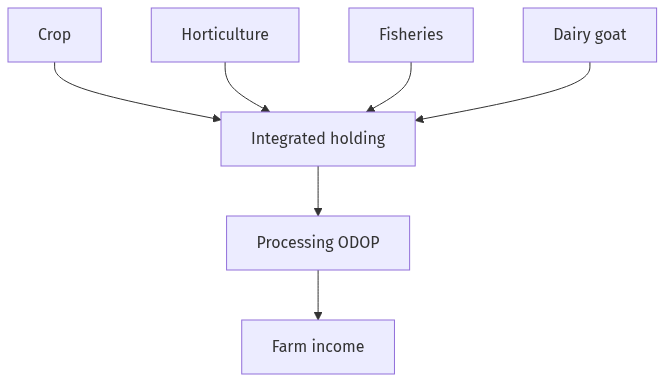
- Crop residue and cane tops can feed cattle; dung returns as biogas and manure, which is the farm circular loop.
- ODOP gives each district a product identity — mango, potato, fish, or jaggery — so that integration has a market name.
- Food processing and mega food parks turn a glut week into a packaged year, which is how horticulture becomes GSDP, not roadside waste.
- Women SHGs in dairy, mushroom, and backyard poultry are the labour that integration actually uses.
Progress test
- Progress is diversification of income and nutrition, not only a higher wheat total.
- Without roads, power for cold rooms, and veterinary time, integration is a pamphlet.
Flow diagram
Conclusion
Integrated agri, horticulture, fisheries, and allied activities can raise U.P. farm incomes on small plots. ODOP, dairy, and processing are the joiners. Grain remains the base; the extra rupee is the orchard, the pond, and the cooler.
Quick related
Students also ask
-
Evaluate the crop insurance schemes and their impact on agricultural risk management in Uttar Pradesh.
Next question in the 2025 paper (Q16). View answer →
-
Does integration mean giving up wheat and rice?
No. It means adding orchard, pond, and animal income around the grain base, especially on small holdings.
-
Is ODOP enough without a cold chain?
No. A district brand without storage and processing still dumps fruit in a glut week.
Same topic · past papers
UPPSC has asked this before
These previous-year questions sit on the same topic. Open one to practise the earlier ask.
More from this paper
Q1 · UPSC Mains 2025 · UPGS6 · 8 marks · Solution
Discuss the recent tax reforms undertaken by the Uttar Pradesh Government.
Public finance and ODOP
U.P. tax reform after GST is mainly stamp duty, electricity duty, SGST incentives, and online commercial tax. Industrial policy uses those three state tools to attract plants. Digitised registration and e-way bills cut compliance delay. Households see stamp-duty concessions more clearly than GST rates, which are Union-led. The state cannot rewrite GST slabs; it can only run administration and property-linked taxes better.
Q2 · UPSC Mains 2025 · UPGS6 · 8 marks · Solution
What is the concept of Invest U.P.? Evaluate its role in the economic development of Uttar Pradesh.
Schemes, skill and investment
Invest U.P. is the state investment promotion agency, not a factory owner. It markets sectors and walks files through Nivesh Mitra. Summits and land banks are the pitch; after-care is the development test. It helps a land-locked state compete on speed of clearance. It cannot substitute power, logistics, or skills.
Q3 · UPSC Mains 2025 · UPGS6 · 8 marks · Solution
What is "Green Star Rating System" launched in 2025?
Economy, budget and industry of UP
U.P. launched a Green Star Rating in 2025 as a state mark for greener buildings and industry. Stars rest on energy, water, and waste performance. The rating is a signal for buyers and departments, not a replacement for pollution law. It has no privately invented ISO number in this answer. Its worth depends on audit, not on the logo alone.