
Revision summary
DST is the Union department that funds national S&T infrastructure. FIST is a central scheme that upgrades university department labs, including in U.P. hosts. SATHI is a central scheme for shared sophisticated analytical facilities. U.P. institutions host some of these; the schemes are not state programmes. Innovation impact is measurement, training, and MSME testing access if booking is open.
Model answer
Introduction
Innovation needs instruments, not only a syllabus. The Department of Science and Technology of the Union Ministry of Science and Technology funds FIST and SATHI as central schemes. Universities and institutes in Uttar Pradesh host some of those facilities; the schemes themselves are not state plans.
Body
DST
- The Department of Science and Technology designs national S&T infrastructure, fellowships, and mission calls.
- State science councils and universities in U.P. plug into DST calls; Lucknow and campus labs do not replace DST, they receive it.
- DST’s value in U.P. is a pipeline: equipment, people, and a national peer review that a single state budget rarely matches.
FIST
- FIST is the Fund for Improvement of S&T Infrastructure in universities and higher-education departments.
- It pays for departmental instruments, networks, and modest renovation so that a chemistry or physics department can actually measure, not only lecture.
- U.P. universities that win FIST grants host those instruments; the grant remains a central competitive scheme.
- Innovation impact is graduate training and faculty papers that can later feed industry only if a transfer office exists.
SATHI
- SATHI, Sophisticated Analytical and Technical Help Institutes, builds shared high-end analytical facilities that many colleges cannot buy alone.
- A SATHI host, including in a U.P. institution where awarded, offers booking of NMR, microscopy, and related tools to a region, not only to one department.
- Banaras Hindu University’s SATHI-type shared facility is the clearest U.P. example of a central sophisticated-instrument host serving surrounding researchers.
- Industry MSMEs can use such cores for testing if access rules allow, which is how a central lab becomes a state innovation service.
Role in U.P. innovation
- These facilities raise the floor of experimental science in a large teaching state.
- They do not by themselves create a semiconductor fab or a defence OEM; they create measurement and people.
- The correct statement in an answer is: central schemes, U.P. campuses as hosts, statewide users if access is open.
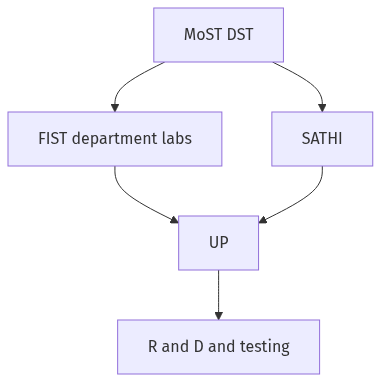
Flow diagram
Conclusion
DST funds national S&T. FIST upgrades university departments. SATHI shares high-end analytical machines. In U.P. they matter because campuses host them and nearby researchers book them. They are central MoST schemes, not Lucknow-branded parks, and they support innovation by measurement, not by slogan.
Quick related
Students also ask
-
Highlight the holistic vision of transforming Uttar Pradesh into a digitally empowered society and a leading investment destination.
Next question in the 2025 paper (Q20). View answer →
-
Are FIST and SATHI Uttar Pradesh government schemes?
No. They are central MoST/DST schemes. U.P. institutions compete to host facilities and then serve users.
-
Does a FIST grant equal a full research university?
No. It upgrades a department’s kit and network. Faculty, students, and industry links still decide innovation.
Same topic · past papers
UPPSC has asked this before
These previous-year questions sit on the same topic. Open one to practise the earlier ask.
More from this paper
Q1 · UPSC Mains 2025 · UPGS6 · 8 marks · Solution
Discuss the recent tax reforms undertaken by the Uttar Pradesh Government.
Public finance and ODOP
U.P. tax reform after GST is mainly stamp duty, electricity duty, SGST incentives, and online commercial tax. Industrial policy uses those three state tools to attract plants. Digitised registration and e-way bills cut compliance delay. Households see stamp-duty concessions more clearly than GST rates, which are Union-led. The state cannot rewrite GST slabs; it can only run administration and property-linked taxes better.
Q2 · UPSC Mains 2025 · UPGS6 · 8 marks · Solution
What is the concept of Invest U.P.? Evaluate its role in the economic development of Uttar Pradesh.
Schemes, skill and investment
Invest U.P. is the state investment promotion agency, not a factory owner. It markets sectors and walks files through Nivesh Mitra. Summits and land banks are the pitch; after-care is the development test. It helps a land-locked state compete on speed of clearance. It cannot substitute power, logistics, or skills.
Q3 · UPSC Mains 2025 · UPGS6 · 8 marks · Solution
What is "Green Star Rating System" launched in 2025?
Economy, budget and industry of UP
U.P. launched a Green Star Rating in 2025 as a state mark for greener buildings and industry. Stars rest on energy, water, and waste performance. The rating is a signal for buyers and departments, not a replacement for pollution law. It has no privately invented ISO number in this answer. Its worth depends on audit, not on the logo alone.