
Revision summary
Self-regulation is steering one’s own conduct without waiting for punishment. Workplaces need it because supervision cannot sit at every desk. Components include awareness, observation, goals, impulse control, and use of feedback. Public office especially needs work that continues because the citizen is waiting. Fear produces short compliance; habit and fair appraisal produce performance.
Model answer
Introduction
Self-regulation is the capacity to notice, steer, and correct one’s own conduct without waiting for a scolding. Workplace performance depends on it as much as on skill.
Body
Role
- A workplace cannot station a supervisor at every desk, so output and civility rest on people who can govern their impulses.
- Self-regulation converts a service rule from an external threat into an inner habit, which reduces both delay and misconduct.
- It protects colleagues from mood, gossip, and harassment, which are performance costs even when the file is technically done.
- In public office it is the difference between working when the inspector is present and working because the citizen is waiting.
Components
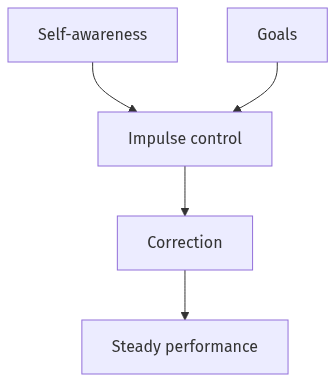
- Self-awareness is knowing one’s triggers, biases, and limits, including fatigue and prejudice in a hearing.
- Self-observation is watching one’s own delay, tone, and accuracy during the day, not only in an annual appraisal.
- Goal setting is choosing a clear, lawful target for the day’s files instead of drifting with the inbox.
- Impulse control is postponing anger, a gift, or a shortcut until the rule is checked.
- Corrective feedback is using error, complaint, and audit as fuel to change the next act, not as a wound to hide.
Link to performance
- Teams with these components finish work with fewer reworks, fewer leaks, and fewer grievances.
- Training, peer example, and fair appraisal can strengthen self-regulation; fear alone produces only short compliance.
Flow diagram
Conclusion
Self-regulation is inner governance of attention, impulse, and correction. Its components make workplace performance steady when the supervisor is not in the room.
Quick related
Students also ask
-
"Emotional intelligence is the ability to make your emotions work for you instead of against you." Do you agree with this statement? Discuss.
Next question in the 2025 paper (Q7). View answer →
-
Is self-regulation the same as obedience?
No. Obedience can be fear of the boss. Self-regulation can also refuse an unlawful shortcut.
-
Can a toxic office destroy self-regulation?
Chronic unfairness weakens it. Clear goals, fair appraisal, and example from seniors can still rebuild it.
Same topic · past papers
UPPSC has asked this before
These previous-year questions sit on the same topic. Open one to practise the earlier ask.
More from this paper
Q1 · UPSC Mains 2025 · UPGS4 · 8 marks · Solution
Defining value; explain the distinctive features of human values and the role of the family in inculcating these values.
Civil Service aptitude and values
A value is a stable standard that guides worthy choice, not a passing mood. Human values are taught, claim universal worth, join conscience to conduct, and can be justified in public. The family is the first school of trust, empathy, and honour through daily example. A closed home can also plant prejudice, so the family’s power is not automatically ethical. Later schools and offices confirm or correct that first map.
Q2 · UPSC Mains 2025 · UPGS4 · 8 marks · Solution
Evaluate the contemporary relevance of Chanakya's life and thoughts in the context of ethical and people-centric governance.
Emotional Intelligence
Kautilya judges the ruler by the happiness and security of subjects. Yogakshema, a tested service, and honest accounts remain usable tests of ethical administration. Danda is lawful restraint of the strong, not personal cruelty. A democracy cannot import palace deceit; rights and publicity now bind the officer. The living lesson is welfare plus fiscal integrity under the Constitution.
Q3 · UPSC Mains 2025 · UPGS4 · 8 marks · Solution
Discuss the Aristotelian view of virtues and its application in administrative affairs.
Emotional Intelligence
Aristotle’s moral virtue is a stable habit of the mean, learned by practice. Courage, temperance, and justice are civic virtues an officer must show in files, not only in speech. Phronesis is practical wisdom that finds the right mean in a live case. Administration applies this as honest noting, fiscal restraint, and equal treatment. Office culture can train vice; example and rules can still rebuild the mean.