
Revision summary
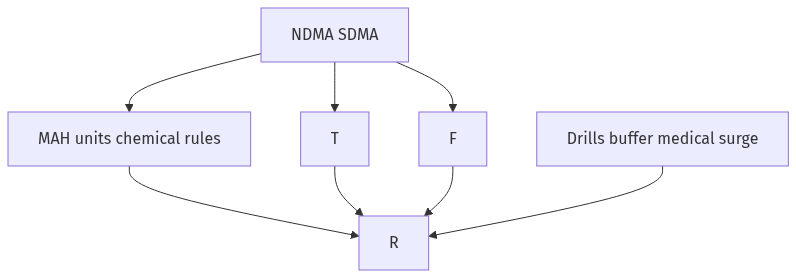
Man-made disasters come from plants, terror, and fire, and they are largely preventable. Hazardous-chemical rules, the Factories Act, and MAH mapping are the industrial core. NDMA guidelines must become inspections and mock drills, not shelf text. Terror risk needs intelligence, precursor control, and protected crowded places. Fire risk needs building-code enforcement, hydrants, and professional fire services.
Model answer
Introduction
Man-made disasters are preventable harm from plants, bombs, and fire. India already has NDMA guidelines and factory law. The strategy is to make those rules live on the shop floor and in the city, not only in a manual.
Body
Industrial accidents
- Enforce the Factories Act, the Manufacture, Storage and Import of Hazardous Chemical Rules, and on-site / off-site emergency plans required after Bhopal.
- Map MAH (major accident hazard) units, run mock drills, and keep buffer zones so that housing does not sit on a leak path.
- NDMA chemical-disaster guidelines plus State Disaster Management Authorities must inspect, not only draft.
Terrorist attacks
- Intelligence fusion, urban CCTV with rights limits, and protection of crowded soft targets (stations, markets, festivals) cut mass-casualty risk.
- Coastal and aviation security, and control of explosives precursors, shrink the tool kit.
- Community reporting and fast medical surge matter as much as a commando unit after the first minutes.
Fires
- National Building Code fire norms, working hydrants, and licensed electrical load are cheaper than a high-rise funeral.
- Professional fire services, industrial fire tenders, and public education on crowding in marriage halls and hospitals are the city half of the same file.
Cross-cutting tools are land-use zoning, one-incident command, and insurance that actually pays only if drills were real.
Flow diagram
Conclusion
Industrial, terror, and fire risk fall when law, drills, intelligence, and fire services operate as one system. NDMA and factory-chemical rules already exist; the effective strategy is compliance, buffers, and practised emergency medical care.
Quick related
Students also ask
-
Did India copy CIMAH by that name?
The Control of Industrial Major Accident Hazards idea is in Indian chemical rules and MAH mapping, not always under the UK CIMAH label.
-
Are mock drills enough?
Only if buffer zones, hydrants, and hospitals are real. A drill on paper does not stop a leak.
Same topic · past papers
UPPSC has asked this before
These previous-year questions sit on the same topic. Open one to practise the earlier ask.
More from this paper
Q1 · UPSC Mains 2025 · UPGS3 · 8 marks · Solution
Identify the critical challenges faced by the handicraft industries in India and discuss their challenges.
Food processing
Handicrafts are large in jobs but weak in organisation. Costly inputs, middlemen, and machine-made copies cut the artisan’s price. Credit, GST paperwork, and export compliance are hard for household units. GI tags and e-commerce help some clusters, not the whole sector. The challenge is to move skill, credit, and direct sale to the maker.
Q2 · UPSC Mains 2025 · UPGS3 · 8 marks · Solution
"Construction of new airports will facilitate industrialization and development in India." Examine.
Infrastructure
Airports can shorten time to markets and support logistics jobs. UDAN tries to spread air access beyond metros. Land, wetlands, and noise are real costs of greenfield sites. Thin traffic means some airports need heavy subsidy and still do not pull factories. Industrialisation needs hinterland demand, not only a terminal.
Q3 · UPSC Mains 2025 · UPGS3 · 8 marks · Solution
Discuss the concept of unemployment in India as developed by National Sample Survey Office (NSSO).
Poverty, unemployment and inclusive growth
India measures unemployment on more than one reference period because work is often casual. Usual status (ps and ps+ss) uses the last year and usually gives the lowest rate. Current weekly status uses the last seven days. Current daily status counts person-days and captures underemployment. PLFS is the present NSO survey that carries these NSSO concepts.