
Revision summary
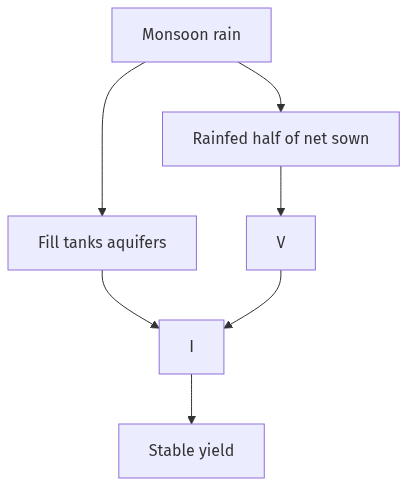
Most of India’s rain comes in the south-west monsoon, so timing shocks hit the crop fast. About half of net sown area is irrigated; the other half is rainfed. Irrigated land still needs rain to recharge wells and reservoirs. PMKSY and micro-irrigation stretch scarce water rather than replace the monsoon. Rainfall and irrigation are complementary insurance, not two rival systems.
Model answer
Introduction
Indian farming still lives on a four-month monsoon and on irrigation that covers only about half of the net sown area. Rainfall and canals or wells are therefore not substitutes. They complete each other when the weather slips.
Body
Weather vulnerability
- A large share of annual rain falls in the south-west monsoon, so a late onset, a long break, or an early withdrawal hits sowing and yield in the same season.
- About half of India’s net sown area is irrigated; the rest is rainfed and takes the first shock of a weak monsoon.
- Even irrigated tracts depend on rainfall to recharge groundwater and to fill reservoirs, so a dry year raises diesel bills and empties tanks.
Why the two are complementary
- Irrigation is insurance: it keeps a crop alive in a dry spell. Rainfall is the cheap bulk water that fills the system.
- Micro-irrigation under PMKSY (including the per-drop-more-crop window) raises the value of a scarce tank or tube well instead of replacing rain.
- Accelerated Irrigation Benefit Programme works and watershed projects try to store rain so that irrigation is not only a deep well.
- Round figures from agriculture censuses and Economic Surveys have long shown that irrigated yields are higher and more stable, while rainfed districts swing with El Niño and break-monsoon weeks.
- The data lesson is simple: expand irrigation and still respect rain, because neither source alone carries Indian agriculture.
Flow diagram
Conclusion
Agriculture is weather-vulnerable because roughly half the net sown area is still rainfed and the monsoon is bunched. Irrigation complements rainfall as insurance and storage; PMKSY and micro-irrigation make that insurance less wasteful.
Quick related
Students also ask
-
What is meant by income inequality? How can income inequality be minimised in India?
Next question in the 2025 paper (Q12). View answer →
-
If irrigation expands, does the monsoon stop mattering?
No. Reservoirs and groundwater still refill from rain. A weak monsoon raises irrigation cost and empties stores.
-
Is the irrigated share three-quarters?
No. The well-known national picture is still about half of net sown area under irrigation, with wide state variation.
Same topic · past papers
UPPSC has asked this before
These previous-year questions sit on the same topic. Open one to practise the earlier ask.
More from this paper
Q1 · UPSC Mains 2025 · UPGS3 · 8 marks · Solution
Identify the critical challenges faced by the handicraft industries in India and discuss their challenges.
Food processing
Handicrafts are large in jobs but weak in organisation. Costly inputs, middlemen, and machine-made copies cut the artisan’s price. Credit, GST paperwork, and export compliance are hard for household units. GI tags and e-commerce help some clusters, not the whole sector. The challenge is to move skill, credit, and direct sale to the maker.
Q2 · UPSC Mains 2025 · UPGS3 · 8 marks · Solution
"Construction of new airports will facilitate industrialization and development in India." Examine.
Infrastructure
Airports can shorten time to markets and support logistics jobs. UDAN tries to spread air access beyond metros. Land, wetlands, and noise are real costs of greenfield sites. Thin traffic means some airports need heavy subsidy and still do not pull factories. Industrialisation needs hinterland demand, not only a terminal.
Q3 · UPSC Mains 2025 · UPGS3 · 8 marks · Solution
Discuss the concept of unemployment in India as developed by National Sample Survey Office (NSSO).
Poverty, unemployment and inclusive growth
India measures unemployment on more than one reference period because work is often casual. Usual status (ps and ps+ss) uses the last year and usually gives the lowest rate. Current weekly status uses the last seven days. Current daily status counts person-days and captures underemployment. PLFS is the present NSO survey that carries these NSSO concepts.