
Revision summary
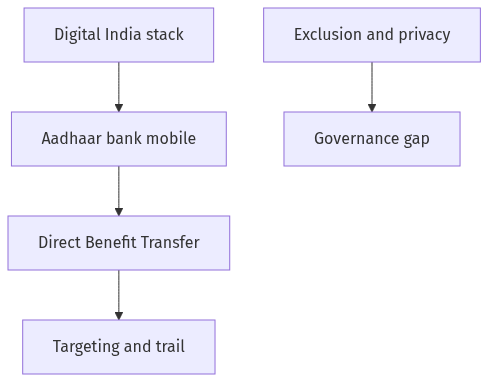
DBT pays entitlements into Aadhaar-linked accounts instead of long office chains. It uses the Digital India stack: identity, PFMS, banks, and mobiles. Good governance gains are fewer ghosts, a visible trail, and faster credit in schemes such as PAHAL. Exclusion from biometrics or connectivity is the matching risk. The 2023 data-protection law is the statutory frame for the identity data DBT uses.
Model answer
Introduction
Direct Benefit Transfer pays a subsidy or scholarship into an identified account instead of through a long chain of offices. That design matches Digital India infrastructure and the good-governance tests of targeting, speed, and a recorded trail.
Body
Alignment with Digital India
- Digital India promised identity, online services, and connectivity; DBT uses Aadhaar, bank accounts, and mobile as the JAM trinity to move money.
- PFMS and scheme dashboards make the same payment visible to the Union and the State, which is a digital ledger, not a file lost in a block office.
- DigiLocker and online KYC cut repeat paper, so DBT is not an isolated payment gadget but part of the same stack.
Alignment with good governance
- Good governance asks for the right person, the right amount, and a grievance path; seeding and bank transfer attack ghost and duplicate entries that cash and kind chains allowed.
- PAHAL for LPG and similar transfers showed that a subsidy can be a credit, which is transparent in the account statement.
- Time-bound credit and fewer middlemen match the citizen-charter idea of a published, checkable service.
Critical frictions
- Exclusion of a genuine beneficiary when biometrics fail or an account is dormant is a governance failure, not a rounding error.
- Connectivity and literacy gaps mean Digital India is uneven, so DBT can punish the poorest first.
- Authentication data raises privacy questions that the Digital Personal Data Protection Act, 2023, now frames in statute.
- Not every subsidy should be cash; food and public goods still need in-kind capacity beside transfer.
Analysis
- DBT aligns with Digital India as the payment layer of identity-plus-bank-plus-mobile.
- It aligns with good governance when inclusion errors are fixed as seriously as leakage; otherwise it is efficiency for the already documented.
Flow diagram
Conclusion
DBT is the money-end of Digital India and a practical tool of good governance in targeted schemes. Alignment is strong on leakage and trail, and it is incomplete until exclusion, privacy, and last-mile help are treated as equal tests.
Quick related
Students also ask
-
Examine the emerging dimensions of e-governance and explain how they contribute to making government services more accessible, transparent and efficient.
Next question in the 2025 paper (Q16). View answer →
-
Does DBT abolish the need for ration shops?
No. Many food schemes still use in-kind delivery. DBT is one instrument; public goods and PDS capacity remain.
-
Is every Aadhaar failure a proof that DBT is illegitimate?
No. It is proof that seeding and fallback must be designed. Leakage control does not justify silent exclusion.
Same topic · past papers
UPPSC has asked this before
These previous-year questions sit on the same topic. Open one to practise the earlier ask.
More from this paper
Q1 · UPSC Mains 2025 · UPGS2 · 8 marks · Solution
What role do Joint Parliamentary Committees (JPCs) play in the Indian legislative process? How do they contribute to effective law-making? Analyse.
Parliament and State legislatures
A JPC is an ad hoc joint committee used for complex bills or major controversies. It gathers evidence that floor debate cannot gather at the same depth. Reports have shaped later drafting after inquiries such as Bofors and 2G. The committee cannot enact law; the Houses may still ignore the report. Effective law-making follows only when Parliament uses that record to amend the bill.
Q2 · UPSC Mains 2025 · UPGS2 · 8 marks · Solution
How does Alternative Dispute Resolution (ADR) strengthen efficient governance and enhance the effectiveness of the justice delivery system in India? Analyze.
Separation of powers
Section 89 CPC and the 1996 Arbitration Act, with the 2023 Mediation Act, give ADR a legal base. Lok Adalats under the 1987 Legal Services Authorities Act clear compoundable claims in bulk. Governance gains when contracts and welfare complaints do not wait years for a trial. Justice delivery gains only if weaker parties are not forced into unfair bargains. Courts remain necessary for crime and for constitutional rights.
Q3 · UPSC Mains 2025 · UPGS2 · 8 marks · Solution
"Legislature is supreme within its domain, yet it is not sovereign." Examine this statement in the constitutional context with examples.
Indian Constitution
Articles 245 and 246 make a legislature supreme on its constitutional list. Kesavananda and Minerva Mills deny unlimited amending power. Articles 13, 32, and 226 allow courts to void unconstitutional statutes. The NJAC judgment is an example of a constitutional amendment falling to basic structure review. India follows constitutional supremacy, not British parliamentary sovereignty.