
Revision summary
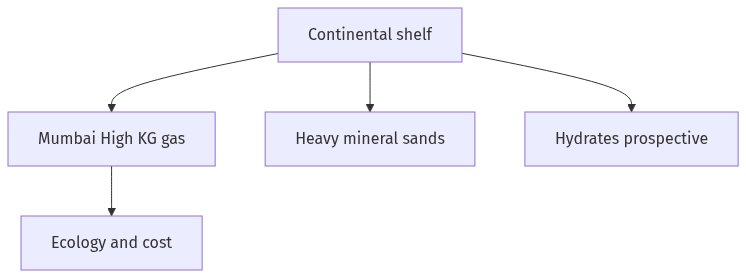
The shelf is the shallow seabed around India and the islands. Mumbai High is the principal offshore oil example on the western shelf. The KG basin is the principal eastern gas example, with a mixed production history. Kerala–Tamil Nadu–Odisha placers hold ilmenite, rutile, zircon, and monazite. Gas hydrates are still largely prospective. Ecology and UNCLOS rights condition what can actually be lifted.
Model answer
Introduction
The continental shelf is the shallow seabed around the peninsula and the islands. It does hold minerals and energy, and a critical examination must separate producing fields from hopeful maps.
Body
Energy on the shelf
- Mumbai High, discovered in 1974, is the main example of offshore petroleum on India’s western shelf.
- The Krishna–Godavari basin on the eastern shelf has gas and oil in deeper water, including the KG-D6 field, which showed both promise and later decline.
- Coal-bed and gas-hydrate prospects have been surveyed on the shelf and slope; hydrate is still largely a research resource, not a producing one.
- Offshore wind is an energy use of the shelf surface, not a mineral, but it is part of the same maritime energy store.
Minerals
- Placers of heavy minerals such as ilmenite, rutile, zircon, and monazite occur in Kerala, Tamil Nadu, and Odisha beach and nearshore sands.
- Phosphorite and some polymetallic signs are reported on parts of the western shelf, with more nodule interest on the deep ocean floor beyond the shelf.
- Construction sand and lime shell have been taken from some nearshore areas, which is a mineral use with high ecological cost.
Critical examination
- The statement is true for petroleum, gas, and heavy-mineral sands that are already produced.
- It is only partly true for hydrates and many phosphorite maps, which remain prospective.
- Storms, coral, turtle nesting, and fishery grounds limit where extraction is wise, so a storehouse is not an open warehouse.
- UNCLOS gives a coastal state sovereign rights over shelf resources, and India has submitted extended-shelf claims, which is law, not yet extra oil in the tank.
Examples to keep
- Mumbai High shows a real energy store.
- Chavara and Manavalakurichi sands show a real mineral store.
- KG basin shows that a store can decline if geology and management disappoint.
Flow diagram
Conclusion
India’s continental shelf is a storehouse of petroleum, gas, and heavy-mineral sands in proven belts. The statement becomes weak if it treats hydrates and every map anomaly as the same as Mumbai High, or if it ignores fishery and reef limits on extraction.
Quick related
Students also ask
-
Differentiate between frontiers and boundaries and present a detailed account on the types of boundaries giving suitable examples from the Indian subcontinent.
Next question in the 2025 paper (Q20). View answer →
-
Is the deep ocean the same as the continental shelf?
No. The shelf is the shallow submerged margin. Nodules of the deep ocean floor lie beyond it, in a different legal and technical zone.
-
Does a storehouse mean easy extraction?
No. Cost, storms, reefs, and fisheries decide what is lifted. Prospective hydrates are not yet a store in production.
Same topic · past papers
UPPSC has asked this before
These previous-year questions sit on the same topic. Open one to practise the earlier ask.
-
2019 · Q20 · UPGS1 · 12 marks
Critically examine the oceanic energy resources and their potentialities on the coast zone of India. -
2025 · Q20 · UPGS1 · 12 marks
Differentiate between frontiers and boundaries and present a detailed account on the types of boundaries giving suitable examples from the Indian subcontinent. -
2022 · Q9 · UPGS1 · 8 marks
Give an account of Irrigation Projects of Uttar Pradesh in detail with suitable examples. -
2019 · Q10 · UPGS1 · 8 marks
Give an account of Minor Irrigation Projects of Uttar Pradesh with suitable examples. -
2018 · Q15 · UPGS1 · 12 marks
Discuss the impact of globalization on the status of women in Indian society by citing suitable examples.
More from this paper
Q1 · UPSC Mains 2025 · UPGS1 · 8 marks · Solution
Comment briefly on the development of art and technology during the Maurya period.
Indian culture
Mauryan art is court stone: edict pillars, the Sarnath lion capital, yaksha figures, Barabar caves, and early stupas. Mauryan technology is iron, state mines, punch-marked coins, roads, wells, and the Sudarshana lake begun under Pushyagupta. Both grew under one imperial administration from Chandragupta to Ashoka.
Q2 · UPSC Mains 2025 · UPGS1 · 8 marks · Solution
"Women's issue was a major concern in the socio-religious reform movements of 19th century India." Explain.
Women, population and associated issues
Reformers treated women’s status as a public test of social change in the nineteenth century. Sati was prohibited in Bengal Presidency in 1829 after Rammohan Roy’s campaign. The Hindu Widows’ Remarriage Act, 1856, followed Vidyasagar’s work. Phule schools and later women writers showed that education and household power were part of the same question. Child marriage remained contested in the Age of Consent debates of 1891.
Q3 · UPSC Mains 2025 · UPGS1 · 8 marks · Solution
"Extremism was a reaction against the ideas and modus operandi of the moderates." Critically explain this statement.
Modern Indian history
Moderates trusted petitions, councils, and British public opinion. The 1905 partition and failed prayers pushed Tilak, Pal, and Lajpat Rai toward Swaraj, boycott, and Swadeshi. Surat 1907 displayed the clash of methods inside Congress. Extremism also had a constructive Swadeshi programme, so it was not only a reaction. Later nationalism combined constitutional work with mass pressure.