
Revision summary
U.S. reciprocal tariffs in 2025 threatened both Indian and EU exports and compressed FTA timelines. The partnership already includes TTC, climate talk, student mobility and a values vocabulary. Friction remains on agriculture, data, CBAM, Russia and human-rights politics. Directionally closer is true; a finished trade-and-tech pole is not yet true. India–EU is the best Western hedge if Washington stays protectionist, not a substitute for U.S. defence enablers.
Model answer
Copper italics in this answer — like this — are the key facts. Each one is unpacked in the Facts & figures rail.
Introduction
Trump-era reciprocal tariffs in 2025 threatened both Indian exports and the European Union’s Atlantic market. Shared pain is a diplomat’s opportunity. India and the EU were already negotiating a trade and investment package that had stalled since the late 2000s. The tariff shock did push them closer. Evaluation must ask: closer to what — a deal, a technology club, or a press conference?
Body
The push
When the United States prices market access as a political favour, second-largest relationships gain value. The EU needs buyers for cars, machinery and green tech. India needs capital, chips, and a hedge against a protectionist Washington. The Trade and Technology Council (TTC), resumed FTA/BIT/GIs talks, and cooperation on CBAM explanations are the bureaucratic face of the jolt. Q4(c)’s European defence-industrial awakening and Q6(b)’s FOIP connectivity meet here: Europe looking east, India looking for rules that are not only American.
What the partnership already is
- It is a values-adjacent relationship: democracy, a talk of rules, climate diplomacy, and student mobility. It is a market relationship still below potential — cars, spirits, dairy, data and procurement are the usual fight. It is a strategic relationship in infancy: maritime exercises with France more than with ‘Brussels’; Germany’s times-turn is national. On Russia, Brussels wanted condemnation India would not give; the partnership survived by compartmentalisation. Human rights and agri-standards will remain European domestic politics, not a footnote.
Grade
The statement is fair as direction. Tariff threats compressed timelines and created a shared narrative of ‘we are not vassals of the White House’. It is too strong as achievement until a FTA text is signed and until European capital shows up in Indian manufacturing at China-replacing scale. Carbon border taxes can still look, from Delhi, like green protectionism. From Brussels, Indian tariffs and quality control can look like the old Licence Raj in a new badge.
- A realistic evaluation: India–EU is the most plausible Western hedge if the U.S. stays tariff-nationalist. It will not replace the U.S. in defence enablers or the Gulf in energy. Closer, yes. A finished pole, not yet.
Flow diagram
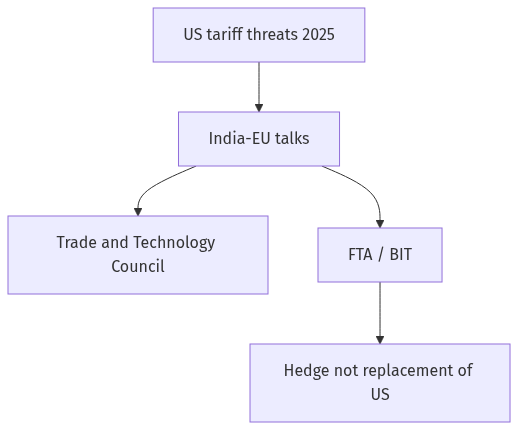
Conclusion
Tariff threats pushed India and the EU into each other’s arms as markets and as rule-seekers. The partnership is real in talks and in TTC. It becomes historic only when a trade deal and technology transfer survive the next domestic veto on both sides.
Quick related
Students also ask
-
Trump's unilateral imposition of reciprocal tariffs on scores of countries poses impending threat to the future of the rule-based multilateral global trading system under the WTO. What options do the WTO members have to salvage the organization?
Next question on this syllabus topic (2025 · Q7(b)). View answer →
-
Did tariffs alone create the India–EU opening?
No. China+1, Ukraine energy shock and Modi’s Europe tours predated 2025. Tariffs were an accelerant.
-
Will a FTA ignore farmers?
Not in a year of elections on either side. Dairy and agriculture will be carved, delayed, or compensated — the usual political economy.
Same topic · past papers
UPSC has asked this before
These previous-year questions sit on the same topic. Open one to practise the earlier ask.
-
2025 · Q1(c) · PSIR GS 2 · 10 marks
Explain the non-traditional security threats in the context of food and environmental crises.
More from this topic
Q7(a) · UPSC Mains 2026 · PSIR GS 2 · 20 marks · Solution
How does illegal cross border migration pose challenges to India's security? Discuss the steps taken by the government in this direction and their effectiveness
Comparative Politics
Illegal cross-border migration undermines India's national security by altering demographic balances, straining economic resources, and exacerbating internal security vulnerabilities. The government has responded through border fencing, technological integration like SMART fencing, institutional mechanisms, and bilateral agreements. However, porous terrain, regional political complexities, and local connivance limit the complete effectiveness of these measures. A holistic approach combining strict border management with socio-economic development and robust legal frameworks is essential for sustainable containment.
Q5(d) · UPSC Mains 2026 · PSIR GS 2 · 10 marks · Solution
Discuss the main features of the land-boundary agreement between India and Bangladesh.
Comparative Politics
• Operationalized via the 100th Constitutional Amendment Act of 2015 to resolve Radcliffe Line anomalies. • Rooted in the unratified 1974 bilateral agreement and the 2011 additional protocol. • Involved the peaceful exchange of 111 Indian enclaves in Bangladesh and 51 Bangladeshi enclaves in India. • Granted affected residents the sovereign right to choose their nationality and place of residence. • Demarcated roughly 6.1 km of previously un-demarcated land boundaries to end administrative confusion. • Secured human rights and welfare access for over 50,000 formerly stateless enclave residents. • Reduced bilateral trust deficits, paving the way for deeper cooperation in security and connectivity.
Q4(c) · UPSC Mains 2026 · PSIR GS 2 · 15 marks · Solution
What is UNCLOS? Explain its salient features
Comparative Politics
UNCLOS, established in 1982, serves as the constitution of the oceans, codifying customary international law regarding maritime jurisdictions. Its salient features include distinct maritime zones ranging from territorial waters to the high seas, balancing coastal state sovereignty with freedom of navigation. It establishes compulsory dispute settlement mechanisms through institutions like ITLOS. The convention also mandates environmental protection and sustainable management of marine resources. For India, UNCLOS provides a rules-based order in the Indo-Pacific while respecting navigational rights. It remains central to addressing contemporary maritime security and resource challenges.