
Revision summary
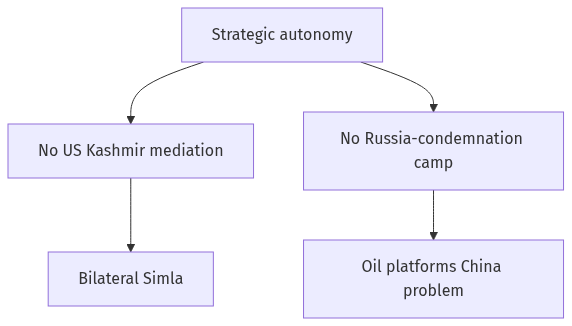
Strategic autonomy means India will not outsource core security choices to a patron. Kashmir is treated as bilateral; U.S. mediation offers are refused, especially after terror shocks such as Pahalgam. On Ukraine, India avoids Western condemnation blocs while buying oil and keeping Russian platforms, without endorsing conquest. The two refusals share a doctrine but not the same moral file. This is NonAlignment 2.0 practice: partners, not instructors.
Model answer
Copper italics in this answer — like this — are the key facts. Each one is unpacked in the Facts & figures rail.
Introduction
Strategic autonomy is India’s long habit of refusing to outsource core security choices. It is not isolation. It is not a treaty alliance. In the 2020s it is tested on two loud files: U.S. offers to mediate on Kashmir, and Western pressure to denounce Russia over Ukraine. Delhi’s double refusal is the question’s fact. The comment is that this is autonomy as issue-based stubbornness, not a claim that the two wars are the same.
Body
Kashmir and mediation
India holds that Jammu and Kashmir is a bilateral matter with Pakistan, framed by Simla (1972) and Lahore (1999), not a trusteeship of Washington. After Pahalgam 2025, any U.S. presidential offer of good offices would look, in Indian politics, like a reward to terror’s sponsors. Autonomy here is domestic legitimacy plus legal position. The United States is a Quad partner; it is not a Kashmir referee. Accepting mediation would reopen internationalisation that Delhi has spent decades closing. Hyper-realist signalling and autonomy meet on this point.
Russia and Ukraine
India abstained in several UN votes, raised dialogue and diplomacy, increased discounted oil, and kept defence-spares logic alive because the Indian arsenal is still partly Russian. History — 1971, the Cold War veto — still counts in the bureaucracy. Autonomy here is material: you cannot condemn your mechanic in the middle of a two-front problem with China. It is also diplomatic: a Global South that remembers Iraq and Libya will not be lectured into a NATO morality play. This is not approval of the invasion. Jaishankar has said territory should not be changed by force. It is a refusal to let Brussels or Washington write India’s communiqué.
Comment
The two refusals sit in one doctrine and differ in ethics. Kashmir mediation is a sovereignty red line about India’s own territory and a terror context. Ukraine is someone else’s war in which India is a customer and a fence-sitter with a China problem. Treating them as identical ‘plague on both houses’ would be cynical. Treating autonomy as a blank cheque for any great-power violence would be worse. The mature line: India will take U.S. technology and Russian hydrocarbons, and will not take instruction on either file. That is energetic, sometimes cold, strategic autonomy. It is consistent with NonAlignment 2.0 more than with NAM theatre.
Flow diagram
Conclusion
Rejecting U.S. Kashmir mediation and refusing to join a Russia-condemnation bloc are one autonomy, two tests. The first is a territorial red line. The second is a material and Global South hedge. Neither makes India a U.S. ally or a Russian client.
Quick related
Students also ask
-
Critically examine the continuity and change in India's Palestine policy in the wake of the ongoing Israel-Hamas War.
Next question on this syllabus topic (2024 · Q8(a)). View answer →
-
Is this equidistance?
No. India is closer to the U.S. on China and the Indo-Pacific, and closer to Russia on platforms. Autonomy is the right to be uneven.
-
Could mediation ever be useful?
Quiet crisis communication is not the same as a public U.S. broker on Kashmir. Delhi will take the first and reject the second.
Same topic · past papers
UPSC has asked this before
These previous-year questions sit on the same topic. Open one to practise the earlier ask.
-
2022 · Q8(a) · PSIR GS 2 · 20 marks
How does India-Israel bilateral ties reflect the autonomy of India's foreign policy choices?
More from this topic
Q6(b) · UPSC Mains 2025 · PSIR GS 2 · 15 marks · Solution
India maintains strong ties with countries that will assure a free and open Indo-Pacific and guarantee greater connectivity with rest of the world. Analyze
Indian Foreign Policy
FOIP for India is an open maritime order, not a Chinese lake or a U.S. private canal. Core partners: Japan, the United States, Australia, France and ASEAN; Quad is the sharpest minilateral. Connectivity — SAGAR, IPOI, IMEC, Chabahar, INSTC, digital public goods — is the other half of ‘assurance’. The strategy is sound; neighbourhood leakage and thin shipyard capacity make it incomplete. A portfolio of partners, not one ally, is the actual policy.
Q8(a) · UPSC Mains 2024 · PSIR GS 2 · 20 marks · Solution
Critically examine the continuity and change in India's Palestine policy in the wake of the ongoing Israel-Hamas War.
Indian Foreign Policy
Baseline India policy was anti-colonial support for Palestine, two states, and UN voting with the South. From the 1990s–2010s India de-hyphenated and built defence and technology ties with Israel. After October 2023 India condemned Hamas’s terror quickly and kept humanitarian and two-state language as the war widened. Continuity is the diplomatic formula; change is partner hierarchy and the terror frame. Critical need: keep both sentences, because dropping either one breaks either the South or India’s own terrorism diplomacy.
Q8(a) · UPSC Mains 2023 · PSIR GS 2 · 20 marks · Solution
What are the external determinants of the Foreign Policy of a State?
Indian Foreign Policy
External determinants are systemic power, geography, economic dependence, and international institutions. Waltz and Mearsheimer emphasise anarchy and great-power threat; Keohane adds regimes and interdependence. Cox adds the hegemonic structure of ideas and production. India’s live external set includes China, Pakistan, Myanmar 2021, Afghanistan 2021, and sanctions maps. Governments still choose among constrained options, which is why multi-alignment is a policy, not a geography.