
Revision summary
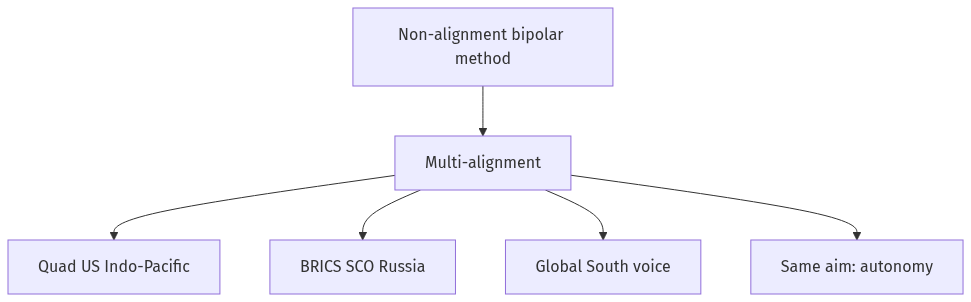
Non-alignment was no-camp autonomy in a bipolar world; multi-alignment is many partnerships at once in a multipolar one. India’s Quad and U.S. pacts would have broken NAM orthodoxy; BRICS, SCO and Russia keep the other side of the ledger. The aim remains strategic autonomy, as in NonAlignment 2.0. ‘Debunk’ overstates: the method has been updated, the aim has not been ridiculed. Agree on the pursuit of multi-alignment; reject a cartoon of India mocking Nehru.
Model answer
Copper italics in this answer — like this — are the key facts. Each one is unpacked in the Facts & figures rail.
Introduction
Non-alignment was India’s Cold War doctrine: no military camp, voice for the South, room to deal with both blocs. Multi-alignment is the present practice: many partnerships at once, including security minilaterals with the United States. The statement that India has debunked non-alignment in pursuit of multi-alignment captures a real shift. The verb debunk is too theatrical. India has re-tooled autonomy, not mocked its own past in a seminar.
Body
What has changed
India sits in the Quad with three U.S. allies, holds 2+2s with Washington, and uses Indo-Pacific language (5(d)). That would have been unintelligible as NAM orthodoxy. At the same time it sits in BRICS and the SCO with China and Russia, buys discounted oil, and refuses a Ukraine condemnation camp (the autonomy of 7(c)). It convenes the Voice of Global South. This is issue-based coalitions, which S. Jaishankar has named in public. It matches the partial neoliberal turn of 6(a): markets and U.S. technology without a treaty.
Multi-alignment is not equidistance. It is the right to be closer to Washington on China and closer to Moscow on platforms, in the same year.
What has not been debunked
India still will not sign a NATO-like alliance (7(c)). It still uses NAM membership and South language when useful. The end — strategic autonomy in a hierarchical world — is Nehruvian even when the means are minilateral. NonAlignment 2.0 already wrote this in 2012. To say India has ‘debunked’ non-alignment is to confuse instrument with aim. The instrument of a 120-member movement as the first tool has been set down. The aim of not being a junior ally has not.
Comment
Agree that multi-alignment is the pursuit. Disagree that non-alignment has been thrown out as a false theory. NAM was a method for bipolarity. Bipolarity ended. The successor method is multi-alignment. Continuity is autonomy. Change is the willingness to join the Quad without calling it a camp. An honest comment uses those two sentences, not a culture-war word like debunk.
Flow diagram
Conclusion
- India pursues multi-alignment: Quad and the United States beside BRICS, SCO and Russia, plus a Global South voice. That is not classical NAM theatre. It is still autonomy. Non-alignment has been superseded as method. It has not been exposed as a fraud. Multi-alignment is the update, not the funeral oration.
Quick related
Students also ask
-
Quadrilateral Security Dialogue (QUAD) performs an important role in India's strategic balancing act to withstand the dominance of China in Asia. Discuss
Next question on this syllabus topic (2023 · Q6(c)). View answer →
-
Did India leave NAM?
No. It de-emphasised it. Membership without doctrinal centrality is the fact.
-
Is multi-alignment just opportunism?
It can look like that. The doctrine’s defence is that a rising state in a fluid order must keep several doors open. Opportunism is the insult; autonomy is the claim.
Same topic · past papers
UPSC has asked this before
These previous-year questions sit on the same topic. Open one to practise the earlier ask.
-
2026 · Q7(c) · PSIR GS 2 · 15 marks
India has adopted multi-alignment to fulfill its core values and interests in international relations. Discuss
More from this topic
Q5(a) · UPSC Mains 2026 · PSIR GS 2 · 10 marks · Solution
Describe India's objections to agricultural negotiations at the World Trade Organisation.
India’s Contribution to the Non-Alignment Movement
India's objections at WTO agricultural negotiations stem from protecting livelihood security for over 800 million rural citizens against subsidized Western agricultural exports. Key sticking points include the Peace Clause ambiguity regarding public stockholding for food security, lack of permanent solutions for domestic support limits, and safeguarding Special Safeguard Mechanisms against import surges. India balances defensive multilateral interests in plurilateral trade forums while championing Global South coalitions like the G-33. The strategy prioritizes food sovereignty over unfettered market access in developing country agriculture.
Q8(c) · UPSC Mains 2025 · PSIR GS 2 · 15 marks · Solution
Discuss the potential role India can play in initiating a possible phase of trilateral economic engagement among India, China and Nepal
India’s Contribution to the Non-Alignment Movement
Map-logic supports India–China–Nepal talks on hydropower, trade, tourism and Himalayan disasters. The trust deficit is structural: LAC after Galwan, BRI in Nepal, and Kalapani–Lipulekh map fights. Nepal will omni-enmesh; Delhi cannot veto that without pushing Kathmandu further toward Beijing. India’s realistic role is initiator of thin technical engagement, not chair of a Himalayan concert. Grade potential as moderate and politically capped — the same honesty used for Latin American regionalism.
Q6(a) · UPSC Mains 2025 · PSIR GS 2 · 20 marks · Solution
Critically analyze the different phases of India's foreign policy since independence. How justified, do you think, is S. Jaishankar's classification of the current phase as the phase of 'energetic diplomacy'? 15+5=
India’s Contribution to the Non-Alignment Movement
Phases: Nehruvian NAM, post-1962/1971 realism, 1991 economic opening, 1998 nuclear break, U.S. civil nuclear bargain, then Modi-era multi-alignment. The core across phases is strategic autonomy, not a simple Nehru-to-neoliberal conversion. Jaishankar’s energetic diplomacy fairly describes tempo: G20, minilaterals, argumentative Global South voice. It is weaker as a claim of structural success: LAC, Bangladesh and industrial depth still bind. Treat ‘energetic’ as method, not as a new telos.