
Revision summary
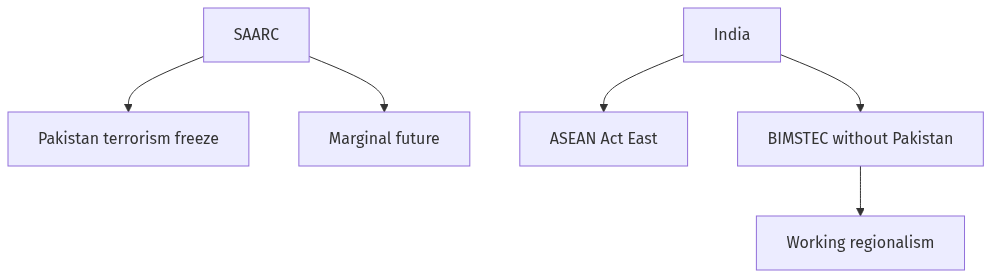
SAARC aimed at South Asian cooperation but stalled because of India–Pakistan hostility and terrorism-related diplomatic freeze. ASEAN is India’s Act East and Indo-Pacific diplomatic centre. BIMSTEC offers Bay of Bengal connectivity without Pakistan. India is practising variable geometry, not a formal abolition of SAARC. SAARC’s future is frozen and technical at best unless the Pakistan political file changes.
Model answer
Copper italics in this answer — like this — are the key facts. Each one is unpacked in the Facts & figures rail.
Introduction
SAARC was meant to be South Asia’s regional club: trade, people and a soft security community among India and its neighbours, with Pakistan inside the room. India’s increased focus on ASEAN and BIMSTEC is a response to SAARC’s political freeze. The future of SAARC is therefore the future of a body that still exists on paper and barely works in practice.
Body
Why SAARC stalled
The South Asian Association for Regional Cooperation never matched ASEAN’s convening success or the EU’s legal depth (4(c)). India–Pakistan hostility, especially after cross-border terrorism and the post-2016 diplomatic freeze, made summits impossible. Connectivity and a serious free-trade practice could not outrun the security veto. Smaller members feared Indian dominance; India feared a ganging-up with extra-regional players. SAARC became a lowest-common-denominator calendar.
ASEAN and BIMSTEC as substitutes
ASEAN is the diplomatic centre of Act East and of the Indo-Pacific claim in 5(d). It offers markets, a China-balancing room, and a method (consensus) that does not require Pakistan. BIMSTEC (Bay of Bengal Initiative) links India to Bangladesh, Myanmar, Sri Lanka, Thailand, Nepal and Bhutan — the eastern and Bay neighbourhood without Pakistan. Energy, coastal shipping and the northeast’s outlet are the practical files. For Delhi, BIMSTEC is SAARC minus the blockage, plus a Southeast Asian hinge.
- This is rational variable geometry. It is also a signal to Islamabad: regionalism will proceed around you. Neighbours still use SAARC language when they want a South Asian roof that includes Pakistan. They use BIMSTEC when they want projects.
Future of SAARC
Legal death is unlikely; no member wants the funeral. Functional future is poor unless India–Pakistan politics thaw, which is not the 2020s baseline. SAARC may survive as a humanitarian and technical label (health, standards) and as a dormant summit. India’s primary regional bets will remain BIMSTEC, ASEAN, IORA and bilateral neighbourhood first. The honest discussion: SAARC’s future is marginal, not resurrected, unless the Pakistan file changes. India should not spend political capital pretending otherwise, and should not insult smaller members who still value a South Asian name.
Flow diagram
Conclusion
SAARC stalled on the India–Pakistan security veto. ASEAN and BIMSTEC give India working regionalism aligned with Act East and the Bay of Bengal. SAARC will likely remain a frozen brand rather than a dead treaty. Its future is limited unless politics with Pakistan change.
Quick related
Students also ask
-
Can SAARC work on non-political issues?
In theory yes (health, culture). In practice even those files need meetings and visas that the political freeze damages.
-
Does BIMSTEC replace SAARC for Nepal and Bhutan?
It supplements. Those states still live in a South Asian security space. BIMSTEC is the project vehicle India prefers.
Same topic · past papers
UPSC has asked this before
These previous-year questions sit on the same topic. Open one to practise the earlier ask.