
Revision summary
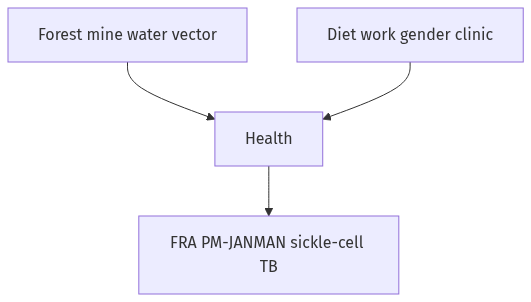
Environmental loads include malaria, mining dust, indoor smoke, iodine and water, plus displacement from dams and parks. Biocultural loads include shrinking forest diets, migration-TB, gender and fertility, medical pluralism and sickle-cell without counselling. Xaxa and the tribal health expert group asked for local cadres and disease-specific work, not a single plains protocol. PM-JANMAN, sickle-cell mission, Nikshay, POSHAN and Jal Jeevan matter only if hamlets are reached in their language. Forest rights are nutrition rights.
Model answer
Copper italics in this answer — like this — are the key facts. Each one is unpacked in the Facts & figures rail.
Introduction
Tribal health in India is not a single disease. It is the meeting of forest, water, mine and altitude with work, food, marriage and the clinic. Environmental and biocultural factors act together, which is why anaemia, malaria, tuberculosis, addiction and undernutrition cluster in Scheduled Tribe districts.
Body
Environmental factors
- Many ST habitats are hilly, forested or mining belts: malaria and other vector diseases in Bastar, Mayurbhanj, the Terai and the North-East; fluorosis or laterite anaemia in pockets; iodine deficiency in some Himalayan and North-Eastern hills; respiratory load from indoor smoke and from coal and silica dust in Jharkhand and Chhattisgarh. Displacement to dam and park edges cuts access to forest foods and clean water. Climate stress — irregular rain, failed mahua and tendu years — shows up as lean-season hunger.
Wildlife sanctuaries and tiger reserves can criminalise movement to clinics and to shifting plots. The Forest Rights Act, 2006 and the Supreme Court’s later FRA-related orders sit in this health story: mobility and grove rights are also nutrition rights.
Biocultural factors
Jhum and forest diets (millet, tuber, leafy greens, hunted or river protein) can be balanced when the forest is intact and lean when it is not. Cash-crop and PDS rice substitution has reduced dietary width. Early marriage, repeated pregnancy and low birth weight among some groups, documented in NFHS ST tables, are kinship and gender facts, not “tribal nature”.
- Work: migrant brick-kiln and construction labour from western Odisha and southern Rajasthan spreads TB and breaks treatment. Alcohol and, in some North-Eastern and central belts, injecting drug use, add HIV and hepatitis risk. Medical pluralism — gunia, herbalist, church prayer, ANM — shapes when a child reaches a PHC.
Stigma and language at the PHC delay care. Sickle-cell in Gond, Pawra and other central Indian groups is a genetic fact that becomes a health disaster only when screening and counselling are absent.
Interaction and public action
The Bhore Committee already said environment and poverty make disease. The Xaxa Committee (2014) and the Expert Committee on Tribal Health (Ministry of Health and MoTA, 2018, chaired in the public telling by experts including tribal physicians) asked for local cadres, respectful delivery, sickle-cell and malaria specials, and warned against a single national menu.
- Schemes that matter on the ground: National Sickle Cell Anaemia Elimination Mission, Nikshay for TB, POSHAN Abhiyaan and PM POSHAN, Jal Jeevan for water, PM-JANMAN for PVTG habitations (housing, piped water, health outreach), Ayushman Bharat cards that still fail when Aadhaar and hamlet addresses do not match. PESA Gram Sabha can site anganwadis; it cannot by itself staff a doctor.
- A biocultural reading says: restore forest foods and FRA, staff the last mile in the local language, screen sickle-cell, and stop treating undernutrition as a character flaw of the tribe.
Flow diagram
Conclusion
Environment supplies vectors, dust, altitude and broken forests. Culture supplies diet, work, gender and the path to the clinic. Tribal health improves when FRA, PESA, sickle-cell missions and PVTG outreach treat both together.
Quick related
Students also ask
-
Elucidate the role of demographic and social factors for population growth in India
Next question on this syllabus topic (2025 · Q4(b)). View answer →
-
Is tribal ill-health mainly genetic?
A few conditions such as sickle-cell have a genetic base. Most of the burden is infection, undernutrition, work and failed public services.
-
How does FRA change health?
Community forest rights restore foods, medicines and mobility. Eviction without rights does the opposite.
Same topic · past papers
UPSC has asked this before
These previous-year questions sit on the same topic. Open one to practise the earlier ask.
-
2022 · Q8(c) · Anthropology GS 2 · 15 marks
How can a balance be struck between livelihood concern and environmental degradation in the context of shifting cultivation?
More from this topic
Q4(b) · UPSC Mains 2026 · Anthropology GS 2 · 15 marks · Solution
Why have the classifications of Indian populations, based on somatometric and somatoscopic characteristics, failed to develop a common understanding of the population diversity?
Demographic profile of India
• Early classifications used body measurements (somatometry) and visual traits (somatoscopy) to group Indians into rigid racial categories. • These methods failed because physical traits are subjective, easily influenced by the environment, and overlap heavily across different groups. • Static racial models ignored India's indigenous evolution, long-term gene flow, and continuous biological variation. • Centuries of social mixing, migration, and endogamy created complex hybrid populations that defied pure typological grouping. • Modern DNA research proves there is deep genetic continuity beneath superficial physical differences across Indian groups. • Anthropology has now shifted away from outdated racial types toward dynamic studies of population genetics and linguistics.
Q8(c) · UPSC Mains 2025 · Anthropology GS 2 · 15 marks · Solution
What are the identifying criteria for PVTGs in India? Examine their current status, nomenclature and distribution
Demographic profile of India
PVTGs are a vulnerable subset of STs, about 75 groups, identified on pre-agricultural livelihood, lagging population and literacy. The name changed from Primitive Tribal Groups to drop a colonial adjective. Distribution: mainland scatters plus Andaman isolates with a separate contact ethic. PM-JANMAN, older CCD plans, FRA habitat rights and Niyamgiri are the status markers. Gaps: missed hamlets, standard housing, weak habitat titles.
Q4(b) · UPSC Mains 2025 · Anthropology GS 2 · 15 marks · Solution
Elucidate the role of demographic and social factors for population growth in India
Demographic profile of India
Demographic factors: falling mortality, delayed fertility decline, young age structure and momentum. Social factors: early marriage, son preference, class and region, women’s education and work. NFHS shows convergence, with remaining high-fertility pockets. NPP 2000, Mission Parivar Vikas and girls’ education are the humane policy line; Emergency coercion is the warning. Javed (2003) allowed two-child rules for panchayat office; the social cost is still debated.