
Revision summary
India nears replacement fertility with momentum still adding people, then ageing. The next fifty years bring jobs for youth, care for the old, north–south political imbalance, urban migration and gender gaps. Tribal and poor child undernutrition remains a biocultural failure inside the same story. Emergency coercion and Malthusian panic are the wrong tools. Household education, women’s work and social security are the anthropological policy line.
Model answer
Copper italics in this answer — like this — are the key facts. Each one is unpacked in the Facts & figures rail.
Introduction
India is leaving a long era of rapid population growth and entering a divided half-century: more workers in some states, more elderly in others, more cities, and a still-skewed child sex ratio in parts of the north-west. The challenges of the next fifty years are about age structure, care, migration and inequality, not only about a national headcount.
Body
Where the dynamics stand
Census 2011 and NFHS-5 show a total fertility rate near or below replacement in many southern and western states, with higher fertility still in parts of the Hindi belt, though falling. Population momentum from a young age pyramid will add people for decades even at replacement fertility. Life expectancy has risen; infant mortality has fallen. The child sex ratio remains adverse where son preference and sex selection persist. Urbanisation and internal migration (Bihar–UP to Delhi and Mumbai, east to Kerala, tribal belts to brick kilns) already reshape households.
- UN and national projections toward 2070 commonly show India ageing: a larger share above sixty, a shrinking child share, and a south that ages first. Absolute numbers may peak then decline slowly. These are projections, not fate; they depend on education, contraception and mortality shocks (COVID-19 showed that).
Challenges of the next fifty years
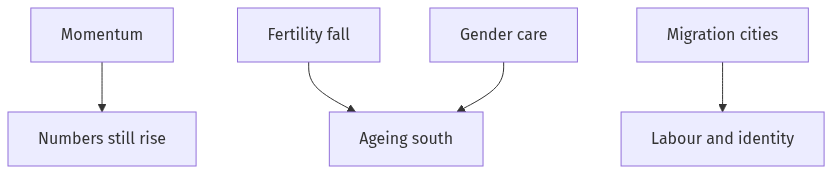
Employment and the youth bulge. Northern states will still send young workers. If jobs are informal and urban housing is slum-based, the “dividend” is a political risk. Caste and ST/SC school gaps decide who captures formal work.
Ageing and care. Kerala, Tamil Nadu and later Bengal will need pensions, geriatrics and kin care when daughters-in-law are themselves workers. Anthropology of the joint family (Irawati Karve, A. M. Shah) matters: the family cannot automatically absorb elder care. Transnational care chains (nurses abroad) already exist.
Regional imbalance. Delimitation after the freeze on Lok Sabha seats will pit high-fertility north against low-fertility south. This is a federal demographic conflict, not a technical footnote.
Gender. Missing women, widowhood, and unpaid care will shape the half-century. A two-child political norm, where revived, collides with reproductive rights and with minority and tribal fears of counting.
Health and environment. Stunting among tribal and poor children, non-communicable disease in ageing cities, heat and water stress, and megacity air are biocultural problems. COVID-19 showed that migrant workers and slum density are demographic facts.
Migration and identity. Assam, Bengaluru and Delhi politics already treat migrants as ethnic others. Ethno-nationalism (a later question on this paper) will use numbers. Tribal areas may empty of youth while census ST shares shift through listing politics.
Data. Without a delayed Census completed and without civil registration that covers hamlets, policy will fly blind. Digital population registers raise the ethics named in 4(a): counting must not become exclusion.
Anthropological stance
Malthusian panic and Emergency sterilisation are the two failed grammars. Household strategy — son, school fee, land fragment, bride-price or dowry — is the unit. Srinivas’s mobility and Vidyarthi’s tribal transformation both predict that fertility falls when the forest or the field no longer rewards extra hands and when women stay in school. Policy that is health, education, childcare and old-age security matches that ethnography. Policy that only preaches small families does not.
Flow diagram
Conclusion
The next fifty years will test whether India can employ a still-large youth cohort, care for a growing old cohort, and share political power across regions with different fertility histories. The demographic challenge is social organisation, not a single national birth rate.
Quick related
Students also ask
-
Safeguards for linguistic minorities in India
Next question on this syllabus topic (2022 · Q1(d)). View answer →
-
Will India’s population keep exploding for fifty years?
Growth is slowing. Momentum adds numbers for a time; ageing and possible peak-then-decline are the newer problems.
-
Is religion the main driver of future numbers?
No. Education, mortality, age structure and region explain more. Differentials exist and have been narrowing in NFHS rounds.
Same topic · past papers
UPSC has asked this before
These previous-year questions sit on the same topic. Open one to practise the earlier ask.
-
2025 · Q4(b) · Anthropology GS 2 · 15 marks
Elucidate the role of demographic and social factors for population growth in India
More from this topic
Q4(b) · UPSC Mains 2026 · Anthropology GS 2 · 15 marks · Solution
Why have the classifications of Indian populations, based on somatometric and somatoscopic characteristics, failed to develop a common understanding of the population diversity?
Demographic profile of India
• Early classifications used body measurements (somatometry) and visual traits (somatoscopy) to group Indians into rigid racial categories. • These methods failed because physical traits are subjective, easily influenced by the environment, and overlap heavily across different groups. • Static racial models ignored India's indigenous evolution, long-term gene flow, and continuous biological variation. • Centuries of social mixing, migration, and endogamy created complex hybrid populations that defied pure typological grouping. • Modern DNA research proves there is deep genetic continuity beneath superficial physical differences across Indian groups. • Anthropology has now shifted away from outdated racial types toward dynamic studies of population genetics and linguistics.
Q8(c) · UPSC Mains 2025 · Anthropology GS 2 · 15 marks · Solution
What are the identifying criteria for PVTGs in India? Examine their current status, nomenclature and distribution
Demographic profile of India
PVTGs are a vulnerable subset of STs, about 75 groups, identified on pre-agricultural livelihood, lagging population and literacy. The name changed from Primitive Tribal Groups to drop a colonial adjective. Distribution: mainland scatters plus Andaman isolates with a separate contact ethic. PM-JANMAN, older CCD plans, FRA habitat rights and Niyamgiri are the status markers. Gaps: missed hamlets, standard housing, weak habitat titles.
Q4(b) · UPSC Mains 2025 · Anthropology GS 2 · 15 marks · Solution
Elucidate the role of demographic and social factors for population growth in India
Demographic profile of India
Demographic factors: falling mortality, delayed fertility decline, young age structure and momentum. Social factors: early marriage, son preference, class and region, women’s education and work. NFHS shows convergence, with remaining high-fertility pockets. NPP 2000, Mission Parivar Vikas and girls’ education are the humane policy line; Emergency coercion is the warning. Javed (2003) allowed two-child rules for panchayat office; the social cost is still debated.