
Revision summary
A theocratic state derives sovereignty and law from the sacred and from priestly or god-king office. A secular liberal democracy derives them from a constitution, rights and contested elections. Tribal illustrations are sacral chiefs, priest-dairymen and sacred mountains, not full modern theocracies. India is designed as the second type; custom under PESA is subordinate to Fundamental Rights. Fundamentalism is the project of closing that gap toward sacred coercion.
Model answer
Copper italics in this answer — like this — are the key facts. Each one is unpacked in the Facts & figures rail.
Introduction
A theocratic state claims that sovereign authority is divine and that law is first a sacred code administered by priests or by a ruler as god’s deputy. A secular, liberal, democratic state claims that sovereignty is popular, that law is human and revisable, that religions are plural and that individuals have rights against the majority. Anthropology compares how each produces legitimacy, not which temple is true.
Body
Theocratic authority
In a theocracy, office is sacred. The Egyptian pharaoh, early Tibetan priest-rule, Iran’s post-1979 velayat-e faqih, and historic Papal States are textbook forms. Law is revelation plus interpretation. Dissent is heresy. Citizenship may depend on faith.
Tribal and traditional societies rarely built a full territorial theocracy, but they show sacral kingship and priest-chiefs. Shillong’s Khasi states mixed custom and sacred geography. Zulu and some African kingships were ritual as well as military. Toda priest-dairymen of the Nilgiris controlled sacred buffaloes, not a modern state. Ahom swargadeo and many Gond and Bhil chiefs used sacred kingship (Hocart, Frazer’s older language, later African political anthropology). Vidyarthi’s Gaya is a sacred complex inside a republic, not a theocratic state. The point of illustration is legitimacy by the sacred, which can exist at village scale (a pahan or jhankar who must bless sowing) without a Vatican.
- A contemporary tribal example of tension: Niyamgiri Dongria Kondh treat the mountain as a god. That is sacred sovereignty over a landscape. The Indian Union is a secular republic that, in 2013, let Gram Sabhas speak. The episode is a meeting of theocratic feeling for land with democratic procedure, not a Dongria state.
Secular, liberal, democratic state
Secular: the state does not establish one church; in India, principled distance (Articles 25–28, Bommai). Liberal: basic rights, rule of law, limits on majority (Fundamental Rights, independent courts). Democratic: rulers are chosen in contested elections, and can be removed (adult franchise, panchayats, Parliament).
- India is this type in constitutional design, with exceptions and failures: personal laws, religious trusts, and majoritarian movements that want a sacral nation. Sixth Schedule councils and PESA custom sit inside the secular constitution; they are not licensed theocracies, which is why custom must yield to women’s dignity and to Fundamental Rights.
Contrast
| Theocratic | Secular liberal democratic | |
|---|---|---|
| Source of law | Revelation, priestly office | Constitution, legislation, courts |
| Dissent | Blasphemy | Protected speech within public order |
| Plural religions | Subject or banned | Equal civic status |
| Headship | God, imam, god-king | President/PM and elected houses |
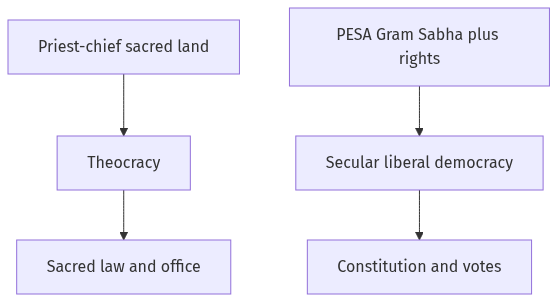
| Tribal analogue | Priest-chief, sacred mountain as law | Gram Sabha under PESA plus Constitution |
Fundamentalism (question 6b) seeks to push a democracy back toward theocracy. Ethno-nationalism (7c) may sacralise blood rather than a church. A liberal democracy can still be religious in society (religiosity). The distinction is who may coerce.
Failed democracies that hold elections but police ritual (or that lynch in the name of a cow or a book) are democracies under theocratic pressure, not a third stable type.
Flow diagram
Conclusion
A theocratic state rules in the name of the sacred; a secular liberal democracy rules in the name of equal citizens. Tribal priest-chiefs and sacred landscapes show the first logic at small scale. India’s Constitution chooses the second, while still housing custom and religiosity. The test is whether a dissenter and a religious minority can live without a priest’s permission.
Quick related
Students also ask
-
Critically examine the impact of modern democratic institutions on contemporary tribal societies. Illustrate with suitable ethnographic examples.
Next question on this syllabus topic (2023 · Q3(c)). View answer →
-
Is a village with a priest a theocratic state?
No. Sacred office in a village is ritual authority. A theocratic state monopolises territorial law in the name of God.
-
Can a democracy be religious?
Society can be highly religious. The state remains secular if it does not make one faith the source of criminal law for all.
Same topic · past papers
UPSC has asked this before
These previous-year questions sit on the same topic. Open one to practise the earlier ask.
-
2023 · Q3(c) · Anthropology GS 2 · 15 marks
Critically examine the impact of modern democratic institutions on contemporary tribal societies. Illustrate with suitable ethnographic examples. -
2026 · Q6(b) · Anthropology GS 2 · 15 marks
Discuss the impact of democratic institutions on the tribal populations of India
More from this topic
Q6(b) · UPSC Mains 2026 · Anthropology GS 2 · 15 marks · Solution
Discuss the impact of democratic institutions on the tribal populations of India
Social change and contemporary tribal societies
1. The Indian Constitution and democratic framework have deeply transformed tribal socio-political landscapes. 2. The Fifth and Sixth Schedules provide distinct administrative autonomies to protect tribal land and culture. 3. The PESA Act, 1996, empowers Gram Sabhas with self-governance and resource management in Scheduled Areas. 4. Political reservations ensure nominal legislative representation for Scheduled Tribes in Parliament and Assemblies. 5. High voter turnout and new educated leaders show successful electoral integration and political efficacy. 6. However, structural issues like bureaucratic paternalism and elite capture often turn local bodies into rubber stamps. 7. Major development projects frequently override Gram Sabha dissent, creating a gap between token and substantive democracy. 8. True tribal autonomy requires strengthening local institutions and ensuring informed consent in resource management.
Q7(c) · UPSC Mains 2025 · Anthropology GS 2 · 15 marks · Solution
Critically evaluate the concept of Nation-State and describe its impact on indigenous societies
Social change and contemporary tribal societies
Nation-state: one people, territory, law and citizenship; indigenous life is clan, grove and seasonal land. India is a Union with asymmetric clauses, not a pure nation-state, but still centralising in school, army and mine. Impacts: borders, legal monopoly, standard language, development-security, market. FRA, PESA, 371 and Sixth Schedule are domestic tools of coexistence. India has not ratified ILO 169; consultation remains the unkept promise.
Q7(a) · UPSC Mains 2025 · Anthropology GS 2 · 20 marks · Solution
Identify the contemporary limitations in the process of tribal development. How can anthropological knowledge contribute in this process?
Social change and contemporary tribal societies
Limits: consent deficit, list-area mismatch, livelihood substitution, last-mile services, security overlay, elite capture, blunt data. Xaxa, PESA, FRA and Niyamgiri name the same gap between paper and hamlet. Anthropology contributes field method, ethnoecology, medical and linguistic knowledge, gendered land. Use it in FRA mapping and social impact before clearance, not as decoration in an EIA. PM-JANMAN helps only if PVTG hamlets author the micro-plan.