
Revision summary
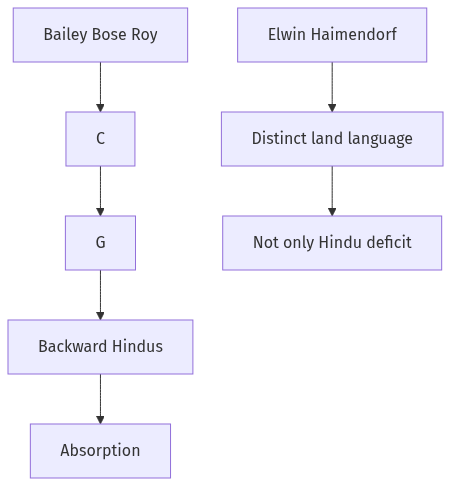
Ghurye held that Indian tribes are incomplete Hindus who should be absorbed into caste civilisation. He was right that many middle-Indian groups already share festivals, rank, and landlords with peasants. Bose, Srinivas, Roy, and Bailey document that continuum. He was wrong to treat Khasi matriliny, Naga polity, Munda khuntkatti, and sarna or church as mere backwardness. Elwin, Haimendorf, and the Xaxa Committee keep tribe as a distinct historical and legal category.
Model answer
Copper italics in this answer — like this — are the key facts. Each one is unpacked in the Facts & figures rail.
Introduction
G. S. Ghurye argued that Indian tribes are not a separate civilisation but backward Hindus, that is, groups on the edge of caste society who already share many Hindu beliefs and who should be absorbed further. The statement is a policy claim as well as a description, and it must be tested against hill and forest ethnography.
Body
Ghurye’s thesis
- In The Aborigines — So-Called — and Their Future and later The Scheduled Tribes, Govind Sadashiv Ghurye rejected the colonial isolation of “aborigines”.
- He held that many tribes already worshipped Hindu gods, used Hindu festivals, and sat on a caste-like rank ladder next to peasants.
- “Backward” meant incomplete Sanskritisation and weak access to plains resources, not a different human type.
- Policy followed description: education, Hindu social reform, and administrative integration, against Verrier Elwin’s call to protect a distinct hill genius.
What the thesis gets right
- N. K. Bose’s Hindu method of tribal absorption and M. N. Srinivas’s Sanskritisation show real traffic: Oraon, Munda, Bhil, and Gond groups take on Hindu festivals, gotras, and vegetarian elites.
- S. C. Roy already recorded Oraon and Munda contact with Hindu landlords and missionaries. Tribe and caste are a continuum in much of middle India, as F. G. Bailey later said of Bisipara.
- Census and reservation politics often treat “tribe” as a legal list, while everyday rank behaves like a jati.
What the thesis gets wrong
- Language families (Austroasiatic, Tibeto-Burman, Dravidian hill tongues), clan land such as Munda khuntkatti, Naga morung, and Khasi matriliny are not delayed varna.
- Elwin’s NEFA, Apatani, and Baiga work, and later Christoph von Fürer-Haimendorf on Gonds and Nagas, show political and ritual systems that do not wait to become Hindu jatis.
- Calling tribes “backward Hindus” erases Christian Naga and Mizo publics, Buddhist Monpa monasteries, and sarna or sacred-grove religion as mere deficit.
- Xaxa Committee (2014) treated ST as a political-historical category of dispossession, not as incomplete Hindus.
Critical comment
- Ghurye correctly attacked a museum view of tribes and correctly saw Hinduisation in the plains fringe.
- He wrongly made Hindu society the only future, and he used “backward” as a civilisational rank.
- Anthropology now reads tribe–caste contact as two-way, historically specific, and legally Scheduled, not as a single ladder into Hinduism.
Flow diagram
Conclusion
Ghurye’s phrase names contact and absorption in middle India. It fails as a general law. Tribes are historically distinct in land, language, and polity even when they take Hindu rites. Integration without erasure is the better policy reading.
Quick related
Students also ask
-
Elucidate the problems and challenges in educational attainment of the Scheduled Tribes
Next question on this syllabus topic (2021 · Q4(c)). View answer →
-
Did Ghurye deny that tribes exist?
He denied that they were a separate civilisation sealed from Hindu society. He still used the administrative category while aiming at absorption.
-
Are all tribes Hinduising?
No. Many Naga, Mizo, Khasi, and Arunachal groups are Christian or Buddhist. Others keep sarna, clan cults, or mixed practice.
Same topic · past papers
UPSC has asked this before
These previous-year questions sit on the same topic. Open one to practise the earlier ask.
More from this topic
Q7(c) · UPSC Mains 2026 · Anthropology GS 2 · 15 marks · Solution
Write an account on Development Action Plan for Scheduled Tribes (DAPST)
Problems of exploitation and deprivation of Scheduled Castes, Scheduled Tribes and Other Backward Classes. Constitutional safeguards for Scheduled Tribes and…
• DAPST (formerly Tribal Sub-Plan) is a central financial mechanism ensuring earmarked fund allocation for ST development. • It originated during the 5th Five-Year Plan (1974) and was later renamed to streamline planning and fund allocation. • Central ministries must allocate 2.5% to 17.5% of their scheme outlays proportional to the national ST population. • The primary goal is to bridge critical infrastructure, health, education, and livelihood gaps in tribal regions. • Major hurdles include historical fund diversion, under-utilization, poor data disaggregation, and local administrative bottlenecks. • Strengthening statutory backing and decentralized monitoring via Gram Sabhas are key to improving its ground-level impact.
Q5(e) · UPSC Mains 2024 · Anthropology GS 2 · 10 marks · Solution
Constitutional Safeguards for Backward Classes.
Problems of exploitation and deprivation of Scheduled Castes, Scheduled Tribes and Other Backward Classes. Constitutional safeguards for Scheduled Tribes and…
Backward Classes (OBCs) are covered by Articles 15(4) and 16(4), the 340 commissions, and constitutional NCBC (338B). The 105th Amendment restored state OBC lists after the 102nd Amendment controversy. 15(5) supports education reservation; 16(6) EWS is a separate economic quota. Indra Sawhney set 27 percent, creamy layer and a general 50 percent ceiling. OBC safeguards differ from SC/ST list protections and from Fifth/Sixth Schedule land autonomy.
Q4(c) · UPSC Mains 2021 · Anthropology GS 2 · 15 marks · Solution
Elucidate the problems and challenges in educational attainment of the Scheduled Tribes
Problems of exploitation and deprivation of Scheduled Castes, Scheduled Tribes and Other Backward Classes. Constitutional safeguards for Scheduled Tribes and…
ST attainment lags because of distance, migration, and teacher gaps. Unscheduled home languages meet a majority-medium school. Ashram and Eklavya schools raise enrolment more than outcomes. Reservation helps the few who finish the ladder. Health and land poverty keep education a risky bet.