
Revision summary
Jainism teaches anekantavada, karmic bondage of the jiva, and the three jewels of faith, knowledge, and conduct. Monastic vows centre on ahimsa and aparigraha; householders keep a milder code. Impact includes vegetarian ethics, mercantile specialisation, and temples at Abu, Palitana, and Shravanabelagola. Caste endogamy continued; occupation was ranked by injury to life. Gandhi’s political ahimsa drew on this Gujarati neighbourhood without making the nation a Jain polity.
Model answer
Copper italics in this answer — like this — are the key facts. Each one is unpacked in the Facts & figures rail.
Introduction
Jainism is a shramana religion of non-violence, self-restraint, and many-sided truth. Its tenets shaped Indian ethics, diet, trade, and art. Impact is visible in Gujarat, Rajasthan, Karnataka, and in the wider Hindu and Buddhist conversation about ahimsa.
Body
Basic tenets
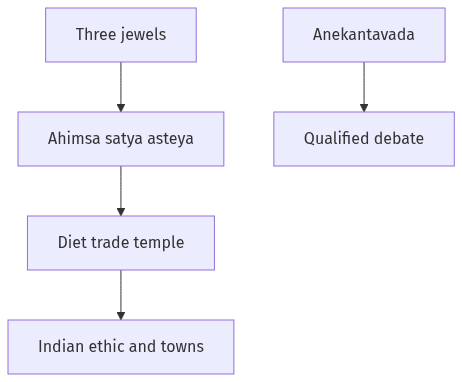
- Reality is many-sided (anekantavada); judgement should be qualified (syadvada). This is an ethic of intellectual restraint as well as a logic.
- The soul (jiva) is caught in karma as a kind of matter; release is through right faith, right knowledge, and right conduct (the three jewels).
- The five great vows for monks are ahimsa, satya, asteya, brahmacharya, and aparigraha. Householders keep a milder set.
- Mahavira (and the earlier tirthankara line culminating in him for the historical period) organised the community; Digambara and Shvetambara later split on clothing, women’s liberation, and canon.
- Extreme care for life produced rules on water, fire, farming, and night travel for monks.
Social and economic impact
- Ahimsa fed vegetarianism and bans on animal sacrifice that also moved Hindu practice, especially in trading towns.
- Aparigraha did not stop wealth. Jain lay families in western India specialised in trade, banking, and later industry, because farming and warfare were ethically harder. Max Weber noted this-worldly accumulation with other-worldly restraint.
- Kings such as Kharavela (Hathigumpha) and later western Indian patrons funded temples at Mount Abu, Shravanabelagola, and Palitana. Gomateshwara at Shravanabelagola is a public monument of Digambara prestige.
- Caste was not abolished. Jain jatis remain endogamous. The ethic ranked occupations by injury to life, which pushed some groups out of butchery and into commerce.
Wider Indian society
- Debate with Buddhism and Brahmanism sharpened ideas of karma, rebirth, and ahimsa that enter the Gita and later bhakti in changed form.
- Legal and constitutional India uses ahimsa as a public value (Directive Principles on cow slaughter are one contested heir). Gandhi drew on Jain neighbours in Gujarat for non-violence as a political method, without becoming a Jain monk.
- Vilas Sangave and later sociologists describe a small, literate, urban community with high education and strong temple trusts.
Limits
- Jainism did not become a mass peasant church. Its social impact is deep in ethic and trade, not in numbers.
- Women’s status differs by sect. Shvetambara tradition allows nuns a fuller path; Digambara classical theory is harsher.
Flow diagram
Conclusion
Jain tenets are ahimsa, non-possession, many-sided truth, and karmic release through conduct. They shaped Indian vegetarian ethics, mercantile life, and royal temple art. They did not dissolve caste, and the community remained a small, organised minority with outsized moral influence.
Quick related
Students also ask
-
Impact of Jainism on Indian society
Next question on this syllabus topic (2016 · Q1(d)). View answer →
-
Did Jainism abolish caste?
No. Jain groups remain endogamous jatis. The religion ranked work by violence but did not create a casteless society.
-
Is Gandhi’s ahimsa the same as Jain ahimsa?
He took the word and the Gujarati climate of non-killing. Political satyagraha is not identical with monastic micro-rules about insects and water.
Same topic · past papers
UPSC has asked this before
These previous-year questions sit on the same topic. Open one to practise the earlier ask.
-
2016 · Q1(d) · Anthropology GS 2 · 10 marks
Impact of Jainism on Indian society
More from this topic
Q4(b) · UPSC Mains 2024 · Anthropology GS 2 · 15 marks · Solution
Write an essay on the life history of tribal activist and freedom fighter Birsa Munda. What was the impact of his sacrifice on tribal society?
Impact of Buddhism, Jainism, Islam and Christianity on Indian society.
Birsa Munda (1875–1900) led a Munda revitalisation and agrarian revolt, the Ulgulan. He preached a purified Munda faith against diku landlords, forced labour and colonial power. He died in Ranchi jail in 1900 after capture. The Chotanagpur Tenancy Act, 1908, and later Jharkhand politics are part of his impact. His martyrdom is a living language of land rights; dispossession has not automatically ended.
Q7(b) · UPSC Mains 2016 · Anthropology GS 2 · 15 marks · Solution
Discuss the impact of Islam on scheduled tribes of India
Impact of Buddhism, Jainism, Islam and Christianity on Indian society.
Islam met tribes through trade, state, and reform, not one wave. Lakshadweep and some western Himalayan groups show deep mix. Central Indian ST conversion is limited; list politics still matters. Inheritance and mosque may strain clan land and groves. Elwin’s caution applies to any rapid creed that splits territory.
Q1(d) · UPSC Mains 2016 · Anthropology GS 2 · 10 marks · Solution
Impact of Jainism on Indian society
Impact of Buddhism, Jainism, Islam and Christianity on Indian society.
Jainism spread ahimsa and a vegetarian public ethic. Merchant Jains shaped western Indian towns and credit. Monasticism offered release outside Vedic sacrifice. Jati-like ranks continued inside Jain society. Hindu civilisation absorbed Jain shrines into a shared sacred map.