
Revision summary
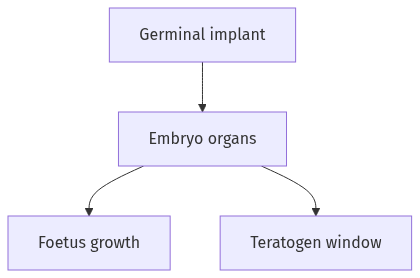
Prenatal life is germinal, embryonic, then foetal. Implantation occupies the first two weeks. Organ formation in weeks 3–8 is the main teratogen window. The foetal period is growth and maturation until birth. Nutrition and infection in each stage leave different adult traces.
Model answer
Copper italics in this answer — like this — are the key facts. Each one is unpacked in the Facts & figures rail.
Introduction
Human prenatal life is divided by weeks into germinal, embryonic, and foetal stages. Anthropology uses the calendar to read teratogens, nutrition, and birth timing.
Body
The stages
- Germinal (0–2 weeks): fertilisation, zygote, morula, blastocyst, implantation. Hertig and later embryology mapped this in the uterus.
- Embryonic (3–8 weeks): gastrulation, neurulation, and organ primordia. This is the high-risk window for rubella, alcohol, and folate-sensitive neural-tube defects.
- Foetal (9 weeks to birth): growth, lung and brain maturation, and fat stores. Tanner and auxology treat this as the first growth phase.
Why it matters
- A 40-week obstetric calendar is a cultural as well as a biological fact. Prematurity and intrauterine growth restriction later show in adult stature studies.
- Prenatal stages are not a miniature adult. They are a sequence of sensitive periods.
Flow diagram
Conclusion
Germinal, embryonic, and foetal stages are the working clock of human prenatal life. Risk and growth do not spread evenly across that clock.
Quick related
Students also ask
-
Human adolescent growth spurt
Next question on this syllabus topic (2021 · Q5(a)). View answer →
-
Is the first trimester the same as the embryonic period?
The first trimester includes germinal, embryonic, and early foetal weeks. Embryonic is the narrower organ-forming band.
-
Does a birth at 37 weeks end the foetal stage?
Clinically yes as a live birth. Biologically some maturation still continues after birth.
More from this topic
Q1(b) · UPSC Mains 2026 · Anthropology GS 1 · 10 marks · Solution
Canalization and catch-up growth.
Factors affecting growth and development
Canalization refers to the genetic buffering of human growth and development, ensuring a stable trajectory despite minor environmental perturbations. Catch-up growth is the accelerated growth period that occurs once a temporary environmental stressor or illness is removed. Together, these concepts illustrate the remarkable plasticity and resilience of the human organism during the juvenile growth phase. Waddington's epigenetic landscape provides the classical theoretical model for understanding canalization. Nutritional rehabilitation and clinical recovery often demonstrate profound catch-up growth in children.
Q5(a) · UPSC Mains 2021 · Anthropology GS 1 · 10 marks · Solution
Human adolescent growth spurt
Factors affecting growth and development
The adolescent growth spurt is a rapid height-weight rise at puberty. Girls peak earlier than boys on Tanner velocity curves. Hormones drive it; nutrition and class time it. Menarche follows the height peak. Human life history pairs long childhood with this late acceleration.
Q6(c) · UPSC Mains 2016 · Anthropology GS 1 · 15 marks · Solution
Discuss different factors affecting growth and development in human beings.
Factors affecting growth and development
Genes and hormones set tempo and a stature range. Nutrition and infection decide whether that range is reached. Altitude, toxins, and workload add environmental load. Secular trend and feeding bias are cultural-historical factors. Tanner charts make the factors visible as velocity.