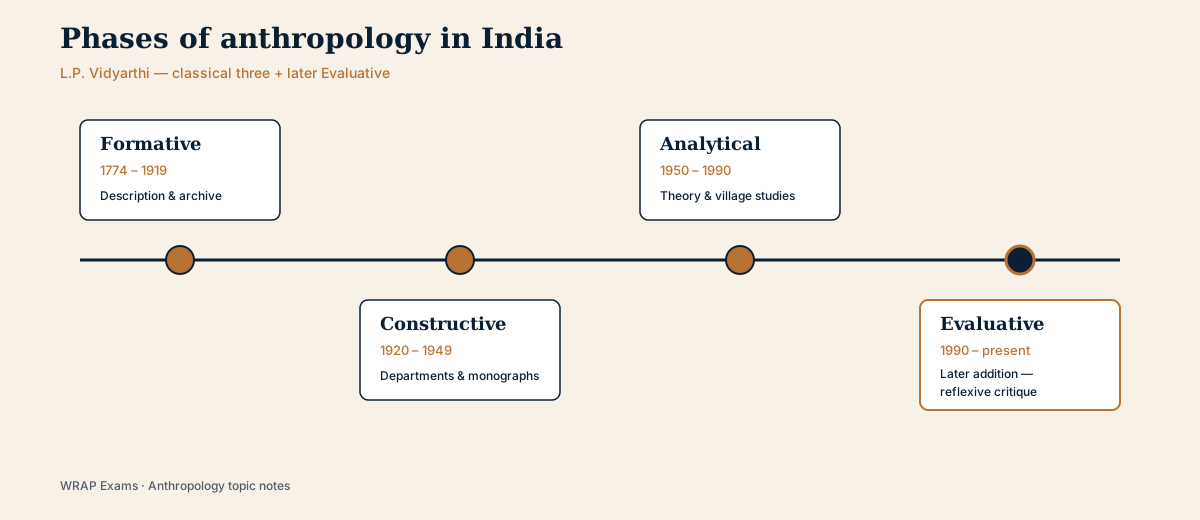
Vidyarthi's scheme at a glance
L.P. Vidyarthi mapped Indian anthropology as Formative, Constructive, Analytical; Evaluative is a later coda.
- Classical Vidyarthi = three phases (Formative, Constructive, Analytical).
- Evaluative (~1990 onward) is a later teaching addition — still quote it, but flag it as post-Vidyarthi.
- Movement: outsider description → professional institutions → theory/applied fieldwork → reflexive critique.
| Phase | Years | One-line sense |
|---|---|---|
| Formative | 1774–1919 | Travellers, administrators, missionaries, Asiatic Society; description before departments. |
| Constructive | 1920–1949 | University departments, monographs, Indian ethnographers take the field. |
| Analytical | 1950–1990 | Village studies, structural-functional work, applied anthro, concept-building. |
| Evaluative | 1990–present | Ethics, development critique, identity, gender, politics of representation. |
Formative phase (1774–1919)
- Begins with India-watching outside universities — travellers, missionaries, revenue/census officials.
- Asiatic Society tradition: languages, customs, antiquities collected as archive.
- Knowledge often utilitarian and coloured by colonial categories.
- Raw documentation of peoples assembled before 'anthropologist' was a stable Indian career.
Examples
- Census ethnography and district gazetteers as Formative source material.
- Missionary and administrator notes on tribes/castes used later by academic ethnographers.
Constructive phase (1920–1949)
- Anthropology becomes institutional: departments, museums, surveys, syllabi.
- Trained ethnographers and full monographs replace scattered notes.
- Indian scholars (e.g. Ananthakrishna Iyer, S.C. Roy) show fieldwork need not be only a foreigner's craft.
- Tribes and castes written as ethnographic subjects, not only administrative problems.
Analytical phase (1950–1990)
- After Independence: village studies, structural-functional analysis, applied anthropology.
- Fieldwork organised around problems — change, planning, caste, tribal development, kinship.
- Vidyarthi's Sacred Complex and Nature–Man–Spirit Complex belong here.
- Say what 'analytical' meant (theory + applied + village India), not only the label.
- Analytical here means theory-informed village and applied work on change, caste, kinship and planning — not only a chronological label.
Evaluative phase (1990–present)
- Anthropology turns the mirror on itself: fieldwork ethics, development orthodoxy, identity.
- Gender, representation, and critique of earlier frames enter teaching.
- Do not invent this as Vidyarthi's original fourth box if the question asks for his scheme strictly.
Examples
- Keep Vidyarthi’s original three phases distinct; treat Evaluative as a later teaching extension in one clear sentence.
Pair with syllabus short notes for clause-by-clause Paper coverage.