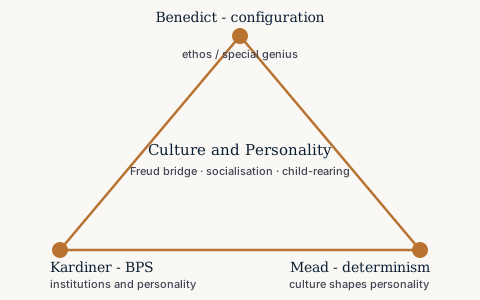
Bridge from Freud to psychological anthropology
The Culture and Personality school asked how childhood socialisation and cultural institutions shape adult personality — and how personality patterns, in turn, colour culture.
- Freud’s model (id, ego, superego) and emphasis on childhood experience gave anthropologists a vocabulary for linking psyche and culture.
- Core assumption: culture is reflected in personality at large; personality is trained through culturally patterned child-rearing.
- Three classic directions: Benedict’s culture configuration (ethos of a culture); Mead’s culture determinism (culture shapes personality and gender); Kardiner–Linton–Du Bois basic/modal personality (institutions ↔ personality).
| Approach | Key scholars | Direction of argument |
|---|---|---|
| Culture configuration | Ruth Benedict | Dominant cultural ethos patterns personality ideals |
| Culture determinism | Margaret Mead | Cultural training shapes personality, adolescence and gender |
| Basic / modal personality | Kardiner, Linton, Du Bois | Primary institutions shape personality, which shapes secondary institutions |
Ruth Benedict — patterns and configurations
- Patterns of Culture (1934): culture is not a random trait list but an integrated configuration with a ‘special genius’ or dominant temperament.
- Apollonian pattern (peace, moderation, cooperation): illustrated by Zuni ritual life oriented to collective harmony rather than individual glory.
- Dionysian pattern (excess, competition, aggression): illustrated by Dobu (via Reo Fortune) as suspicious, magic-ridden rivalry.
- Kwakiutl (from Boas’s materials): prestige competition and potlatch display as a megalomaniac, honour-driven configuration.
- Anthropology and the Abnormal: normality is culturally defined — behaviour prized in one society may be labelled deviant in another.
- Criticisms: single-genius oversimplifies; ahistorical; individuals mix traits; Morris Opler stressed multiple themes inside one culture.
Margaret Mead — culture, adolescence and temperament
- Coming of Age in Samoa (1928): tested whether adolescent storm-and-stress is biologically universal; reported a relatively smooth Samoan transition with more open sexual talk — adolescence as culturally shaped.
- Growing Up in New Guinea (1930): challenged the idea that ‘primitive’ adults think like children; animistic thought is learned culturally.
- Sex and Temperament (1935): Arapesh — both sexes gentle; Mundugumor — both aggressive; Tchambuli/Chambri — women economically dominant, men more emotionally dependent — gender temperament as cultural product.
- Derek Freeman’s critique (Margaret Mead and Samoa): short stay, language limits, over-reliance on adolescent informants, stronger sexual controls than Mead described, alleged misleading by informants.
- Fair balance: Freeman exposed ethnographic weaknesses; Mead still forced a lasting question about culture’s power over behaviour and gender ideals.
Kardiner, Linton and Du Bois — basic and modal personality
- Basic Personality Structure (Kardiner with Linton): shared emotional dispositions produced by similar childhood experience.
- Primary institutions (family, child-rearing, discipline, subsistence) shape basic personality; secondary institutions (religion, myth, folklore, ritual) express and reinforce it.
- The Individual and His Society (1939) modelled this loop; Mark of Oppression (1951) explored how racism and marginalisation pattern common personality and expressive culture.
- Linton (The Study of Man, 1936): status (ascribed/achieved) and role (ideal/actual); cultural universals, alternatives and specialties.
- Cora Du Bois (The People of Alor, 1944): modal personality = most frequent traits, allowing variation — unlike a single identical basic personality for all.
- Alor: sibling-heavy child care linked to modal anxiety, suspicion and emotional detachment; secondary ideology showed little idealism or forgiveness talk.
- Criticisms of BPS: childhood overemphasised; adult experience and history underplayed; risk of homogenising and stereotyping whole communities.
National Character studies
- Wartime ‘culture at a distance’: films, literature, interviews and art used when fieldwork was impossible.
- Benedict, The Chrysanthemum and the Sword (1946): Japanese national character as combining aesthetic refinement/harmony (chrysanthemum) with honour, duty and martial discipline (sword).
- Mead, Keep Your Powder Dry (1942): compared American individualism with more collective Japanese patterns and Russian respect for authority; biological sameness of children, cultural difference via socialisation.
- Geoffrey Gorer on Russia: strict child-rearing linked to submission and conformity (highly contested).
- Criticisms: overgeneralisation, stereotyping, ethnocentrism, internal diversity ignored, static snapshots, heavy secondary-data dependence.
| Scholar | Key concept | Landmark work |
|---|---|---|
| Sigmund Freud | Id–ego–superego; childhood shaping adult psyche | Psychoanalytic writings (bridge, not ethnography) |
| Ruth Benedict | Culture configuration; Apollonian/Dionysian | Patterns of Culture; Chrysanthemum and the Sword |
| Margaret Mead | Culture shapes adolescence and gender temperament | Coming of Age in Samoa; Sex and Temperament |
| Abraham Kardiner | Basic Personality Structure; primary/secondary institutions | The Individual and His Society; Mark of Oppression |
| Ralph Linton | Status and role; cultural universal/alternative/specialty | The Study of Man |
| Cora Du Bois | Modal personality (statistical frequency + variation) | The People of Alor |
| Geoffrey Gorer | National character via child-rearing hypotheses | Studies on Russian character |
Pair with syllabus short notes for clause-by-clause Paper coverage.