
Key points
Rank survives conversion
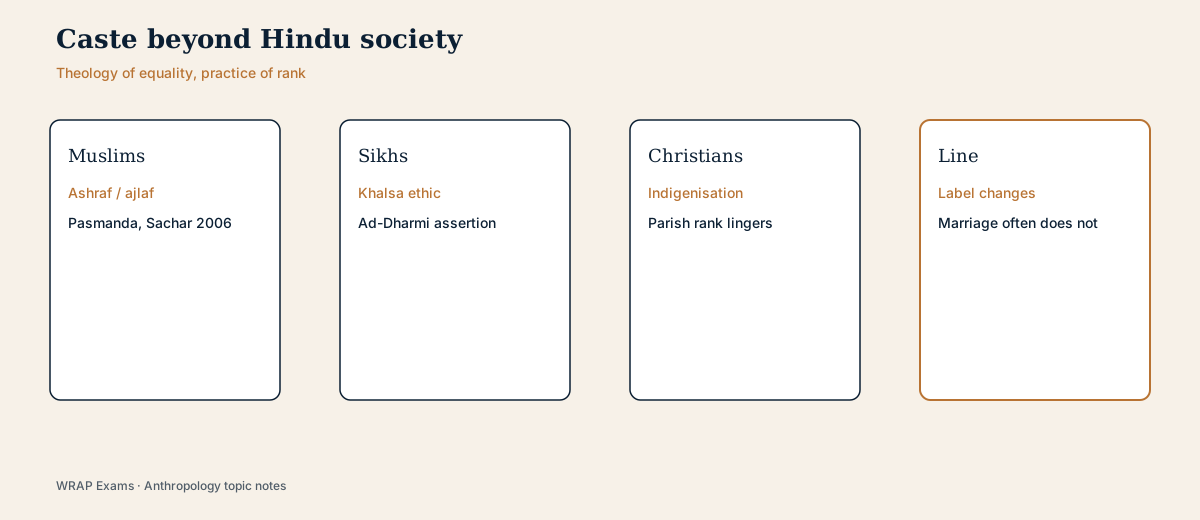
Caste-like ranking appears among Muslims, Sikhs and Christians in India. Conversion changes the religious label; it does not automatically erase graded social practice.
- Theology can preach equality while marriage, burial, seating and naming still sort people by birth-group.
- The census and personal-law debates made these internal ranks politically visible; they were not invented by the census alone.
- Keep this page distinct from religious-minority rights: here the question is hierarchy inside the community.
Case
Muslims — ashraf, ajlaf, pasmanda
- Colonial and later ethnography records status clusters often taught as ashraf (claiming foreign descent: Sayyid, Sheikh, Pathan, Mughal), ajlaf (occupational groups), and arzal (historically stigmatised service groups).
- These are teaching labels for inequality, not a single all-India census table. Regional names differ.
- Sachar Committee (2006) documented high poverty and low literacy among Muslims relative to several other religious groups — use it as a socio-economic peg.
- Pasmanda politics names the demand that ‘Muslim’ not hide internal caste-like disadvantage.
- Moplah (Mappila) of Kerala is a Srinivas-linked teaching case of a regionally specific Muslim community, not a template for all Indian Muslims.
Examples
- Do not write ‘Muslims have no caste’. Write: ranked marriage circles and occupation persist; theology and politics contest them.
Key points
Sikhs — Khalsa ethic and ranked practice
- Khalsa teaching stresses equality before the Guru; regional practice still shows Jat, artisan (e.g. Ramgarhia), and Dalit Sikh (Mazhabi, Ravidasia/Ad-Dharmi) distinctions in marriage and gurdwara politics.
- Surinder Jodhka’s Punjab ethnography is the standard citation for Ad-Dharmi assertion and Guru Ravidas iconography as a counter to upper-caste Sikh dominance.
- Exam line: Sikh equality is a powerful ethic; it is also a field of contest, not a finished social fact.
Key points
Christians — indigenisation and lingering rank
- Indigenisation: liturgy, saints’ days and church organisation adapted to Indian languages and local calendars — conversion was not a carbon-copy of Europe.
- Caste-like practice can survive in marriage, cemetery rows and parish seating; Dalit Christian demands sit at that fault line.
- Difficulties in the teaching notes: linguistic diversity, shortage of local clergy, and ranked groups inside the same denomination.
WRAP Exams coaching notes for UPSC Anthropology optional. Pair with the official syllabus when you need every heading in order.