
Revision summary
Bundelkhand has stone, granite, sand, and related industrial minerals. The present illness is leaky royalty, illegal pits, and dusty crushers. Value addition is thin; rubble leaves, illness stays. District mineral funds and reclamation are the management test. The claim is fair for stone and sand, not a promise of a metal complex the rocks do not give.
Model answer
Introduction
Bundelkhand has stone, granite, sand, and some industrial minerals. The illness of its mining economy is therefore less a empty geology than a broken chain of leases, crushing, roads, and reclamation. Evaluation should test that claim, not recite it.
Body
The mineral base
- The region is not mineral-blind: building stone, granite, morrum, and sand have long fed the north Indian construction boom.
- What it lacks relative to a rich ore province is a high-value metal complex, so geology sets a ceiling, but not the present chaos.
- Illegal and poorly marked sand and stone extraction show that the resource is there; the state has not always been in the pit.
Poor management
- Lease auctions, e-permit, and transport receipts exist on paper; leakage at check posts and riverbeds still steals royalty.
- Crushers sit without green belts, water spray, or haul-road repair, so villages breathe silica while trucks ruin the last good road.
- Value addition is thin: blocks leave as rubble instead of calibrated stone, tiles, or engineered products.
- Mine closure and quarry reclamation are rare, so a worked hill becomes a dump, not a future farm or forest.
- Labour is casual and silicosis-exposed; skill and safety management are as weak as royalty management.
Evaluation of the statement
- The statement is largely fair for stone and sand: the wound is governance, environment, and local share, not a blank map.
- It is less fair if it promises a steel-city future from Bundelkhand’s actual mineral basket.
- Good management would mean transparent e-permits, weighed trucks, crusher norms, district mineral funds that actually reach roads and clinics, and crushing-to-product clusters near Jhansi and Banda.
- Until then, mining will remain a dust economy that exports volume and imports illness.
Flow diagram
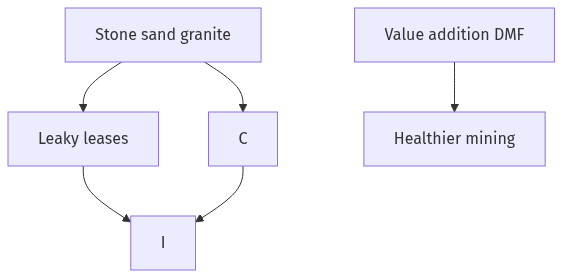
Conclusion
Bundelkhand is not empty of minerals. Its mining industry is ill mainly from leaky leases, dirty crushers, and no value addition. The statement holds for stone and sand. It should not be stretched into a fantasy metal boom the geology does not support.
Quick related
Students also ask
-
Discuss how economic progress of Uttar Pradesh is possible through integrated development of agriculture, horticulture, fisheries and allied activities.
Next question in the 2025 paper (Q15). View answer →
-
Would more leases alone cure the industry?
No. More unmanaged leases would spread dust. Cure is weighed transport, crusher control, and local value addition.
-
Is illegal sand mining a sign of no mineral?
It is the opposite sign: the mineral is valuable enough to steal. That is a management and policing failure.
Same topic · past papers
UPPSC has asked this before
These previous-year questions sit on the same topic. Open one to practise the earlier ask.
-
2023 · Q19 · UPGS6 · 12 marks
Analyse the importance of minerals in industrial development of Bundelkhand region of Uttar Pradesh.
More from this paper
Q1 · UPSC Mains 2025 · UPGS6 · 8 marks · Solution
Discuss the recent tax reforms undertaken by the Uttar Pradesh Government.
Public finance and ODOP
U.P. tax reform after GST is mainly stamp duty, electricity duty, SGST incentives, and online commercial tax. Industrial policy uses those three state tools to attract plants. Digitised registration and e-way bills cut compliance delay. Households see stamp-duty concessions more clearly than GST rates, which are Union-led. The state cannot rewrite GST slabs; it can only run administration and property-linked taxes better.
Q2 · UPSC Mains 2025 · UPGS6 · 8 marks · Solution
What is the concept of Invest U.P.? Evaluate its role in the economic development of Uttar Pradesh.
Schemes, skill and investment
Invest U.P. is the state investment promotion agency, not a factory owner. It markets sectors and walks files through Nivesh Mitra. Summits and land banks are the pitch; after-care is the development test. It helps a land-locked state compete on speed of clearance. It cannot substitute power, logistics, or skills.
Q3 · UPSC Mains 2025 · UPGS6 · 8 marks · Solution
What is "Green Star Rating System" launched in 2025?
Economy, budget and industry of UP
U.P. launched a Green Star Rating in 2025 as a state mark for greener buildings and industry. Stars rest on energy, water, and waste performance. The rating is a signal for buyers and departments, not a replacement for pollution law. It has no privately invented ISO number in this answer. Its worth depends on audit, not on the logo alone.