
Revision summary
Aadhaar-linked DBT and PFMS have sped subsidy and expenditure tracking in many schemes. GSTN and online procurement improved the fiscal ledger. CoWIN showed campaign-scale digital scheduling when networks worked. Exclusion from biometrics or connectivity is the other face of the same tools. The 2023 data-protection statute answers the privacy risk of implementation data.
Model answer
Introduction
Information and Communication Technology has entered targeting, payments, tax, and public health files in India. Usefulness is real in leak-control and speed, and it is limited where connectivity, literacy, and data protection fail.
Body
Where ICT has helped
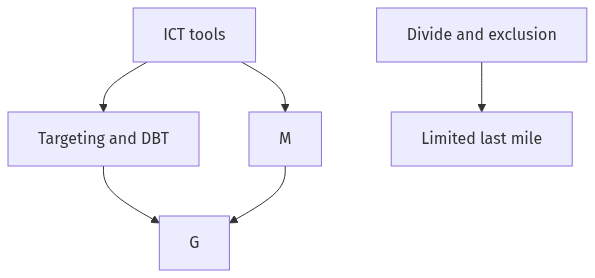
- Aadhaar-seeded Direct Benefit Transfer and schemes such as PAHAL cut duplicate and ghost enrolments in several subsidy streams.
- GSTN, PFMS, and online procurement give the Union and States a common ledger for tax and expenditure that paper files could not match in speed.
- CoWIN and digital health records showed that a national campaign can schedule and report doses when the network holds.
- DigiLocker, UMANG, and online grievance portals reduce the number of visits for certificates and complaints.
Extent and limits
- Exclusion errors occur when biometrics fail, a mobile is missing, or a village has weak signal, so ICT can deny a genuine beneficiary.
- The Digital Personal Data Protection Act, 2023, exists because implementation data can also be misused.
- ICT cannot replace teachers, doctors, or last-mile inspectors; it implements policy only as far as the offline state works.
Balanced view
- To a large extent ICT has made targeting and monitoring cheaper and faster in identified schemes.
- To a smaller extent it has solved last-mile justice, because the poor still meet a kiosk, a tout, or a failed OTP.
Flow diagram
Conclusion
ICT has been useful in policy implementation where identity, payment, and reporting can be digitised. The extent stops at the digital divide, exclusion risk, and the need for human capacity beside the screen.
Quick related
Students also ask
-
How should the India–EU Agreement be viewed in the context of changing global geopolitical dynamics? Explain.
Next question in the 2025 paper (Q8). View answer →
-
Has ICT removed leakage entirely?
No. It has reduced some duplicate and ghost cases. Collusion, wrong seeding, and last-mile capture can still leak funds.
-
Is CoWIN proof that all policy can go fully online?
No. It worked as a campaign tool. Routine health, land, and police work still need offline capacity.
Same topic · past papers
UPPSC has asked this before
These previous-year questions sit on the same topic. Open one to practise the earlier ask.
-
2023 · Q7 · UPGS2 · 8 marks
“The application of Information and Communication Technology (ICT) is for delivering government service.” Discuss. -
2021 · Q16 · UPGS2 · 12 marks
Analyse the problems that have restricted the successes of Panchayati Raj System in India. How far has the Seventy-Third Constitutional Amendment been successful in countering these problems? -
2020 · Q2 · UPGS2 · 8 marks
"The President of India cannot become a dictator." Explain. -
2024 · Q19 · UPGS2 · 12 marks
What are the consequences of the ongoing Israel-Palestine conflict? How should India address the emerging challenges? -
2018 · Q2 · UPGS2 · 8 marks
Critically examine the jurisdiction of the International Court of Justice.
More from this paper
Q1 · UPSC Mains 2025 · UPGS2 · 8 marks · Solution
What role do Joint Parliamentary Committees (JPCs) play in the Indian legislative process? How do they contribute to effective law-making? Analyse.
Parliament and State legislatures
A JPC is an ad hoc joint committee used for complex bills or major controversies. It gathers evidence that floor debate cannot gather at the same depth. Reports have shaped later drafting after inquiries such as Bofors and 2G. The committee cannot enact law; the Houses may still ignore the report. Effective law-making follows only when Parliament uses that record to amend the bill.
Q2 · UPSC Mains 2025 · UPGS2 · 8 marks · Solution
How does Alternative Dispute Resolution (ADR) strengthen efficient governance and enhance the effectiveness of the justice delivery system in India? Analyze.
Separation of powers
Section 89 CPC and the 1996 Arbitration Act, with the 2023 Mediation Act, give ADR a legal base. Lok Adalats under the 1987 Legal Services Authorities Act clear compoundable claims in bulk. Governance gains when contracts and welfare complaints do not wait years for a trial. Justice delivery gains only if weaker parties are not forced into unfair bargains. Courts remain necessary for crime and for constitutional rights.
Q3 · UPSC Mains 2025 · UPGS2 · 8 marks · Solution
"Legislature is supreme within its domain, yet it is not sovereign." Examine this statement in the constitutional context with examples.
Indian Constitution
Articles 245 and 246 make a legislature supreme on its constitutional list. Kesavananda and Minerva Mills deny unlimited amending power. Articles 13, 32, and 226 allow courts to void unconstitutional statutes. The NJAC judgment is an example of a constitutional amendment falling to basic structure review. India follows constitutional supremacy, not British parliamentary sovereignty.