Revision summary
Technology shorts linking digital society, inclusive social change, Bihar’s industrial tech gaps, and green innovation pathways.
Model answer
Introduction
From public service delivery to MSME tooling, technology mediates Bihar’s catch-up growth and national sustainability targets.
Body
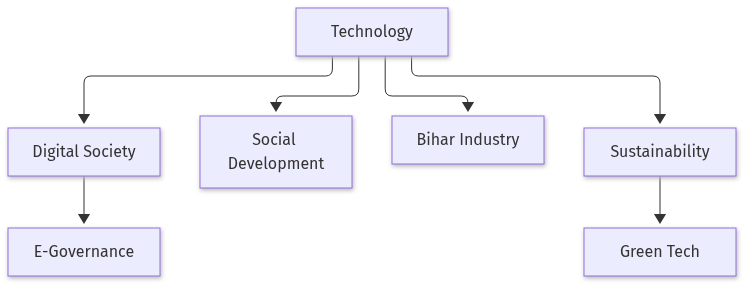
Computers in Society
- Governance: e-SHRAM, e-NAM, digital lockers; transparency vs digital divide.
- Economy: IT services, fintech, platform labour.
Technology and Social Development
- Positive: Tele-education, ASHA mobile apps, women’s mobile banking.
- Risks: Surveillance, algorithmic bias, job polarisation.
S&T in Bihar Industry
- Sectors: Food processing automation, leather/ceramic clusters, pharma in Darbhanga–Aurangabad.
- Needs: Testing labs, incubators (Patna BI), IP awareness.
Sustainable Development Tech
- Tools: GIS watershed planning, smart grids, circular economy marketplaces, EV charging infrastructure.
Flow diagram
Conclusion
Computers and wider technology are double-edged — enabling Bihar’s service leap and green transition if accompanied by digital literacy, MSME credit, and standards that privilege sustainability over extractive growth.
Quick related
Students also ask
-
(a) Misuse of technology and its wrong application lead to pollute the environment and cause climatic changes. Discuss with suitable examples, how misuse of technology has become a curse to the environment of India.
Or
(b) Nanotechnologies have a huge potential to revolutionise our life. Discuss the emerging applications of nanotechnology in human health.
Next question on this syllabus topic (2023 · Q8). View answer →
-
How can technology reduce Bihar’s industrial backwardness?
By enabling modern food processing, quality testing labs, and digital market access for clusters without heavy capital upfront.
-
What is technology’s role in sustainability?
It improves monitoring of emissions, water use, and renewable integration while enabling precision agriculture.
More from this topic
Q8 · UPSC Mains 2025 · GS II · 36 marks · Solution
(a) In the perspective of the basics of cyber security, the need for digital sovereignty and the effectiveness of the Prevention of Money Laundering Act (PMLA), suggest components for a comprehensive internal security strategy. Or (b) “The New Indian Space Policy 2023 has opened the floodgates for the private sector.” Is this transition merely about technological development, or has it qualitatively transformed India’s capabilities for national security disaster response and border management? In the context of drone swarm technology, the security of satellite based communication and the strategic significance of GSLV program, propose the essential pillars of a comprehensive ‘Security-Development-Innovation’ strategy for India’s space and allied technologies.
General Studies II
India’s internal security and strategic posture increasingly depend on space-based C4ISR, private innovation under the 2023 Space Policy, and allied technologies (drones, secure satcom, GSLV-class lift) for disaster and border missions.
Q7 · UPSC Mains 2025 · GS II · 36 marks · Solution
Write short answer of the following questions: (See official booklet Section III short notes — cyber security / digital sovereignty / PMLA components and remaining short parts in media/pyq/2025/BPGS2-english.pdf.) In the perspective of the basics of cyber security, the need for digital sovereignty and the effectiveness of the Prevention of Money Laundering Act (PMLA), suggest components for a comprehensive internal security strategy. (Full short-note set: official PDF.)
General Studies II
Internal security in a digital age requires cyber resilience, sovereign control over critical data infrastructure, and anti-money-laundering architecture — PMLA being one pillar among intelligence, policing, and border coordination.
Q6 · UPSC Mains 2025 · GS II · 38 marks · Solution
(a) Discuss the major ports on eastern coast of India. Critically examine the role of Syama Prasad Mookerjee Port, Kolkata (SMPK) in the development of North East India and Bangladesh, giving suitable examples. Or (b) Describe the concept of fourth industrial revolution (Industry 4.0). Critically analyse the biggest benefits and risks of adopting industry 4.0 technologies in India.
General Studies II
Eastern seaboard ports anchor coal, container, and bulk trade for eastern India; SMPK (Kolkata) retains historic hinterland ties to North-East India and Bangladesh via river-sea multimodal networks despite draft limitations.