Revision summary
Trickle-down growth faced criticism in India’s mixed economy experience; understanding monsoon sub-systems remains essential for planning even when answering the alternate monsoon branch.
Model answer
Introduction
Post-liberalisation India saw rising GDP with uneven inclusion — questioning pure trickle-down; monsoon science underpins every five-year strategy for eastern States.
Body
Trickle-Down Theory
- Elements: Top-end growth raises investment, jobs eventually permeate downwards via profits and wages.
- Benefits claimed: Capital formation, technology diffusion in reform eras (1991+).
- Limitations: Gini persistence, informal sector neglect, agrarian distress despite high growth phases.
- Indian planning response: MGNREGA, GST compensation, PM-KISAN — explicit redistribution beyond trickle-down assumption.
Monsoon System (Structural Note)
- Branches: Arabian Sea and Bay of Bengal arms; Tibetan anticyclone; Somali low-level jet.
- Types: Southwest summer monsoon primary; northeast winter monsoon peninsular.
- Climate change: Increased extreme rainfall events, longer dry spells — planning must adapt irrigation and insurance.
Flow diagram
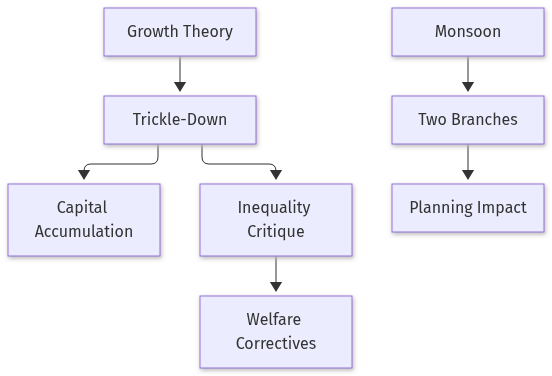
Conclusion
Indian policy increasingly rejects naive trickle-down, pairing growth with rights-based welfare; climate-aware monsoon management remains the backbone of Bihar’s food and income security.
Quick related
Students also ask
-
Write short answer of the following questions:
(a) What is the role of computer in modern society?
(b) With suitable examples, discuss the relationship between technology and social development.
(c) Discuss the role of science and technology in industrial development of Bihar.
(d) Write a note on the role of technology in sustainable development.
(e) (Remaining short note in official booklet.)
Next question on this syllabus topic (2023 · Q7). View answer →
-
Why did trickle-down lose favour in India?
Because high growth phases coexisted with farmer distress and stagnant formal job creation for low-skilled workers.
-
What are the two monsoon branches?
Arabian Sea and Bay of Bengal branches merging over the subcontinent.
More from this topic
Q8 · UPSC Mains 2025 · GS II · 36 marks · Solution
(a) In the perspective of the basics of cyber security, the need for digital sovereignty and the effectiveness of the Prevention of Money Laundering Act (PMLA), suggest components for a comprehensive internal security strategy. Or (b) “The New Indian Space Policy 2023 has opened the floodgates for the private sector.” Is this transition merely about technological development, or has it qualitatively transformed India’s capabilities for national security disaster response and border management? In the context of drone swarm technology, the security of satellite based communication and the strategic significance of GSLV program, propose the essential pillars of a comprehensive ‘Security-Development-Innovation’ strategy for India’s space and allied technologies.
General Studies II
India’s internal security and strategic posture increasingly depend on space-based C4ISR, private innovation under the 2023 Space Policy, and allied technologies (drones, secure satcom, GSLV-class lift) for disaster and border missions.
Q7 · UPSC Mains 2025 · GS II · 36 marks · Solution
Write short answer of the following questions: (See official booklet Section III short notes — cyber security / digital sovereignty / PMLA components and remaining short parts in media/pyq/2025/BPGS2-english.pdf.) In the perspective of the basics of cyber security, the need for digital sovereignty and the effectiveness of the Prevention of Money Laundering Act (PMLA), suggest components for a comprehensive internal security strategy. (Full short-note set: official PDF.)
General Studies II
Internal security in a digital age requires cyber resilience, sovereign control over critical data infrastructure, and anti-money-laundering architecture — PMLA being one pillar among intelligence, policing, and border coordination.
Q6 · UPSC Mains 2025 · GS II · 38 marks · Solution
(a) Discuss the major ports on eastern coast of India. Critically examine the role of Syama Prasad Mookerjee Port, Kolkata (SMPK) in the development of North East India and Bangladesh, giving suitable examples. Or (b) Describe the concept of fourth industrial revolution (Industry 4.0). Critically analyse the biggest benefits and risks of adopting industry 4.0 technologies in India.
General Studies II
Eastern seaboard ports anchor coal, container, and bulk trade for eastern India; SMPK (Kolkata) retains historic hinterland ties to North-East India and Bangladesh via river-sea multimodal networks despite draft limitations.