Revision summary
Constitutional short notes on basic structure, 103rd Amendment EWS quota, Article 368 procedure, Preamble’s aspirational goals, and Bihar’s caste survey politics.
Model answer
Introduction
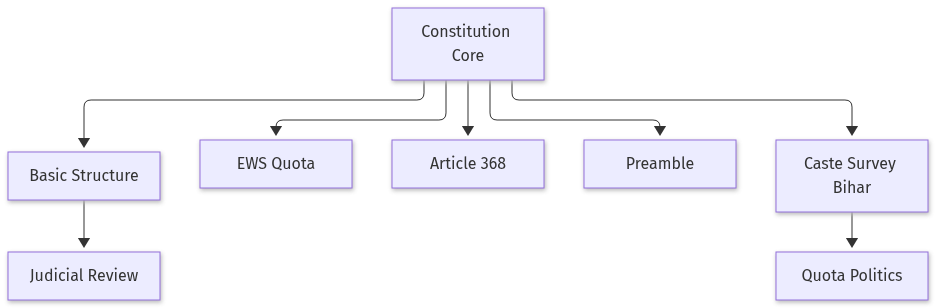
Foundational constitutional concepts anchor this composite — structural limits, affirmative action expansions, amendment mechanics, and Preamble teleology intersecting Bihar’s social census debate.
Body
Basic Structure
- Origin: Kesavananda Bharati; identity of Constitution protected from amending onslaught.
- Elements: Democracy, federalism, secularism, judicial review, rule of law, dignity.
- Critical lens: Balances flexibility with endurance.
EWS Reservation
- 103rd Amendment: 10% for economically weaker forward castes in education and jobs.
- Justification: Formal equality argument — poverty cuts across castes.
- Critique: Creamy layer parity, exclusion of minority institutions debate; Janhit Abhiyan upheld with caveats.
Amendment Process
- Procedure: Article 368 special majority; some provisions need State ratification.
- Critique: No referendum; speed allows partisan spikes; lacks deliberative cooling period.
Preamble as Blueprint
- Goals: Justice, Liberty, Equality, Fraternity; sources sovereignty from people.
- Amended 1976 for socialist, secular; guides interpretation (Berubari, Kesavananda).
Caste Census in Bihar
- 2023 survey: State-led socio-economic caste survey; fuels quota recalibration demands.
- Political impact: RJD/JD(U) outreach to OBC sub-groups; centre–state tussle on census timing.
Flow diagram
Conclusion
Basic structure preserves constitutional soul; EWS quota tests horizontal equity; amendment rules need restraint; Preamble orients interpretation; Bihar’s caste data re-enters Mandal-era politics with granular sub-caste claims.
Quick related
Students also ask
-
(a) Discuss the institutional relationship between the President and the Prime Minister as per the Indian Constitutional text. Discuss their changing role in the present context.
Or
(b) “Indian federalism is fundamentally rooted in two simultaneous pursuits of nationhood : an embrace of state-based cultural diversities and a commitment to the larger Indian political community.” Examine critically the nature of Indian model of federalism in the light of the above statement.
Next question on this syllabus topic (2023 · Q2). View answer →
-
Is EWS reservation constitutionally valid?
The Supreme Court upheld it in 2022 while debating exclusion of minority institutions and the 50% ceiling interaction.
-
Why does Bihar want caste census data?
To align welfare and reservation policies with actual population shares of extremely backward and marginalised sub-castes.
More from this topic
Q8 · UPSC Mains 2025 · GS II · 36 marks · Solution
(a) In the perspective of the basics of cyber security, the need for digital sovereignty and the effectiveness of the Prevention of Money Laundering Act (PMLA), suggest components for a comprehensive internal security strategy. Or (b) “The New Indian Space Policy 2023 has opened the floodgates for the private sector.” Is this transition merely about technological development, or has it qualitatively transformed India’s capabilities for national security disaster response and border management? In the context of drone swarm technology, the security of satellite based communication and the strategic significance of GSLV program, propose the essential pillars of a comprehensive ‘Security-Development-Innovation’ strategy for India’s space and allied technologies.
General Studies II
India’s internal security and strategic posture increasingly depend on space-based C4ISR, private innovation under the 2023 Space Policy, and allied technologies (drones, secure satcom, GSLV-class lift) for disaster and border missions.
Q7 · UPSC Mains 2025 · GS II · 36 marks · Solution
Write short answer of the following questions: (See official booklet Section III short notes — cyber security / digital sovereignty / PMLA components and remaining short parts in media/pyq/2025/BPGS2-english.pdf.) In the perspective of the basics of cyber security, the need for digital sovereignty and the effectiveness of the Prevention of Money Laundering Act (PMLA), suggest components for a comprehensive internal security strategy. (Full short-note set: official PDF.)
General Studies II
Internal security in a digital age requires cyber resilience, sovereign control over critical data infrastructure, and anti-money-laundering architecture — PMLA being one pillar among intelligence, policing, and border coordination.
Q6 · UPSC Mains 2025 · GS II · 38 marks · Solution
(a) Discuss the major ports on eastern coast of India. Critically examine the role of Syama Prasad Mookerjee Port, Kolkata (SMPK) in the development of North East India and Bangladesh, giving suitable examples. Or (b) Describe the concept of fourth industrial revolution (Industry 4.0). Critically analyse the biggest benefits and risks of adopting industry 4.0 technologies in India.
General Studies II
Eastern seaboard ports anchor coal, container, and bulk trade for eastern India; SMPK (Kolkata) retains historic hinterland ties to North-East India and Bangladesh via river-sea multimodal networks despite draft limitations.