Revision summary
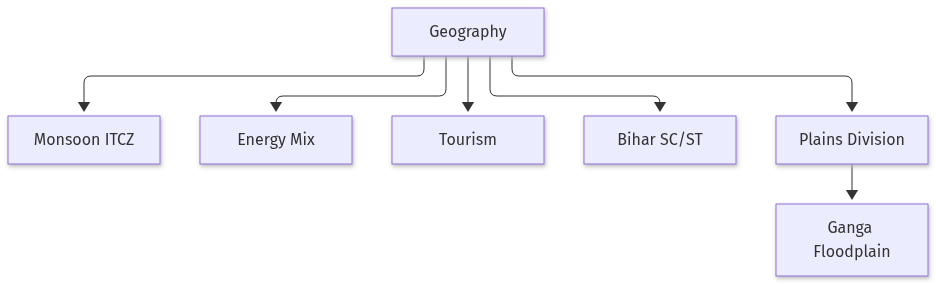
Physical and human geography composite — monsoon dynamics, energy mix, tourism potential, Bihar’s tribal/Dalit geography, and locating Bihar in the northern plains division.
Model answer
Introduction
Monsoon controls agrarian Bihar; energy security debates intersect climate goals; tourism and social geography round out the Section-II cluster.
Body
Indian Monsoon
- Mechanism: Differential heating of land-sea; ITCZ shift; cross-equatorial flow; Tibetan heating; Somali jet.
- Onset/withdrawal: Kerala onset late May; retreat from NW; Bihar gets bulk June–September rains.
- Characteristics: Orographic bursts in Himalayas; break monsoon phases; ENSO modulation.
Energy Sources
- Primary: Coal dominant electricity; oil/gas imports heavy; hydro Himachal/Northeast; nuclear limited.
- Renewables: Solar-wind growth; green hydrogen pilots.
- Critical review: Import dependency ~85% oil; need storage, grid flexibility, demand-side efficiency.
Tourism
- Status: Heritage, nature, medical, spiritual segments; forex earnings pre-COVID strong.
- Future: G20 branding, PRASAD/ SWADESH Darshan, homestays, visa liberalisation; sustainability concerns.
SC/ST in Bihar
- Distribution: SC concentrated in central and north Bihar plains; ST mainly in small pockets unlike Chotanagpur.
- Conditions: Landlessness, sanitation gaps, literacy catching up but below state averages.
Physiography
- Divisions: Himalayas, Indo-Gangetic plains, Peninsular plateau, coasts, islands.
- Bihar: Entirely in northern plain — south Bihar Ganga alluvium, north Bihar wetter flood-prone tract, Rajgir hills minor exception.
Flow diagram
Conclusion
Monsoon rhythm underpins Bihar’s rice-wheat cycle; diversifying energy and tourism while addressing SC/ST disparities requires seeing Bihar as a vulnerable gangetic plain segment within India’s wider physiographic mosaic.
Quick related
Students also ask
-
(a) Explain the factors affecting the climate of Bihar. In what way and in how many parts the agro-climatic zone has been divided in the State? How many seasons are found here in a year? Discuss the effect of these seasons on agriculture.
Or
(b) How are cities classified by the Directorate of Population in India? Throw light on the total population and their rate of growth as per 2011 Census of various classified cities. Discuss the population of Bihar as per 2011 Census and also throw light on the trend of working population in the State.
Next question on this syllabus topic (2023 · Q5). View answer →
-
In which physiographic division does Bihar fall?
The northern plains (Indo-Gangetic division), not the peninsular plateau.
-
Is India’s energy mix sufficient?
Not without accelerated renewables and efficiency given fossil import dependence and rising demand.
More from this topic
Q8 · UPSC Mains 2025 · GS II · 36 marks · Solution
(a) In the perspective of the basics of cyber security, the need for digital sovereignty and the effectiveness of the Prevention of Money Laundering Act (PMLA), suggest components for a comprehensive internal security strategy. Or (b) “The New Indian Space Policy 2023 has opened the floodgates for the private sector.” Is this transition merely about technological development, or has it qualitatively transformed India’s capabilities for national security disaster response and border management? In the context of drone swarm technology, the security of satellite based communication and the strategic significance of GSLV program, propose the essential pillars of a comprehensive ‘Security-Development-Innovation’ strategy for India’s space and allied technologies.
General Studies II
India’s internal security and strategic posture increasingly depend on space-based C4ISR, private innovation under the 2023 Space Policy, and allied technologies (drones, secure satcom, GSLV-class lift) for disaster and border missions.
Q7 · UPSC Mains 2025 · GS II · 36 marks · Solution
Write short answer of the following questions: (See official booklet Section III short notes — cyber security / digital sovereignty / PMLA components and remaining short parts in media/pyq/2025/BPGS2-english.pdf.) In the perspective of the basics of cyber security, the need for digital sovereignty and the effectiveness of the Prevention of Money Laundering Act (PMLA), suggest components for a comprehensive internal security strategy. (Full short-note set: official PDF.)
General Studies II
Internal security in a digital age requires cyber resilience, sovereign control over critical data infrastructure, and anti-money-laundering architecture — PMLA being one pillar among intelligence, policing, and border coordination.
Q6 · UPSC Mains 2025 · GS II · 38 marks · Solution
(a) Discuss the major ports on eastern coast of India. Critically examine the role of Syama Prasad Mookerjee Port, Kolkata (SMPK) in the development of North East India and Bangladesh, giving suitable examples. Or (b) Describe the concept of fourth industrial revolution (Industry 4.0). Critically analyse the biggest benefits and risks of adopting industry 4.0 technologies in India.
General Studies II
Eastern seaboard ports anchor coal, container, and bulk trade for eastern India; SMPK (Kolkata) retains historic hinterland ties to North-East India and Bangladesh via river-sea multimodal networks despite draft limitations.