Revision summary
Technology misuse — industrial effluents, e-waste, stubble burning machines misapplied — harms India’s environment; nanotech offers biomedical counterweights through targeted drug delivery and diagnostics.
Model answer
Introduction
- GS-III environment and health converge: disciplining destructive tech while deploying nanoscale medicine.
Body
Technology Misuse and Pollution
- Industrial: Unscrubbed chimneys, tannery effluents in Gangetic towns, red category industries near rivers.
- Agricultural: Excessive groundwater pumping with electric tubewells; pesticide overuse.
- Digital: E-waste informal burning (Moradabad, Seelampur) releasing heavy metals.
- Climate: Fossil-dependent transport despite available alternates.
Nanotechnology in Health (Alternate Branch)
- Applications: Liposomal drug delivery, cancer theranostics, nano-silver coatings, biosensors for TB/diabetes.
- Regulation: ICMR nano safety guidelines; need pharmacovigilance for nanoparticle toxicity.
Flow diagram
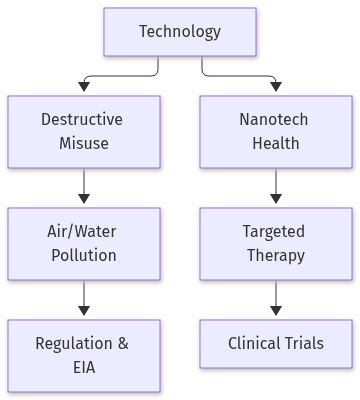
Conclusion
India must enforce environmental compliance on destructive technology while steering nanotech innovation through ethical, safety-assured pathways in public health.
Quick related
Students also ask
-
“The Indian Parliament is not a sovereign legislature. It has vast but not unlimited powers.” Comment on this statement and highlight as to why the Indian Parliament cannot be equated with its British counterpart.
Next question on this syllabus topic (2022 · Q1). View answer →
-
Give an example of technology misuse harming Bihar’s environment.
Unregulated brick kiln and diesel genset emissions contributing to Gangetic plain winter smog and local SO₂/PM loads.
-
How can nanotech help TB control?
Through nano-carrier drug formulations improving bioavailability and shortening treatment regimens under trials.
More from this topic
Q8 · UPSC Mains 2025 · GS II · 36 marks · Solution
(a) In the perspective of the basics of cyber security, the need for digital sovereignty and the effectiveness of the Prevention of Money Laundering Act (PMLA), suggest components for a comprehensive internal security strategy. Or (b) “The New Indian Space Policy 2023 has opened the floodgates for the private sector.” Is this transition merely about technological development, or has it qualitatively transformed India’s capabilities for national security disaster response and border management? In the context of drone swarm technology, the security of satellite based communication and the strategic significance of GSLV program, propose the essential pillars of a comprehensive ‘Security-Development-Innovation’ strategy for India’s space and allied technologies.
General Studies II
India’s internal security and strategic posture increasingly depend on space-based C4ISR, private innovation under the 2023 Space Policy, and allied technologies (drones, secure satcom, GSLV-class lift) for disaster and border missions.
Q7 · UPSC Mains 2025 · GS II · 36 marks · Solution
Write short answer of the following questions: (See official booklet Section III short notes — cyber security / digital sovereignty / PMLA components and remaining short parts in media/pyq/2025/BPGS2-english.pdf.) In the perspective of the basics of cyber security, the need for digital sovereignty and the effectiveness of the Prevention of Money Laundering Act (PMLA), suggest components for a comprehensive internal security strategy. (Full short-note set: official PDF.)
General Studies II
Internal security in a digital age requires cyber resilience, sovereign control over critical data infrastructure, and anti-money-laundering architecture — PMLA being one pillar among intelligence, policing, and border coordination.
Q6 · UPSC Mains 2025 · GS II · 38 marks · Solution
(a) Discuss the major ports on eastern coast of India. Critically examine the role of Syama Prasad Mookerjee Port, Kolkata (SMPK) in the development of North East India and Bangladesh, giving suitable examples. Or (b) Describe the concept of fourth industrial revolution (Industry 4.0). Critically analyse the biggest benefits and risks of adopting industry 4.0 technologies in India.
General Studies II
Eastern seaboard ports anchor coal, container, and bulk trade for eastern India; SMPK (Kolkata) retains historic hinterland ties to North-East India and Bangladesh via river-sea multimodal networks despite draft limitations.