Revision summary
Bihar’s climate blends subtropical monsoon with flood risk; agro-climatic zoning guides cropping. Urban taxonomy and 2011 Census trends show low urbanisation but fast migrant-linked district growth.
Model answer
Introduction
Climate governs Bihar’s three-season agriculture; urban statistics reveal a still-rural state with emergent class-I towns.
Body
Bihar Climate and Agro-Climatic Zones
- Factors: Latitude, monsoon depth, Ganga flooding, sand wind in summer, winter western disturbances fringe.
- Zones: Mapped by ICAR — Zone I Gangetic alluvium, Zone IIB uplands, flood-prone diara lands — dictating rice-wheat vs maize-pulses.
- Seasons: Kharif (June–Oct), Rabi (Nov–Mar), Zaid summer; floods affect kharif transplanting in north Bihar.
Urban Classification (Alternate Branch)
- Census classes: Statutory towns, census towns; million-plus, class I (1 lakh+), II, III etc.
- 2011 trends: 71st rank urbanisation (~11%); Patna class I; Muzaffarpur, Gaya emerging.
- Bihar specifics: Young population, rising worker participation in informal services; feminisation of agriculture in migrant absentee scenarios.
Flow diagram
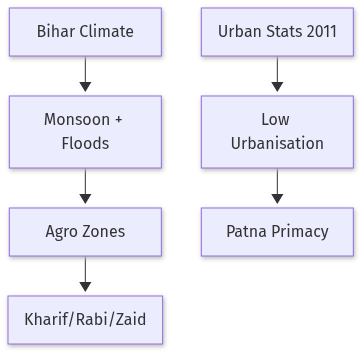
Conclusion
Agro-climatic planning must flood-proof north Bihar while south Bihar diversifies crops; urban policy should upgrade census towns absorbing return migration rather than chasing premature mega-city models.
Quick related
Students also ask
-
(a) Explain ‘trickle-down’ theory of economics, its major elements, benefits, limitations and criticisms in context to Indian planning.
Or
(b) Describe ‘monsoon system of India’, its nature, types, climate change, distribution, synonyms, east and west jet stream and feasibility.
Next question on this syllabus topic (2023 · Q6). View answer →
-
How many cropping seasons does Bihar typically have?
Three — kharif, rabi, and zaid — though floods and moisture determine effective planting windows.
-
What is a census town?
A settlement with urban characteristics not yet governed as a statutory municipality.
More from this topic
Q8 · UPSC Mains 2025 · GS II · 36 marks · Solution
(a) In the perspective of the basics of cyber security, the need for digital sovereignty and the effectiveness of the Prevention of Money Laundering Act (PMLA), suggest components for a comprehensive internal security strategy. Or (b) “The New Indian Space Policy 2023 has opened the floodgates for the private sector.” Is this transition merely about technological development, or has it qualitatively transformed India’s capabilities for national security disaster response and border management? In the context of drone swarm technology, the security of satellite based communication and the strategic significance of GSLV program, propose the essential pillars of a comprehensive ‘Security-Development-Innovation’ strategy for India’s space and allied technologies.
General Studies II
India’s internal security and strategic posture increasingly depend on space-based C4ISR, private innovation under the 2023 Space Policy, and allied technologies (drones, secure satcom, GSLV-class lift) for disaster and border missions.
Q7 · UPSC Mains 2025 · GS II · 36 marks · Solution
Write short answer of the following questions: (See official booklet Section III short notes — cyber security / digital sovereignty / PMLA components and remaining short parts in media/pyq/2025/BPGS2-english.pdf.) In the perspective of the basics of cyber security, the need for digital sovereignty and the effectiveness of the Prevention of Money Laundering Act (PMLA), suggest components for a comprehensive internal security strategy. (Full short-note set: official PDF.)
General Studies II
Internal security in a digital age requires cyber resilience, sovereign control over critical data infrastructure, and anti-money-laundering architecture — PMLA being one pillar among intelligence, policing, and border coordination.
Q6 · UPSC Mains 2025 · GS II · 38 marks · Solution
(a) Discuss the major ports on eastern coast of India. Critically examine the role of Syama Prasad Mookerjee Port, Kolkata (SMPK) in the development of North East India and Bangladesh, giving suitable examples. Or (b) Describe the concept of fourth industrial revolution (Industry 4.0). Critically analyse the biggest benefits and risks of adopting industry 4.0 technologies in India.
General Studies II
Eastern seaboard ports anchor coal, container, and bulk trade for eastern India; SMPK (Kolkata) retains historic hinterland ties to North-East India and Bangladesh via river-sea multimodal networks despite draft limitations.