Revision summary
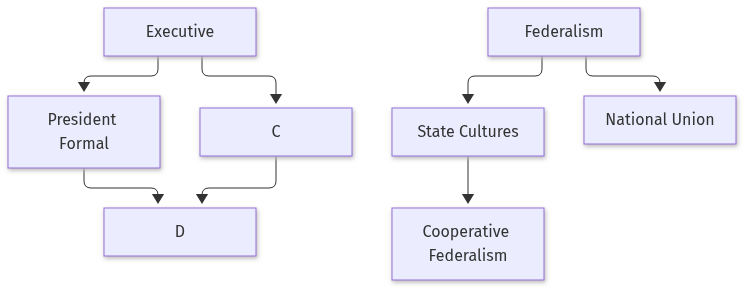
President and PM operate under Articles 74–75 and 78 — nominal vs real executive — while Indian federalism synthesises cultural statehood with national political community.
Model answer
Introduction
- British parliamentary model adapted to a plural union: President as symbolic head, PM as democratic anchor; federalism holds together linguistic states within one citizenship.
Body
President–PM Relationship
- Constitutional text: President exercises powers with aid and advice of CoM (Article 74); PM primus inter pares; communicates all decisions to President (Article 78).
- Appointments: President appoints PM when commanding majority; other ministers on PM advice.
- Discretion pockets: Hung assemblies, summoning/dissolving House subject to conventions; Bommai limits misuse.
- Contemporary shifts: Active President public engagements; coalition eras reduce PM unilateralism but not legal supremacy of council.
Indian Federal Model
- Dual pursuit: States embody linguistic-cultural nationhood; Union embodies civic constitutional patriotism.
- Features: Asymmetric federalism (J&K pre-2019, NE special provisions), cooperative-competitive federalism, GST Council federal bargaining.
- Critique: Governor politics, central legislation on State list via concurrent entries, disaster and health federal friction (COVID lesson).
Flow diagram
Conclusion
President and PM remain functionally distinct — dignity versus accountability — while Indian federalism survives because state identities are constitutionally honoured within an indestructible Union.
Quick related
Students also ask
-
(a) Discuss and analyze the fundamental principles of coalition politics in Bihar from the point of view of the fulfilment of the national interests specifically.
Or
(b) Elucidate and evaluate the local government and its working from the point of view of the empowerment of the Panchayat Raj and the City Institutions with the examples from the grassroot level in Bihar.
Next question on this syllabus topic (2023 · Q3). View answer →
-
Can the President ignore ministerial advice?
Generally no; limited exceptions relate to caretaker situations and notional discretion in specific constitutional silences subject to convention and judicial review.
-
Is Indian federalism classical or cooperative?
It is a cooperative-competitive mix — strong Centre with constitutionally empowered States sharing power via Councils and finance commissions.
More from this topic
Q8 · UPSC Mains 2025 · GS II · 36 marks · Solution
(a) In the perspective of the basics of cyber security, the need for digital sovereignty and the effectiveness of the Prevention of Money Laundering Act (PMLA), suggest components for a comprehensive internal security strategy. Or (b) “The New Indian Space Policy 2023 has opened the floodgates for the private sector.” Is this transition merely about technological development, or has it qualitatively transformed India’s capabilities for national security disaster response and border management? In the context of drone swarm technology, the security of satellite based communication and the strategic significance of GSLV program, propose the essential pillars of a comprehensive ‘Security-Development-Innovation’ strategy for India’s space and allied technologies.
General Studies II
India’s internal security and strategic posture increasingly depend on space-based C4ISR, private innovation under the 2023 Space Policy, and allied technologies (drones, secure satcom, GSLV-class lift) for disaster and border missions.
Q7 · UPSC Mains 2025 · GS II · 36 marks · Solution
Write short answer of the following questions: (See official booklet Section III short notes — cyber security / digital sovereignty / PMLA components and remaining short parts in media/pyq/2025/BPGS2-english.pdf.) In the perspective of the basics of cyber security, the need for digital sovereignty and the effectiveness of the Prevention of Money Laundering Act (PMLA), suggest components for a comprehensive internal security strategy. (Full short-note set: official PDF.)
General Studies II
Internal security in a digital age requires cyber resilience, sovereign control over critical data infrastructure, and anti-money-laundering architecture — PMLA being one pillar among intelligence, policing, and border coordination.
Q6 · UPSC Mains 2025 · GS II · 38 marks · Solution
(a) Discuss the major ports on eastern coast of India. Critically examine the role of Syama Prasad Mookerjee Port, Kolkata (SMPK) in the development of North East India and Bangladesh, giving suitable examples. Or (b) Describe the concept of fourth industrial revolution (Industry 4.0). Critically analyse the biggest benefits and risks of adopting industry 4.0 technologies in India.
General Studies II
Eastern seaboard ports anchor coal, container, and bulk trade for eastern India; SMPK (Kolkata) retains historic hinterland ties to North-East India and Bangladesh via river-sea multimodal networks despite draft limitations.