Revision summary
Bihar’s coalition arithmetic (RJD–JD(U)–Congress arrangements) tests policy continuity versus populism; local governments need fiscal and functional devolution beyond election cycles.
Model answer
Introduction
Bihar mirrors national coalition logic — social coalition parties sharing power — while Panchayati Raj and municipalities remain capacity-constrained despite reservation milestones.
Body
Coalition Politics in Bihar — National Interest
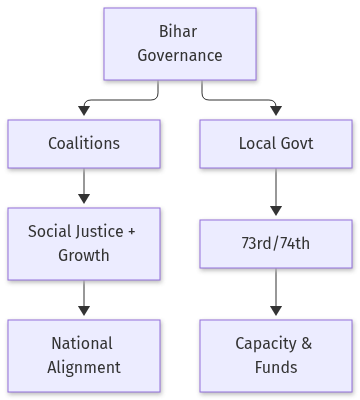
- Pattern: Frequent JD(U)–BJP/RJD realignments; caste-social justice plus governance planks.
- National interest test: Coalitions succeeding when aligning on infrastructure, law and order, Centre–State schemes (Jal Jeevan, food security); failing when patronage overrides fiscal prudence.
- Principles: Common minimum programme, stable CM authority, avoiding policy flip-flops on welfare.
Local Government Empowerment
- Legal frame: 73rd/74th extended in Bihar; 50% women quota; State Finance Commission recommendations unevenly implemented.
- Grassroots examples: PRI-led sanitation drives, panchayat justice on minor disputes, mukhiya facilitation of MNREGA.
- Gaps: Untied funds shortage, functionary salaries delayed, parallel line departments bypass PRIs.
Flow diagram
Conclusion
Bihar coalitions serve national interest when synchronising with constitutional welfare and connectivity goals; grassroots empowerment needs functional rather than skeletal devolution.
Quick related
Students also ask
-
Write short answer of the following questions:
(a) Analyze the mechanism and characteristics of Indian monsoon system.
(b) What are the sources of energy in India? Are they sufficient to meet domestic needs? What are the possible alternative sources of energy for India? Present a critical review.
(c) Discuss the state of tourism industry in India and analyze its future in the country.
(d) Describe the distribution of Scheduled Caste and Scheduled Tribe population in Bihar and comment on their level of socio-economic conditions.
(e) Divide India into major physiographic divisions and describe the region in which the land of Bihar State is included.
Next question on this syllabus topic (2023 · Q4). View answer →
-
When do Bihar coalitions harm national interest?
When short-term patronage or instability delays long infrastructure projects or Centre–State scheme implementation.
-
What blocks Panchayat empowerment in Bihar?
Insufficient untied funds, weak functionary cadres, and departmental silos that bypass elected local bodies.
More from this topic
Q8 · UPSC Mains 2025 · GS II · 36 marks · Solution
(a) In the perspective of the basics of cyber security, the need for digital sovereignty and the effectiveness of the Prevention of Money Laundering Act (PMLA), suggest components for a comprehensive internal security strategy. Or (b) “The New Indian Space Policy 2023 has opened the floodgates for the private sector.” Is this transition merely about technological development, or has it qualitatively transformed India’s capabilities for national security disaster response and border management? In the context of drone swarm technology, the security of satellite based communication and the strategic significance of GSLV program, propose the essential pillars of a comprehensive ‘Security-Development-Innovation’ strategy for India’s space and allied technologies.
General Studies II
India’s internal security and strategic posture increasingly depend on space-based C4ISR, private innovation under the 2023 Space Policy, and allied technologies (drones, secure satcom, GSLV-class lift) for disaster and border missions.
Q7 · UPSC Mains 2025 · GS II · 36 marks · Solution
Write short answer of the following questions: (See official booklet Section III short notes — cyber security / digital sovereignty / PMLA components and remaining short parts in media/pyq/2025/BPGS2-english.pdf.) In the perspective of the basics of cyber security, the need for digital sovereignty and the effectiveness of the Prevention of Money Laundering Act (PMLA), suggest components for a comprehensive internal security strategy. (Full short-note set: official PDF.)
General Studies II
Internal security in a digital age requires cyber resilience, sovereign control over critical data infrastructure, and anti-money-laundering architecture — PMLA being one pillar among intelligence, policing, and border coordination.
Q6 · UPSC Mains 2025 · GS II · 38 marks · Solution
(a) Discuss the major ports on eastern coast of India. Critically examine the role of Syama Prasad Mookerjee Port, Kolkata (SMPK) in the development of North East India and Bangladesh, giving suitable examples. Or (b) Describe the concept of fourth industrial revolution (Industry 4.0). Critically analyse the biggest benefits and risks of adopting industry 4.0 technologies in India.
General Studies II
Eastern seaboard ports anchor coal, container, and bulk trade for eastern India; SMPK (Kolkata) retains historic hinterland ties to North-East India and Bangladesh via river-sea multimodal networks despite draft limitations.